
crowdMOS: Democratizing Image Quality Assessment via Scalable Crowdsourcing
Crowdsourcing subjective image quality evaluation
This paper introduces crowdMOS, a scalable and cost-effective framework for subjective image quality assessment using Amazon Mechanical Turk (MTurk). It provides a statistical methodology (two-way random effects model) and open-source tools to automate Mean Opinion Score (MOS) collection while screening out unreliable data from unsupervised internet workers.
TL;DR
Researchers from the University of São Paulo and Microsoft Research have developed crowdMOS, a framework that shifts subjective image quality testing from the expensive laboratory to the global internet crowd. By introducing a "two-way random effects" statistical model and automated outlier filtering, they achieved a 0.98 correlation with expert lab scores at a fraction of the cost ($0.60/image).
The Bottleneck of Subjective Testing
In the signal processing world, the "Ground Truth" for quality is human perception. However, capturing this is a logistical nightmare. Standardized tests (like ITU-T P.910) require specialized hardware, controlled lighting, and paid volunteers sitting in a room for hours. This high friction often forces researchers to rely on objective metrics like PSNR or SSIM, which—while convenient—frequently ignore how human attention and psychological factors actually perceive distortion.
The authors' core Insight: We can trade the "controlled environment" for a "large-scale statistical average" if we have the tools to separate honest feedback from malicious or distracted noise.
Methodology: Engineering the Crowd
Crowdsourcing on platforms like Amazon Mechanical Turk (MTurk) is notoriously chaotic. To solve this, the authors implemented a three-tier approach:
1. The Two-Way Random Effects Model
Instead of simple averaging, the authors used a mathematical model to decompose every score into:
- Intrinsic Quality (): How good is the original image?
- Worker Preference (): Is this specific worker naturally a "harsh" or "lenient" grader?
- Subjective Uncertainty (): The random noise inherent in human judgment.
2. Systematic Outlier Filtering
Since MTurk workers are unsupervised, they might click randomly to finish faster. crowdMOS calculates a Pearson correlation () for each worker. If a worker’s relative rankings of images don't align with the community consensus (specifically ), their entire data set is discarded before the final MOS calculation.
3. Automated Tooling
The authors released an open-source toolkit that abstracts MTurk's complexity, allowing researchers to simply upload images and receive statistical reports.
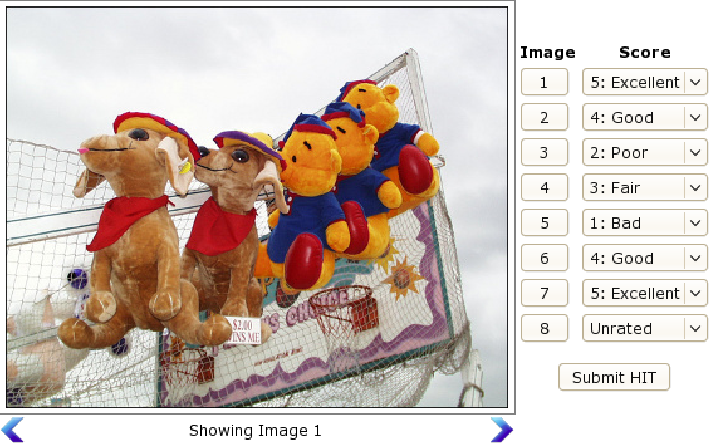 Fig 1: The web-based interface designed for workers to perform multi-stimulus ACR tests.
Experimental Results: Lab Accuracy at Internet Speed
The authors validated crowdMOS using the famous LIVE Image Quality Dataset. They compared scores from signal processing students (Lab) with scores from MTurk workers (Crowd).
Key Findings:
- Correlation: The Pearson correlation reached 0.985, proving that the crowd's perception essentially mirrors the lab's.
- Efficiency: A full study of 233 images with 40 workers per image took only 2 hours.
- Demographics: Interestingly, lab students were found to be more "tolerant" of heavy block effects but more sensitive to faint artifacts—likely due to their technical training. The crowd's responses may actually be more representative of the "average consumer."
 Fig 2: Confidence intervals showing the tight agreement between crowdMOS and traditional laboratory results.
Critical Insight & Future Outlook
The real value of crowdMOS isn't just cost reduction; it's the diversification of hardware. Lab tests use calibrated, high-end monitors. Real users use cheap TN panels, smartphones, and laptops in bright rooms. crowdMOS captures this "In the Wild" variability, which is increasingly important for web-based services like Netflix or YouTube.
Limitations: This method remains better suited for "Absolute Category Rating" (ACR) than for detecting tiny, imperceptible differences that require specific viewing distances or high-dynamic-range (HDR) equipment not available to the general public.
Takeaway: Subjective testing is no longer a luxury reserved for large corporations; with the right statistical filters, the internet can serve as a robust, high-fidelity laboratory for human perception.