
Streamlining SNOMED CT: Crowdsourcing the "Fuzzy" Edge of Medical Tagging
Crowdsourcing techniques to create a fuzzy subset of SNOMED CT for semantic tagging of medical documents
This paper introduces a crowdsourcing framework to develop a fuzzy subset of the SNOMED CT clinical vocabulary. By leveraging user interactions to refine concept relevance, the method creates a streamlined, weighted taxonomy for semantic tagging of medical documents like ultrasound reports.
TL;DR
To tackle the overwhelming complexity of the SNOMED CT vocabulary—which boasts over 300,000 concepts—this paper proposes a crowdsourced fuzzy subset approach. By capturing clinician feedback during routine document tagging, the system learns which concepts truly belong to specific medical domains (like Women's Health Ultrasound), weighting them via fuzzy logic to simplify search and improve semantic interoperability.
The "Curse of Choice" in Clinical Coding
In the quest for semantic interoperability, medicine has turned to massive ontologies. However, for a clinician trying to code a quick radiology report, SNOMED CT is often too comprehensive. A search for a simple term like "Stomach" can yield dozens of irrelevant technical mappings.
The traditional solution—creating crisp subsets—is fragile. It often relies on a "binary" inclusion/exclusion logic that fails to account for concepts that are only "somewhat" relevant to a specific specialty. Furthermore, manual curation by experts is slow and cannot keep pace with the evolving nature of clinical language.
Methodology: Crowdsourcing Meets Fuzzy Logic
The authors propose a "Web 2.0" approach to ontology management. Instead of waiting for experts to define the boundaries of a domain, the system learns from the users themselves.
1. The Membership Function
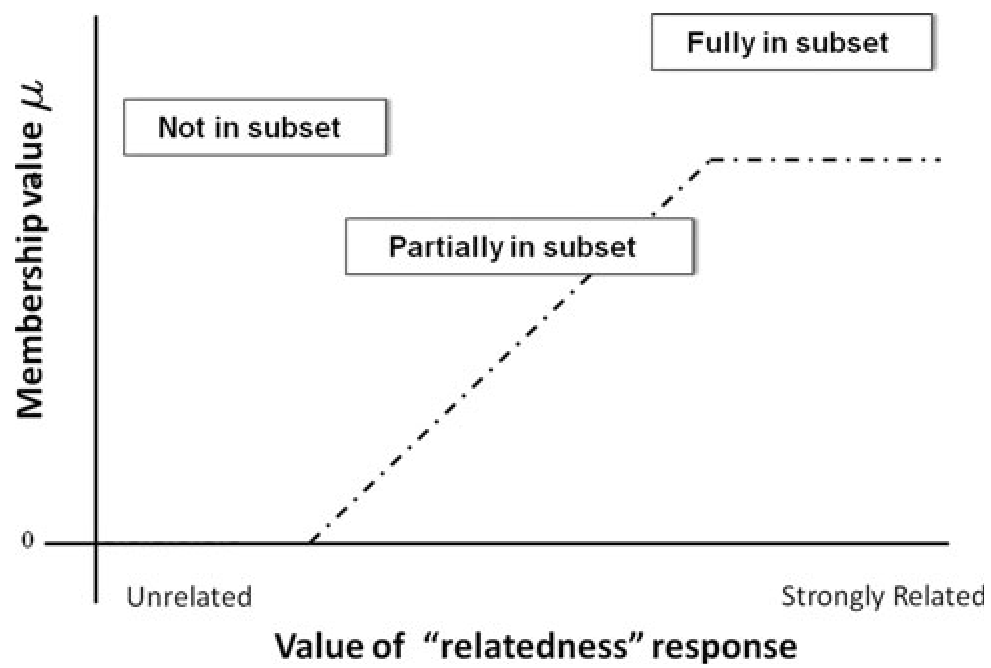
The core of the system is the Fuzzy Membership Value (), ranging from 0 (not in subset) to 1 (fully in subset). When a clinician selects a concept from a suggested list, the system updates its belief in that concept's relevance using a weighted algorithm:

This formula ensures that the system is responsive to new data but stable enough to prevent wild oscillations from single "noisy" inputs.
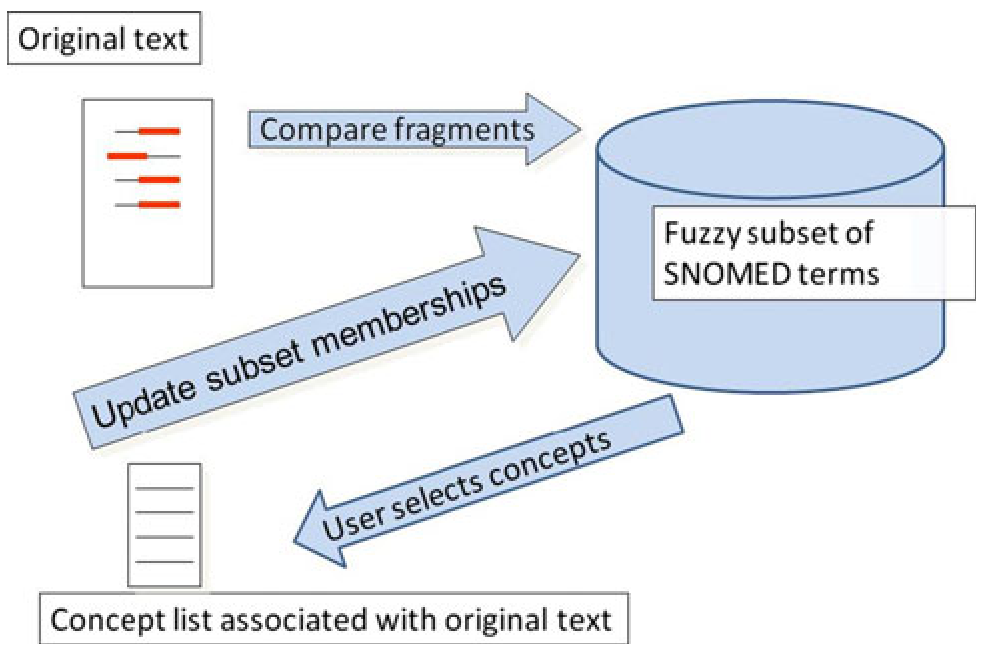
2. The Interaction Loop
The workflow mimics the success of systems like ReCaptcha:
- Parsing: The system extracts potential terms from free-text reports.
- Ranking: It presents a list to the user, ordered by their fuzzy membership scores.
- Learning: User selections act as "votes" that refine the subset in real-time.
Experiments and Insights: Overcoming the "Cold Start"
A major challenge in such systems is the Cold Start problem—if no concepts have ratings yet, the ranking is useless. The authors addressed this by:
- Pre-seeding the subset with a basic hierarchy of Women’s Health Ultrasound (WHU) terms (Initial ).
- Assigning unfamiliar terms a low baseline ().
- Applying updates transitively: if a parent concept is validated, its children inherit a degree of that confidence.
The results suggest that this UI-driven approach significantly reduces the "cognitive load" on clinicians by hiding the irrelevant "noise" of the 300,000+ total SNOMED terms.
Critical Analysis & Future Outlook
Takeaway: This work represents a shift from "Top-Down" ontology engineering to "Bottom-Up" collaborative filtering. By acknowledging that medical domains have "fuzzy" boundaries, the authors provide a more realistic model for clinical informatics.
Limitations:
- Malicious/Erroneous Input: While the authors argue that clinicians gain value from correct coding (incentivizing accuracy), the system remains vulnerable to systematic "lazy" clicking or localized naming conventions.
- Privacy: While reports aren't stored, the reliance on web-based transmission for crowdsourcing requires robust security protocols in a hospital setting.
The Future: Imagine "Tag Clouds" for clinicians where the size of a term indicates its relevance to the current patient context, or integrating this fuzzy logic into HL7 v3 XML messages to carry "uncertainty scores" alongside diagnoses. As we move toward more automated AI-driven healthcare, these human-in-the-loop refinements will be essential for grounding models in actual clinical reality.