
Re-Engineering the Crowd: Transforming Commercial Platforms into Academic Labs
Crowdsourcing Technology to Support Academic Research
This paper serves as a foundational roadmap for integrating crowdsourcing technology into academic research. It categorizes existing platforms (Crowd Providers, Aggregators, Specialized) and proposes a technical framework to transform standard microtask platforms into robust environments for complex scientific studies, specifically targeting HCI, sociology, and psychology.
TL;DR
Academic research often struggles with small participant pools. Crowdsourcing offers a massive, diverse population, but commercial platforms like Amazon Mechanical Turk (AMT) were never built for the nuances of science. This paper dissects why current systems fail researchers and proposes a technical blueprint—ranging from sensor-level monitoring to ethical payment structures—to bridge the gap between "microtasks" and "rigorous scientific studies."
The "Industrial" Mismatch: Why Science Struggles on AMT
The central paradox of modern crowdsourcing is that while researchers need highly specific, reliable, and transparent participant data, platforms are optimized for anonymity and high-throughput repetition.
Current commercial systems prioritize the "Requester" as a business entity looking for cheap labor. This results in three major hurdles for academia:
- Black-Box Demographics: Access to age, education, or even physical attributes is often restricted or non-existent.
- Generic Instrumentation: Researchers can see what a worker submitted, but not how they did it (e.g., were they distracted? did they use a mobile device or a desktop?).
- Rigid Architectures: Most platforms support independent microtasks, making it nearly impossible to run longitudinal studies or collaborative experiments.
A Taxonomy of the Crowd
The authors categorize the landscape into three distinct models, as shown in the following architecture:
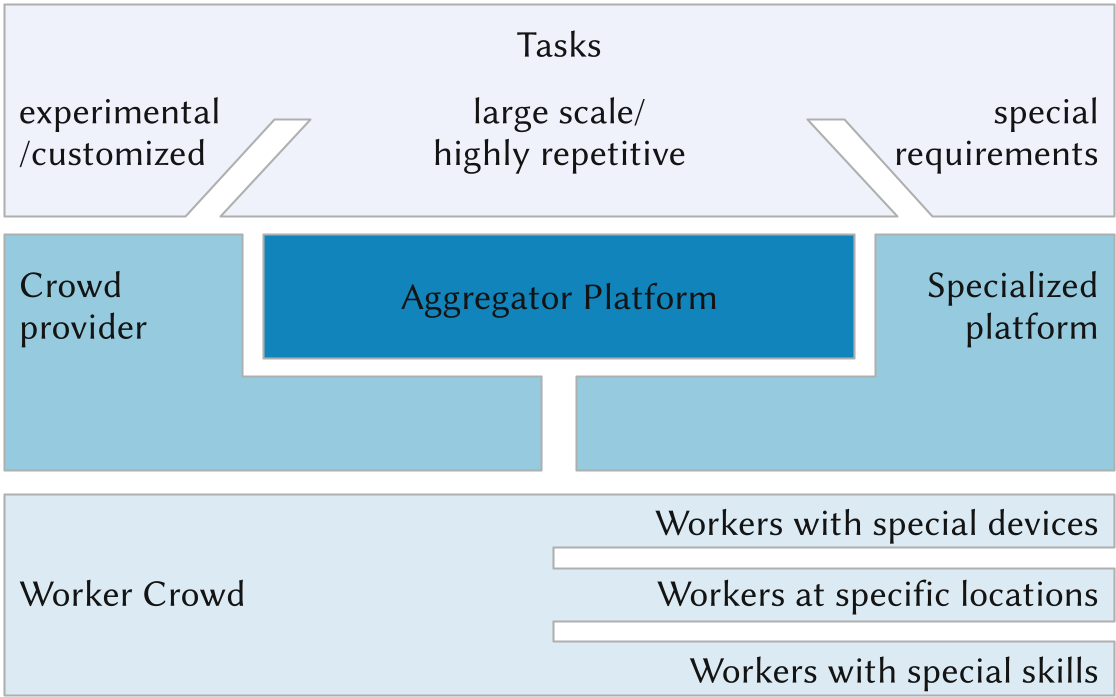
- Crowd Providers (e.g., AMT, Microworkers): The "raw" option. They give unfiltered access to workers, making them the most flexible but technically demanding for researchers.
- Specialized Platforms (e.g., Streetspotr): Focused on specific device types or niche worker skills.
- Aggregators (e.g., CrowdFlower): Business-focused layers that handle design and quality control but increase costs and decrease transparency.
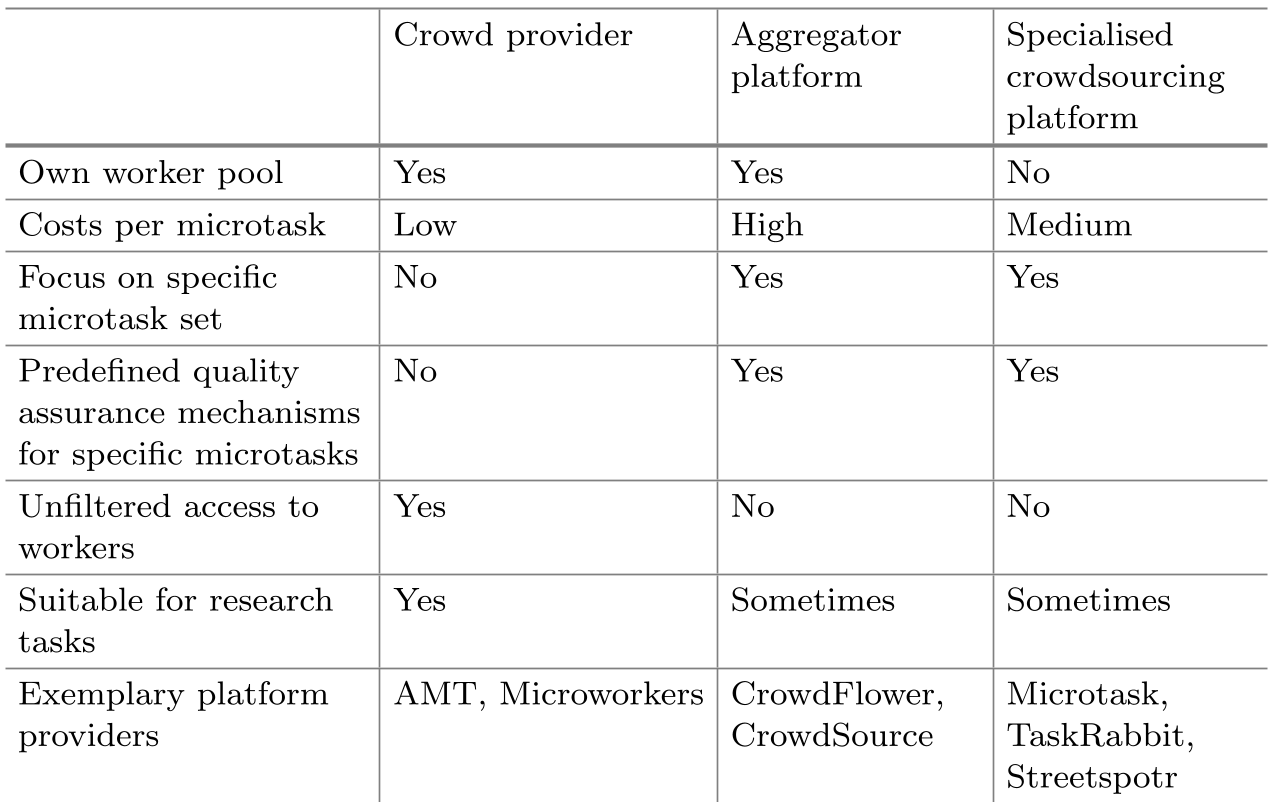
| Feature | Crowd Provider | Aggregator | Specialized |
|---|---|---|---|
| Worker Pool | Yes | Yes (often 3rd party) | No |
| Cost | Low | High | Medium |
| Research Suitability | High (Flexibility) | Sometimes | Sometimes |
Methodology: The Technical Blueprint for Academic Crowdsourcing
To make crowdsourcing "scientifically grade," the authors propose several technical interventions:
1. High-Fidelity Behavior Monitoring
Beyond simple form submissions, the paper advocates for capturing interaction data. This includes:
- Keyboard & Mouse Tracking: Analyzing
focusandblurevents to see if the user is multitasking or using external resources. - Audio-Visual Insights: Utilizing WebRTC or Flash (though now deprecated, updated to HTML5 APIs) for "think-aloud" protocols and eye-tracking via webcams.
- Sensor Fusion: On mobile devices, leveraging GPS, accelerometers, and gyroscopes to validate "in the wild" data.
2. Reputation and Ethics
One of the most innovative suggestions is the Portability of Reputation. Currently, workers are "locked" to a platform. By moving to a centralized or P2P reputation server, high-quality workers can carry their "trust score" across platforms, leading to better pay and more reliable data for researchers.
3. Support for Complex Study Designs
The paper outlines how technology can automate the logistical nightmare of:
- Randomization: Assigning workers to "Control" vs. "Experimental" groups automatically.
- Longitudinal Tracking: Integrated notification systems to bring the same workers back after 6 months for follow-up testing.
- Collaboration: Moving from "human subroutines" to real-time chat and shared workspaces for focus groups.
Experimental Insights: Comparison Table
The authors emphasize that one size does not fit all. For example, AMT remains global but is increasingly "non-naive" (workers become "professional" participants, biasing psychological results), whereas Prolific Academic offers better quality but is still scaling.
Critical Insight & Conclusion
The field is moving toward Participation over Exploitation. The paper correctly identifies that for crowdsourcing to be a sustainable scientific tool, we must move away from treating workers as invisible APIs.
Takeaway: The "Next Gen" crowdsourcing platform won't just be a labor market; it will be a sensor-rich, ethically-aware laboratory environment. The adoption of tools like Apple's ResearchKit serves as a precursor to this shift, blending mobile sensing with strict consent and data management protocols.
Future Work: The challenge remains in "Semantic Obfuscation"—how do we provide researchers with granular demographics (like medical conditions) without compromising the anonymity and safety of the crowd? That remains the final frontier for academic crowdsourcing.