
Harnessing the Crowd: A Taxonomy for Digital Disaster Management
Crowdsourcing tools for disaster management: a review of platforms and methods
This paper provides a comprehensive review and taxonomy of crowdsourcing tools and methods utilized in disaster management. It categorizes technological solutions (16 platforms and 9 mobile apps) into four distinct crowdsourcing roles—sensors, social computers, reporters, and microtaskers—mapping them across the four phases of the disaster management cycle (mitigation, preparedness, response, and recovery).
TL;DR
As social media turns every citizen into a potential first responder, disaster management has shifted from a top-down broadcast model to a distributed, multi-way network. This paper reviews 25 state-of-the-art tools and introduces a hierarchical model—ranging from passive "citizen sensors" to active "microtaskers"—to align crowdsourcing technology with the four phases of the disaster lifecycle.
Background Positioning
In the wake of events like Hurricane Sandy, which generated 20 million tweets, the challenge has shifted from a lack of data to a "data deluge." This work serves as a topological map for the field, categorizing how different apps and platforms (like Ushahidi, Sahana, and ESA) transform unstructured social noise into actionable intelligence.
The "Knowledge Chain" Pyramid: Why It Works
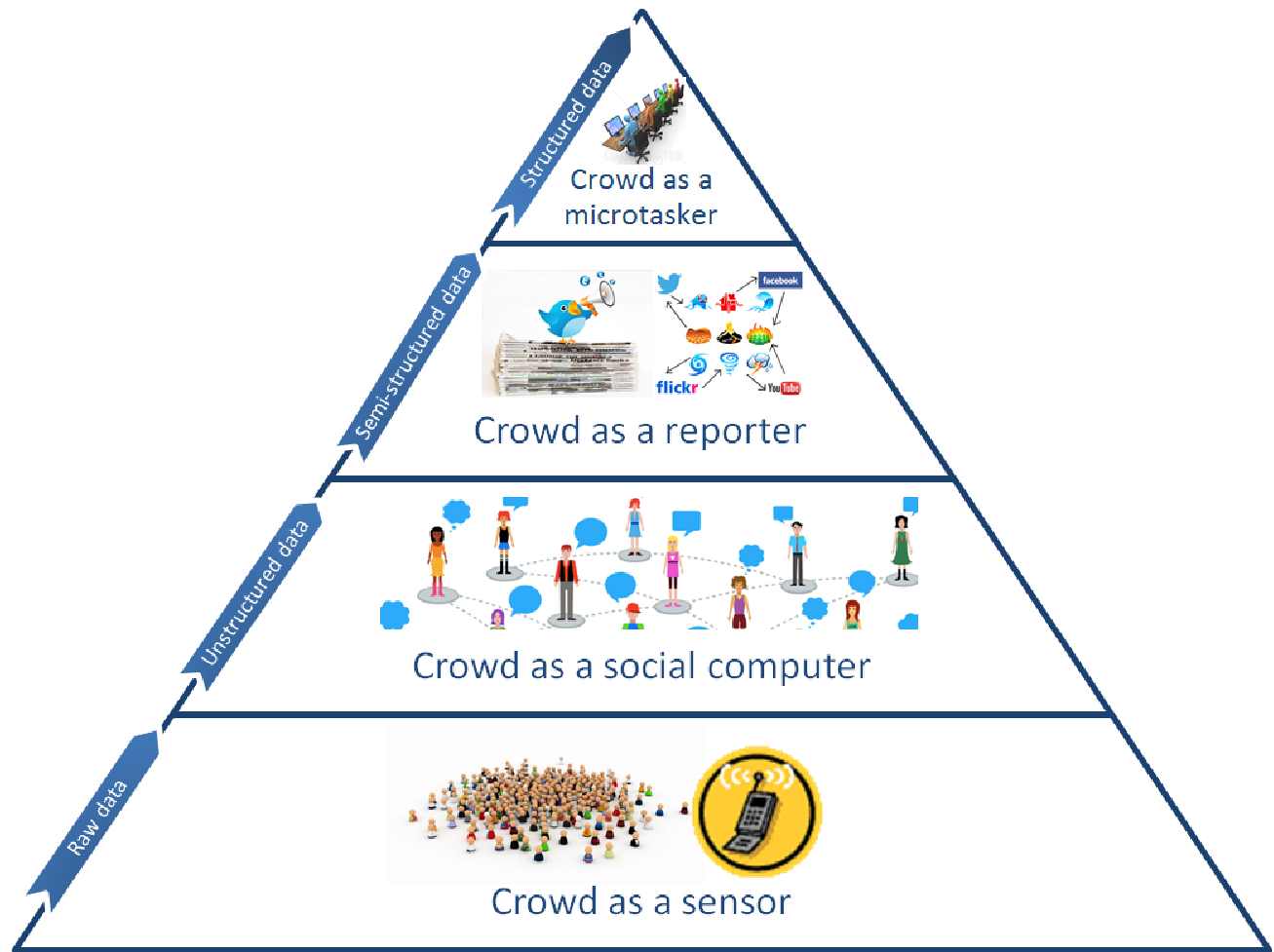
The authors argue that not all crowdsourcing is created equal. They define a four-tier hierarchy based on the intensity of human cognitive involvement:
- Crowd as a Sensor: Passive data generation (e.g., GPS, accelerometers).
- Crowd as a Social Computer: Unstructured interaction on social media.
- Crowd as a Reporter: Active, real-time georeferenced reporting of events.
- Crowd as a Microtasker: Specialized effort to tag, filter, and structure raw data.
This hierarchy is essential because it allows emergency managers to understand the quality-effort trade-off: while sensors provide volume, microtaskers provide the high-quality, interpreted data necessary for high-stakes rescue operations.
Methodology: Mapping Crowd Roles to the Disaster Cycle
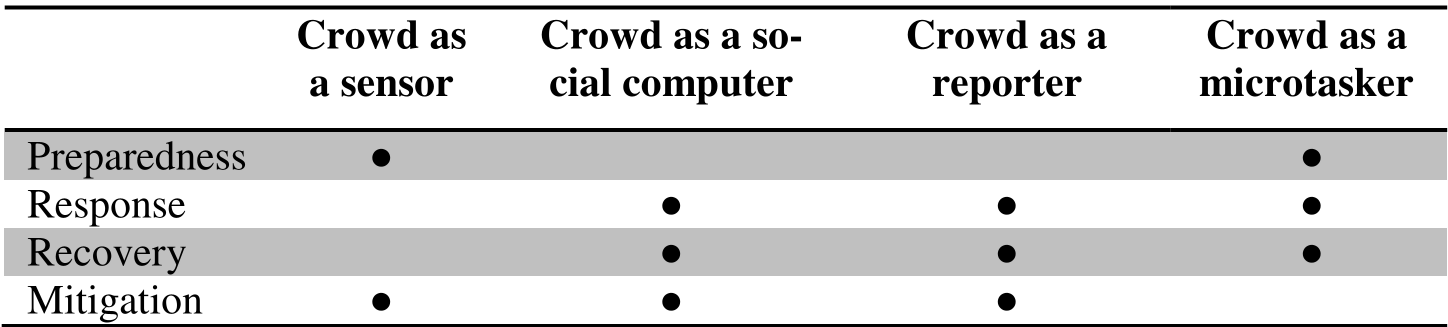
The paper bridges the gap between technology and the Disaster Management Cycle (DMC):
- Mitigation & Preparedness: Dominated by "Crowd as a Sensor" (e.g., seismic monitoring) and specialized "Microtaskers" (e.g., risk mapping).
- Response & Recovery: Heavily reliant on "Reporters" and "Social Computers" for real-time situational awareness.
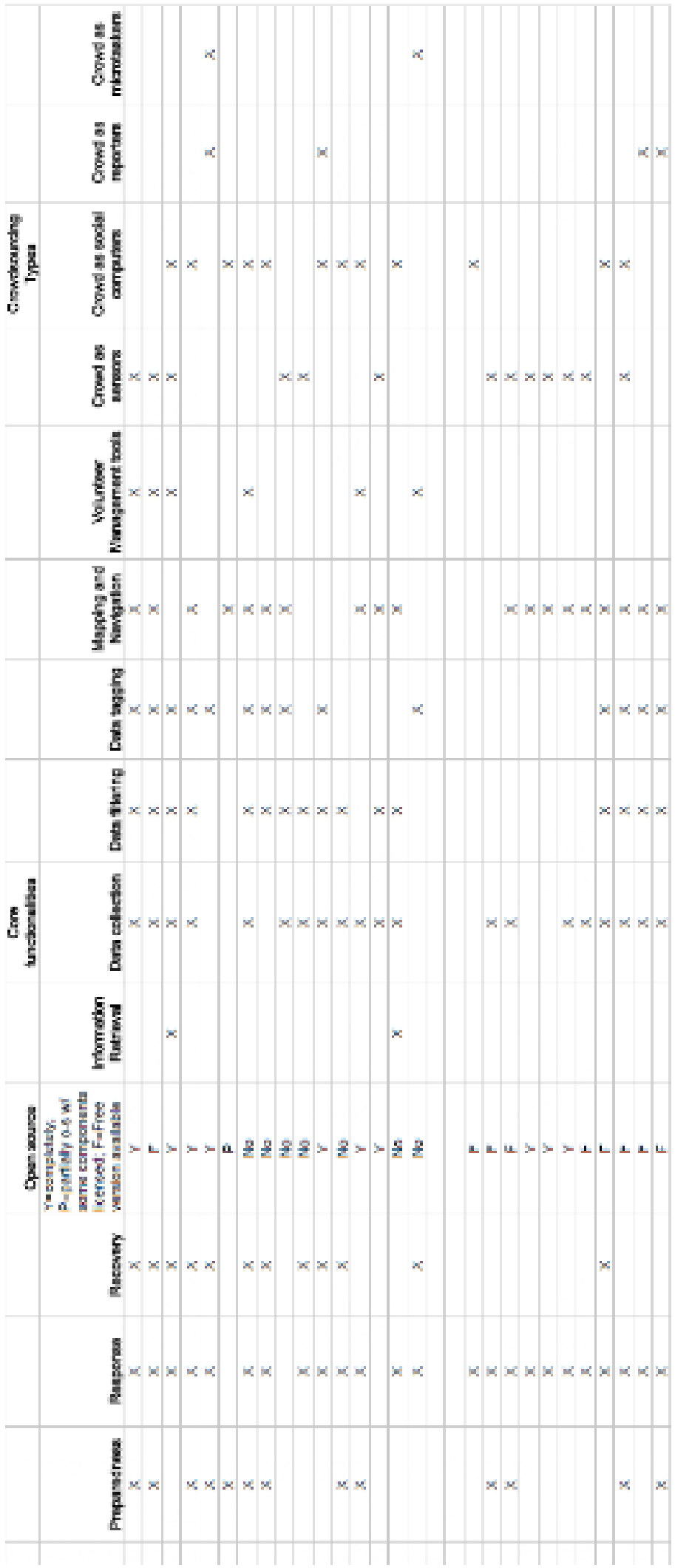
The authors conducted a survey of 16 platforms and 9 mobile apps, evaluating them on core functionalities such as Information Retrieval (IR), data tagging, and mapping.
Critical Findings and SOTA Comparison
A standout example highlighted is the Emergency Situation Awareness (ESA) system. Compared to traditional meteorological systems like the Japan Meteorological Agency (JMA), which may have a 6-minute reporting delay, ESA leverages Twitter data to provide alerts within 2 minutes at 93% accuracy.
Key trends identified:
- Open Source Dominance: The majority of effective platforms (e.g., Sahana, Ushahidi) are open-source, catering to the humanitarian sector's need for transparency and low cost.
- The One-Way Bottleneck: Despite the tech, many official government bodies still treat social media as a broadcast channel ("not monitored 24/7"), failing to ingest the valuable bottom-up data available.
Deep Insight & Conclusion
The real value of this paper lies in its recognition that trust and verification are the primary hurdles for crowdsourced data. By defining the "Crowd as a Reporter" role, the authors suggest a path toward better verification—where the proximity and identity of the user become metadata for trust.
Limitations & Future Work
While the taxonomy is robust, the paper notes a disconnect between real-world platforms and formal disaster management ontologies. Furthermore, as AI (and LLMs in current contexts) becomes more prevalent, the role of the "microtasker" may shift from human to hybrid human-AI teams. The next frontier in this research will likely involve solving the legal and privacy challenges of geolocating citizens in distress across different jurisdictions.
Takeaway: Effective disaster response no longer views the public as a "victim" to be helped, but as a "distributed processor" to be utilized.