
Crowdsourcing the "Top-K": Resolving Ranking Ambiguity via Human-in-the-Loop Policies
7582_Crowdsourcing for top-K query processing over uncertain data.
This paper introduces a hybrid human-machine framework for processing Top-K queries over uncertain data. It proposes a variety of task selection policies (offline, online, and incremental) to minimize the expected residual uncertainty of ranked results by strategically posing comparison questions to a crowd.
TL;DR
Uncertain data leads to "fuzzy" rankings where no single "best" list exists. This paper presents a systematic approach to use crowdsourced pairwise comparisons to prune the space of possible orderings. By modeling the problem as a Tree of Possible Orderings (TPO), the authors introduce offline and online algorithms that intelligently select which questions to ask humans to maximize the clarity of the final Top-K result.
Contextualizing the Problem: The Curse of Uncertainty
In modern sensor networks and social media, "score" is rarely a fixed number. It’s often a probability density function (PDF). When these PDFs overlap, the relative order of items becomes undefined, leading to a combinatorial explosion of possible rankings.
The core challenge is: Given a limited budget (B questions), which pair-wise comparisons should we send to the crowd to minimize our confusion about the Top-K list?
Methodology: Pruning the Tree of Possible Orderings (TPO)
The authors model the ranking space as a TPO where every path is a potential reality. They identify that not all uncertainty is equal. While standard Shannon Entropy () is a baseline, they propose three more sophisticated measures:
- Weighted Entropy (): Focuses more on the top levels of the tree.
- Optimal Rank Aggregation (ORA): Measures distance from a "median" ordering.
- Most Probable Ordering (MPO): Focuses on the single most likely path.
Algorithm Archetypes
- Offline (A-off, C-off)**: Decide all questions upfront. A is optimal but computationally heavy; C-off is a faster conditional greedy approach.
- Online (T1-on): Decide the next question based on the answer to the previous one. This allows for adaptive pruning.
- Incremental (Incr): A hybrid approach that builds the TPO level-by-level, making it suitable for massive datasets where the full tree cannot be materialized.
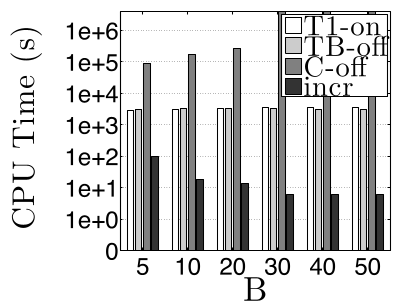 Figure 1: Illustration of the TPO structure and the impact of pruning via crowd answers.
Why it Works: The Efficiency of Human Judgment
The authors proved that while no deterministic algorithm is perfectly optimal, T1-on (Top-1 Online) offers a near-optimal tradeoff. By asking the single best question and updating the tree probabilities in real-time, the system avoids "wasted" questions that might have been rendered irrelevant by previous answers.
Key Findings from Experiments:
- Noise Tolerance: The system handles "noisy" workers (less than 100% accuracy) by adjusting path probabilities instead of aggressive pruning.
- Accuracy: As shown in the performance charts, the proposed targeted strategies (T1-on, C-off) converge to the "ground truth" ranking much faster than naive or random methods.
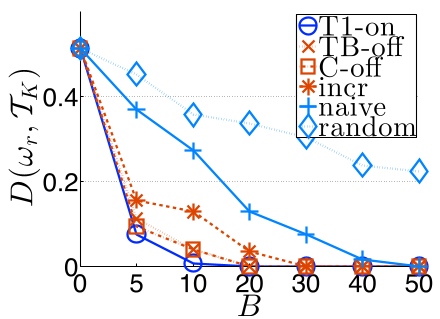 (a) This chart demonstrates how distance to the real ordering decreases as the budget of questions increases.
Critical Analysis & Conclusion
The beauty of this work lies in its transformation of a fuzzy database problem into a structural search problem.
Takeaway: If you are dealing with uncertain rankings, don't just ask the crowd to rank everything. Use the Tree of Possible Orderings to identify the specific "hinge" comparisons that provide the most information gain.
Limitations: The computational cost of maintaining the TPO can be high for extremely large and . While the incr algorithm helps, the "state-space explosion" of the tree remains a theoretical bottleneck for massive-scale applications.
Future Outlook: These policies for "Uncertainty Reduction" are highly relevant today in the context of RLHF (Reinforcement Learning from Human Feedback), where choosing the right pairs for human comparison is critical for efficient model alignment.