
Crowdsourcing vs. Uncertainty: How to Efficiently Find the True Top-K Ranking
Crowdsourcing for top-K query processing over uncertain data
This paper introduces a framework for processing Top-K queries over uncertain data by strategically leveraging crowdsourcing. It proposes the "Uncertainty Resolution" (UR) problem and develops offline, online, and incremental task selection policies (notably T1-on and incr) to minimize the number of human interactions required to identify the true ranking of result sets.
TL;DR
In the world of social media and IoT, data is messy and uncertain. Determining a "Top-10" list isn't just a matter of sorting; it's a probabilistic puzzle. This paper introduces a systematic way to ask a crowd of humans the minimum number of "Is A better than B?" questions to collapse thousands of possible rankings into one true answer. By using structural tree heuristics (T1-on) and incremental processing, they achieve 80% budget savings over standard methods.
The "Possible Worlds" Headache
When scores are uncertain (represented as probability distributions), we no longer have a single list. Instead, we have a Tree of Possible Orderings (TPO). If 100 items have slightly overlapping scores, the number of possible "total orders" explodes exponentially.
Prior works often ignored the "Top-K" nature of these queries—they tried to clean all the data or asked questions at random. This is like trying to fix every typo in a library when you only need to read the first page of the best-seller.
Methodology: Pruning the Tree of Uncertainty
The core insight of the authors is that not all questions are created equal. Comparing two items at the very bottom of the ranking is a waste of money if our goal is to find the Top-K.
1. Structural Uncertainty Measures
Instead of using standard Shannon Entropy (which treats all rankings as equal symbols), the authors propose MPO (Most Probable Ordering) and ORA (Optimal Rank Aggregation). These measures use the Weighted Kendall-Tau distance, prioritizing the accuracy of the top positions.
2. The T1-on and Incremental Algorithms
The authors suggest two power players for task selection:
- T1-on (Top-1 Online): After every crowd answer, it recalculates the tree and picks the next question that offers the maximum expected reduction in uncertainty.
- Incr (Incremental): Since building the full tree is computationally "heavy" (taking hours for large N), this algorithm builds the tree level-by-level, only expanding to the next depth when the current top levels are sufficiently "cleaned" by the crowd.
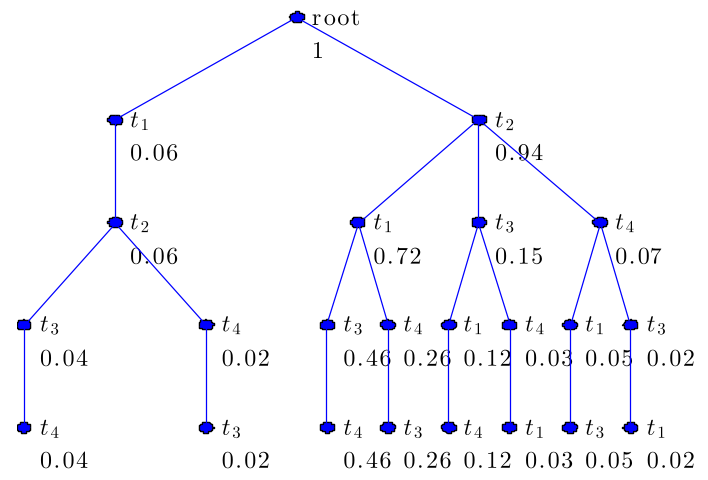 Figure: The Tree of Possible Orderings (TPO) shows how overlapping probability distributions create branching paths of potential rankings.
Experiments: Real Crowd, Real Results
The researchers tested their methods on a YouTube dataset (ordering videos by event time) and an Image Quality dataset.
Efficiency Gains
The results were striking. Compared to a "Naive" baseline (which knows which items overlap but picks questions randomly), the T1-on algorithm reached the true ordering using significantly fewer tasks.
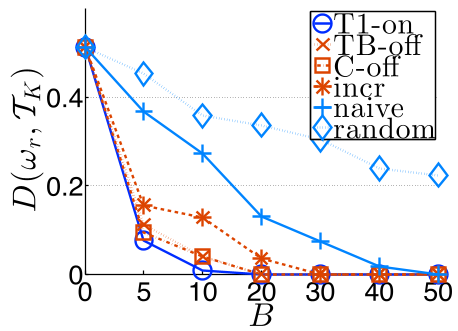 Figure: T1-on (red line) converges to the real ordering significantly faster than random or naive strategies as the question budget increases.
Handling the "Noisy" Crowd
One common fear in crowdsourcing is the "lazy worker." By integrating Bayesian updates, the framework adjusts the TPO probabilities based on worker accuracy. Even with an accuracy of only 80%, the system effectively "weighted" human input to filter out noise, proving that smart algorithms can compensate for human fallibility.
Critical Insight: Why This Matters
The real hero here is the Incremental (incr) approach. While the Best-First Search (A*) strategies are theoretically "optimal," they are practically useless for large-scale databases because they require materializing an exponential state space. The incr algorithm bridges the gap between theoretical computer science and actual production systems, allowing us to process Top-K queries on datasets with millions of tuples.
Conclusion
This work transforms crowdsourcing from a "brute-force" labeling tool into a precision instrument for data cleaning. By focusing human judgment only where it reduces the most structural uncertainty, researchers can now handle Top-K queries in uncertain databases with unprecedented efficiency.
Future Outlook: As skill-based search and expert recommendation systems become more complex, combining these incremental TPO methods with reinforcement learning for worker selection could be the next frontier in human-in-the-loop computing.