
Smart Triage: Optimizing the Geopolitical "Wisdom of Crowds" via Multitask Learning
A crowdsourcing triage algorithm for geopolitical event forecasting
This paper introduces a multitask learning (MTL) framework designed to improve geopolitical event forecasting by triaging questions to the most suitable participants. The method learns hidden participant skill sets from historical prediction data and outperforms traditional majority voting in forecast accuracy.
TL;DR
Predicting global political shifts isn't just about asking more people; it's about asking the right people. This paper proposes a multitask learning framework that extracts a "skill dictionary" from forecasters' past performance. By matching these learned skills to the requirements of new geopolitical questions, the system can triage tasks to experts, significantly boosting accuracy while reducing the cognitive waste of a limited participant pool.
Background: The Sparsity and Noise Problem
Geopolitical forecasting—such as predicting bilateral talk outcomes or preemptive strikes—is fundamentally different from simple image labeling. It involves:
- High Cognitive Load: A single user can only answer a handful of questions.
- Data Sparsity: Most participants lack the specialized knowledge for every topic.
- Heterogeneity: The crowd is a mix of novices, specialists, and "spammers."
Traditional "Majority Voting" treats every voice as equal, but in high-stakes forecasting, the "expert" view is often drowned out by the noise of the uninformed majority.
Methodology: Mapping Skills to Subspaces
The authors' core insight is that a person's ability to answer a specific task (e.g., "Middle East Policy") is a composite of latent basic skills (e.g., "Mathematical Logic" or "Political History").
The Model
They define the probability of a correct answer through a function of participant skill () and question difficulty. To solve the data sparsity problem, they assume skills lie in a low-dimensional subspace: Here, is a shared dictionary of skills, and is a sparse vector representing how much of each skill a participant possesses.
The Two-Step Inference
- MCMC Sampling: Using the Metropolis-Hastings algorithm, the system infers a participant's ability for specific past tasks based on known outcomes.
- Biconvex Optimization: The system then generalizes these abilities into a global dictionary () and individual skill vectors (), allowing it to predict how a participant will perform on a new task they've never seen before.
Experimental Insights: Less is More
Using synthetic data to ensure controlled variables, the researchers uncovered a critical trend in forecasting accuracy.
1. The Skill Recovery Curve
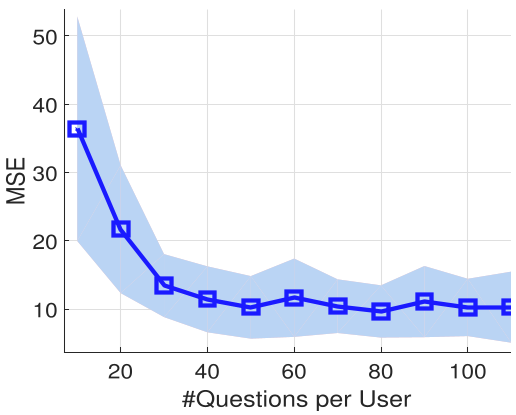
As participants answer more questions, the MCMC inference becomes more stable. However, thanks to Multitask Learning (MTL), the system can recover a user's underlying "skill profile" () faster than it can recover their task-specific "performance" (), effectively "borrowing" knowledge from other tasks.
2. The Danger of Over-Inclusion
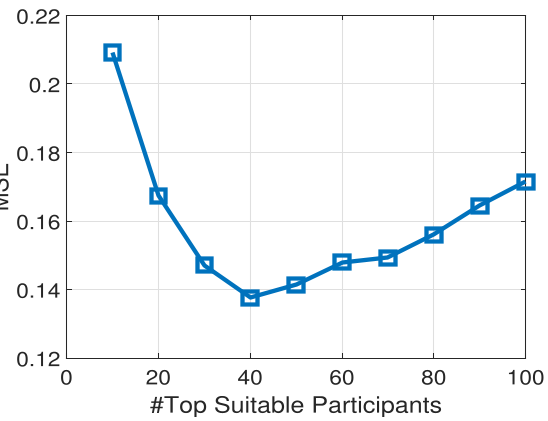
One of the most striking findings is shown in their recommendation experiment. As more "suitable" participants are added to the aggregation, error drops. However, once you move past the core experts into the "general crowd," the error begins to increase again.
Takeaway: In complex forecasting, adding more participants can actually be detrimental if those participants lack the specific "dictionary" of skills required for the task.
Conclusion & Future Look
This multitask triage approach moves beyond simple "wisdom of crowds" and toward "strategic crowdsourcing." By viewing participants through the lens of latent skill subspaces, organizations can maximize the utility of their human assets.
While this study relied on synthetic data, it provides a rigorous mathematical foundation for future real-world platforms where hiring budgets are limited and the stakes of a wrong prediction—such as a military conflict—are incredibly high.