
Empowering the Crowd to Say "I Don't Know": A Strategic Shift in Crowdsourcing Efficiency
Crowdsourcing with unsure option
The paper investigates the "unsure" option in crowdsourcing, proposing a mechanism where workers can opt-out of labeling when uncertain. It establishes theoretical bounds for cost reduction and introduces an online bandit-based algorithm (OLU) to dynamically set confidence thresholds for optimal label aggregation accuracy.
TL;DR
Is more data always better? Not in crowdsourcing, where unconfident guesses from workers can pollute datasets and drain budgets. This paper tackles the Accuracy-Cost Trade-off by introducing an "unsure" option. By allowing workers to opt-out, and dynamically adjusting the confidence threshold using the OLU (OnLine algorithm with Unsure option), the authors prove that we can achieve SOTA accuracy with significantly fewer paid labels.
The "Guessing" Problem in Crowdsourcing
In a standard crowdsourcing pipeline, you pay workers to label an image. If a worker isn't sure, they usually guess to get paid. This adds noise. To cancel this noise, you need even more workers (majority voting), which balloons the cost.
The authors' core Insight is simple but profound: Workers usually have a "gut feeling" about their own accuracy. If we can design a mechanism that pays them to be honest about their uncertainty, we can filter out low-quality data at the source.
Methodology: From Idealized Theory to Online Reality
The paper bridges the gap between theoretical ability (which we can't see) and subjective confidence (which workers report).
1. The Quality Ensured Mechanism (Theoretical)
The authors first define a "Quality Ensured" mechanism where labels are only accepted if the worker's true ability is above a threshold . They derive a quantitative definition of -effectiveness, showing that cost reduction is a function of the crowd's ability distribution variance .
2. The Unsure Mechanism (Practical)
Since we can't measure directly, we use confidence . The paper introduces a Worker Testing Stage (using a few "gold standard" tasks) to ensure a baseline correlation between confidence and actual performance.
3. OLU: The Bandit Approach
To solve the problem of setting the perfect threshold without knowing the crowd's statistics beforehand, the paper treats the choice of as a Multi-Armed Bandit problem.

The reward function serves to maximize the "information per dollar" spent on each label.
Experimental Proof: Variance is Key
The authors tested their theory using Beta distributions to simulate different types of crowds.
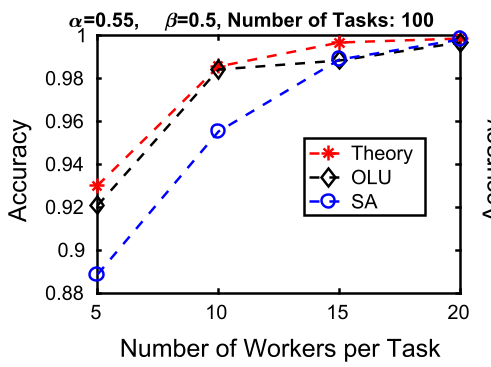
Key Findings:
- The Power of Variance: If the crowd is diverse (high ), the "unsure" option provides massive cost savings because it effectively isolates the "experts" in the crowd.
- Theory vs. Simple Aggregation: Across all distributions (labeled as SA in the charts), the "Theory-based" thresholding and "OLU" consistently reached 95%+ accuracy much faster than the baseline.
Critical Analysis & Professional Insight
This work moves beyond the "worker as a black box" paradigm. By treating the worker as a partner who can report their own state (uncertainty), we shift the Inductive Bias of the system toward high-quality sparsely-collected data.
Limitations: The paper assumes workers are "honest" or incentivized correctly. While it discusses payment strategies (paying for an unsure option), the real-world psychology of workers on platforms like MTurk might be more complex (e.g., speed-running tasks).
Future Outlook
The marriage of Mechanism Design and Online Learning (Bandits) in this paper provides a blueprint for next-generation RLHF (Reinforcement Learning from Human Feedback) pipelines. As we scale LLM alignment, knowing when a human rater is "unsure" could be the key to saving millions in compute and human labor.
Takeaway: High-variance crowds are a goldmine for efficiency, provided you give them an exit ramp for uncertainty.