
Scaling Video Analytics: Turning the Web into a Global UX Laboratory
Crowdsourcing experiments with a video analytics system
This paper presents a scalable crowdsourcing methodology for video analytics using SocialSkip, an open-source system that leverages video clickstream data to understand viewer behavior. By migrating traditional lab experiments to the CrowdFlower platform, the authors achieved rapid, large-scale data collection of user interactions (seek/replay) with high cost-efficiency.
TL;DR
Researchers from the Ionian University have successfully moved video behavior experiments from the lab to the crowd. Using the SocialSkip system and the CrowdFlower platform, they demonstrated that researchers can collect massive amounts of user clickstream data (seeks, skips, and replays) 20x faster and significantly cheaper than traditional methods, all while maintaining high data quality through clever task design.
Background: The Lab Bottleneck
In the world of UX and video analytics, we usually face a choice: either high-quality data from a small, biased group (lab studies with students) or high-quantity data that is noisy and hard to verify (wild web analytics). This paper proposes a middle ground—Structured Crowdsourcing. By treating crowdsourcing workers not just as data annotators but as experimental subjects, we can simulate realistic browsing behavior at a global scale.
Motivation: Why Crowdsourcing is Risky but Rewarding
The primary hurdle for any researcher using platforms like Amazon Mechanical Turk or CrowdFlower is malicious behavior. Workers, motivated by small monetary rewards, might try to "game" the system by clicking randomly or skipping the video entirely.
The authors' insight was that implicit data (the clicks you make while trying to find an answer) is much harder to fake than explicit data (checking a box). If a worker is tasked with finding a specific "Easter egg" in a video, their seekbar navigation patterns naturally reveal what they find interesting or confusing.
Methodology: The SocialSkip Framework
The core of the experiment revolves around the SocialSkip system, a cloud-based tool (GAE + YouTube API) that records every interaction within a one-second accuracy.
The Task Interface
Workers were given a two-stage task:
- Observation: Watch a 4-minute educational video without controls.
- Active Search: Answer specific questions under a 2-minute time limit using a seekbar.
 Figure 1: The CrowdFlower task interface, bridging the survey platform with the SocialSkip video player.
The researchers used a Unique User ID as a lighthouse. If a worker submitted the task but SocialSkip didn't record that specific ID's movements, the worker was flagged as unengaged.
Results: Efficiency vs. Quality
The shift to the crowd was a "speed run" for science:
- Velocity: 200 participants in under 9 hours.
- Cost: 0.30 per subject).
- Data Volume: A massive surge in interaction counts compared to previous lab benchmarks (Edu.A video saw a 490% increase in forward interactions).
Signal vs. Noise
Crucially, the authors compared Raw Data (everyone) vs. Engaged Data (those who correctly interacted with the system).
 Table 1: Comparison of interaction counts showing the massive lead of crowdsourced data over expected lab volumes.
As seen in the replay graphs below, the "Replay" activity (spikes in backward seeking) perfectly aligned with the Ground Truth—the specific segments containing the answers to the questions. This proves that the "collective intelligence" of the crowd effectively filters out individual random behavior.
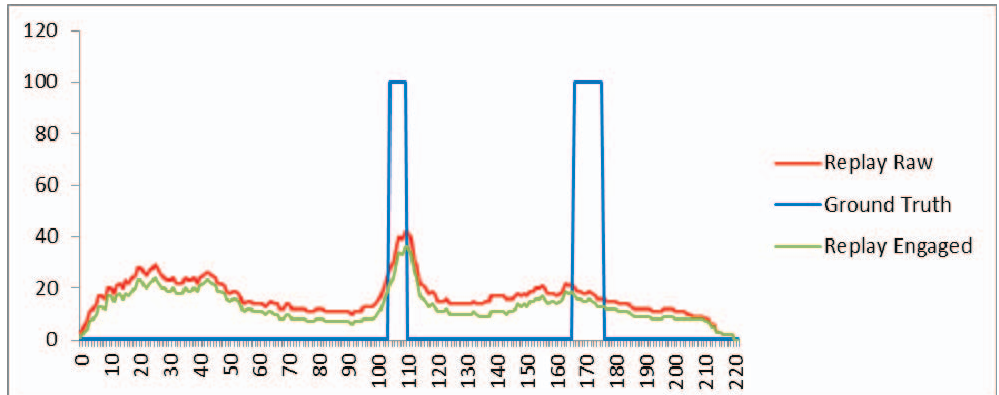 Figure 2: The correlation between Backward activity (Replays) and the Ground Truth (interesting segments).
Critical Insight: The Future of Integrated Analytics
The takeaway for the industry is clear: Analytics should not be a passive observer.
The authors suggest that future social media platforms should have "integrated crowdsourcing modules." Instead of relying on accidental data, platforms can programmatically "nudge" subsets of users with specific tasks to rapidly stress-test new video features or content formats.
Limitations
- Demographics: While more diverse than a lab, the paper notes that they restricted participants to English-speaking countries (USA, Canada, UK) due to the video content, which may still carry Western cultural biases.
- IP Blocking: The strategy of blocking IPs to prevent repeat participation is effective for one-off studies but poses a "subject exhaustion" risk for long-term research as the available pool of unique workers shrinks.
Conclusion
This work validates that video clickstream data is an incredibly resilient signal. Even in an insecure, paid environment like a crowdsourcing platform, the aggregate behavior of users provides a high-fidelity map of video interest. This opens the door for real-time, large-scale UX testing that was once the exclusive domain of giants like Google and Netflix.