
Crowdsourcing Clicks: Turning Player Interactions into Video Intelligence
Crowdsourcing user interactions with the video player
The paper introduces a "user-based" approach to video summarization by crowdsourcing implicit interactions from a custom video player. It demonstrates that aggregating "replay" (GoBackward) signals can accurately identify semantically significant segments and generate representative thumbnails for educational and "how-to" videos.
TL;DR
What if the key to understanding a video isn't in its pixels, but in how we watch it? This paper presents a shift from content-based analysis to user-based modeling. By tracking where users hit the "replay" button, the researchers developed a method to automatically identify the most important parts of a video—achieving a 100% detection rate for key segments in educational content without "looking" at a single frame of the video.
The Motivation: Why Pixels Lie
Standard video summarization algorithms are "monolithic." They use signal processing to find shot changes or movement. However:
- Lecture Videos: A professor standing at a podium is "static" to an algorithm, missing the semantic shifts in the speech.
- How-to Videos: Rapid camera movements and cuts create "noise," leading to an explosion of useless key-frames.
- The Thumbnail Trap: Currently, platforms like YouTube rely on uploaders to pick thumbnails, which can be clickbait or fail to represent what viewers actually care about.
The author's intuition is simple: Collective intelligence is the best filter. If multiple people rewind to a specific timestamp, that moment is objectively important.
Methodology: Mining the "Replay" Signal
The study utilized a custom player called SocialSkip. Unlike standard players with a scrub bar (which is messy to analyze), this player used fixed-interval buttons: GoBackward (-30s) and GoForward (+30s).
The Signal Processing Pipeline:
- Interaction Logging: Every interaction is mapped to a time-series function.
- Replay Aggregation: For every "GoBackward" click, the value of the preceding 30 seconds is incremented.
- Smoothing & Derivatives: The raw "spiky" data is smoothed to create a continuous curve. The "zero-crossing" points of the derivative identify the exact peaks of interest.
- The 60-Second Heuristic: A key discovery was that the actual "start" of a semantic segment usually occurs within 60 seconds of a local interaction peak.
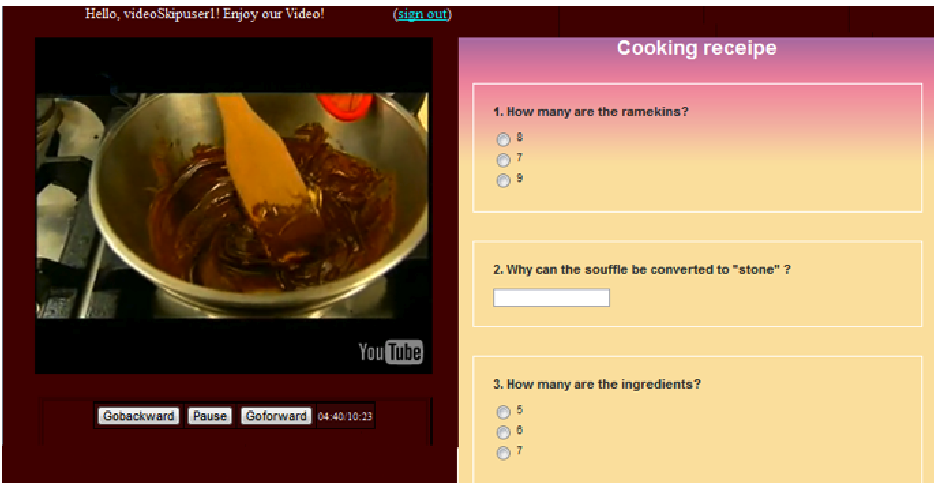 Figure 1: The experimental setup featuring the SocialSkip player and the semantic questionnaire used to stimulate user seeking behavior.
Experimental Results: Humans vs. Ground Truth
The researchers compared the "Replay" signal (solid red line) against a manually defined "Semantic Ground Truth" (blue pulse line). The alignment was remarkably consistent across different genres.
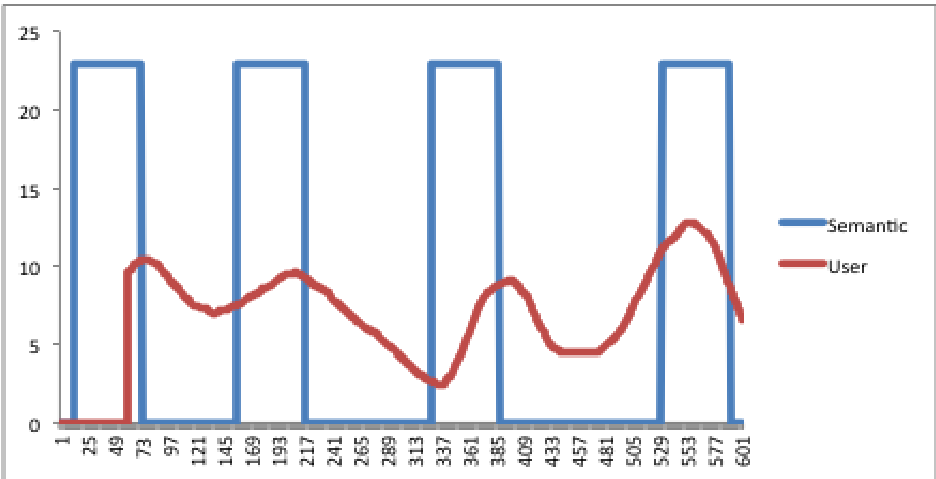 Figure 2: The close match between aggregated user 'replays' and actual lecture semantics.
Key Findings:
- Precision: The local maximum of user activity successfully identified all (100%) of the predefined interesting segments.
- Ranking: The height of the peak provides a natural "importance score," allowing the system to pick the single best thumbnail for a video based on where the most "replaying" happened.
- Independence: The method worked equally well for a static lecture and a visually complex cooking video.
Critical Analysis & Conclusion
The "Content-Free" Advantage
The brilliance of this approach lies in its simplicity and privacy. It doesn't require high-end GPUs to process video files, nor does it require access to a user's webcam (eye-tracking). It only requires a log of button presses.
Limitations & Future Work
While powerful, the study identifies some constraints:
- Cold Start Problem: New videos with zero views cannot be summarized this way.
- Motivation Bias: The experiment was controlled (users were looking for answers to questions). In a "natural" setting like Netflix or TikTok, "replay" might signify confusion or just a funny moment rather than "importance."
Takeaway: This work proves that the video player is more than a display tool—it is a sensor. By treating user interactions as a "social signal," we can build navigation systems that are truly adaptive to how humans consume information.