
VRChat: The Future of Crowdsourced Virtual Reality Research?
Crowdsourcing Virtual Reality Experiments using VRChat
This paper explores the feasibility of using VRChat, a popular social VR platform, as a novel environment for crowdsourcing Virtual Reality experiments. The authors successfully implemented a maze navigation task and recruited 10 participants directly within the platform, demonstrating a scalable alternative to traditional in-lab VR studies.
Executive Summary
TL;DR: Researchers from Northeastern University have demonstrated that VRChat can serve as a potent infrastructure for crowdsourcing VR experiments. By building custom Unity-based worlds and recruiting existing HMD owners within the platform, they bypassed the traditional bottlenecks of laboratory space and equipment costs, successfully conducting a maze-navigation study "in the wild."
Background: This work sits at the intersection of Crowdsourcing and Immersive Analytics. It challenges the status quo of VR research, which historically relied on small, local student samples, by tapping into a global community of VR enthusiasts.
Problem & Motivation: The "VR Bottleneck"
Conducting VR research has long been a logistical nightmare. Even as headsets become cheaper, researchers face three major hurdles:
- Scaling: Most labs only have 1–2 high-end setups.
- Diversity: Participants are often local university students, not representative of the general population.
- Collaborative Complexity: Setting up studies where multiple people interact in VR simultaneously is technically and physically difficult to orchestrate in a single building.
The authors argue that platforms like Amazon Mechanical Turk fail VR researchers because their "crowd" lacks the necessary HMD hardware.
Methodology: Building a Lab in a Social Game
The authors utilized a 4-step workflow to turn a social game into a scientific tool:
1. The Environment
Using the VRChat SDK, they replicated a maze layout from a previous landmark study. They added "researcher-only" features, such as overhead top-down views that were hidden from participants using one-way textures (mirrors).
2. Recruitment & Teleportation
Instead of sending an email link, the researcher logged in as an avatar (e.g., a frog), approached users in public hubs, and opened a "Portal"—a seamless spatial link—to transport consenting participants into the experiment world.
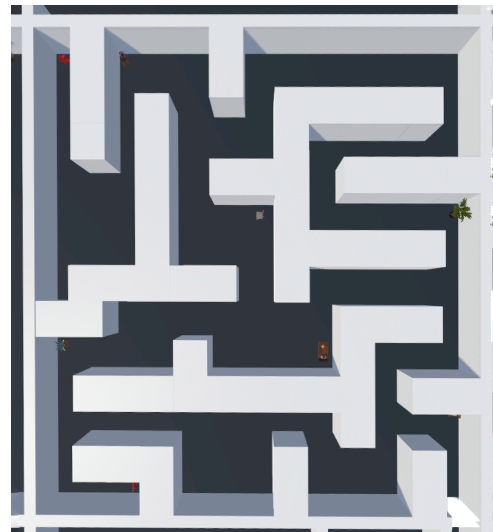 Figure: The implementation of the maze within VRChat, showing the props used for orientation.
3. Data Collection Hack
Since VRChat (at the time) did not allow custom scripts to write to external databases, the authors used a clever workaround: Screen Recording. By observing the top-down "map" in the researcher's view, they could manually record participant paths and completion times.
Experiments & Results
The pilot study (n=10) focused on usability and feasibility rather than just performance.
- High Willingness: Users were generally eager to participate, moving from public socializing to a structured experiment within seconds.
- Hardware Diversity: Participants used a range of setups, from room-scale tracking to seated gamepad play.
- Performance: The average completion time was 1:50. While faster than the original lab study, this highlighted the need to normalize for movement speeds across different VR platforms.
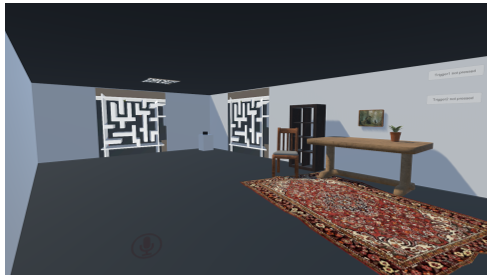 Figure: The researcher's view (antichamber) showing the overhead monitoring screens used for data capture.
Critical Analysis & Future Outlook
The "Udon" Revolution
The paper notes the limitation of the then-current SDK (Triggers only). However, with the release of Udon (a C#-like programming language for VRChat), the potential for complex, self-logging experiments has exploded. Researchers can now theoretically build sophisticated data-logging systems that output strings for participants to copy-paste back to a survey.
Limitations
- Moderation: VRChat is a social platform; "trolling" or unprofessional behavior can occur.
- Ethics: Obtaining digital consent in an avatar-based world requires new protocols.
- Black Box Metrics: You cannot easily control the exact frame rate or latency of the participant's hardware.
Takeaway for the Industry
This research marks a shift from "VR in the Lab" to "VR in the Wild." For HCI researchers, VRChat isn't just a game; it's a globally distributed, high-performance VR laboratory with a built-in participant pool. As social VR matures, the line between "playing" and "contributing to science" will continue to blur.