
Crowd4WS: Leveraging Human Intelligence to Fix the False Positive Problem in Service Discovery
Crowdsourcing for Web Service Discovery
This paper introduces Crowd4WS, an approach that integrates crowdsourcing into the Web service discovery pipeline. By utilizing human intelligence to validate and rank candidate services retrieved by automated matchmakers (specifically RESTful services), the system significantly enhances the precision of service discovery.
TL;DR
Automated Web service matchmakers often return "technically similar" but logically irrelevant results (False Positives). Crowd4WS addresses this by inserting a crowdsourcing layer that validates and ranks services. Using the Bradley-Terry model for aggregation and an expertise-filtering quiz, it transforms a noisy list of candidates into a high-precision, human-verified ranking.
Background: Why Automated Matchmaking Fails
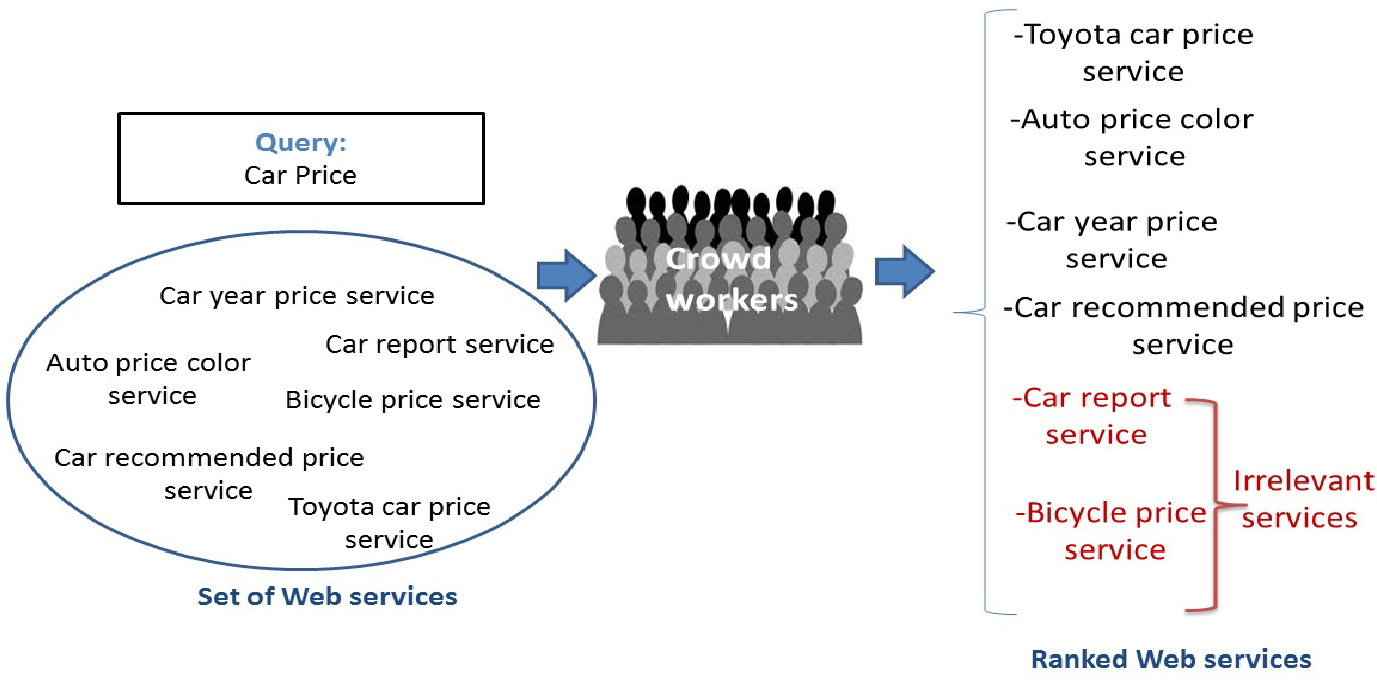
In the last decade, semantic matchmaking (like SAWSDL or RESTful matching) has improved, yet it remains imperfect. A matchmaker might suggest a "Bicycle Price" service to a user searching for "Car Price" because both involve "Price" and "Transport." To a machine, the similarity score is high; to a human, the result is obviously useless. This gap between syntactic/semantic similarity and human intent is the "Semantic Gap" that Crowd4WS aims to bridge.
The Crowd4WS Methodology: Validation & Ranking
The architecture of Crowd4WS (see Figure 2) functions as a post-processing pipeline for existing matchmakers like SR-REST.
1. The Validation Step (Filtering)
Workers are presented with a microtask: "Is Service X relevant to Query Y?" They choose from Relevant, Possibly Relevant, or Irrelevant.
- Aggregation: The system uses Majority Voting with numerical weights () to calculate a global relevance score for each service.
2. The Ranking Step (Pairwise Comparison)
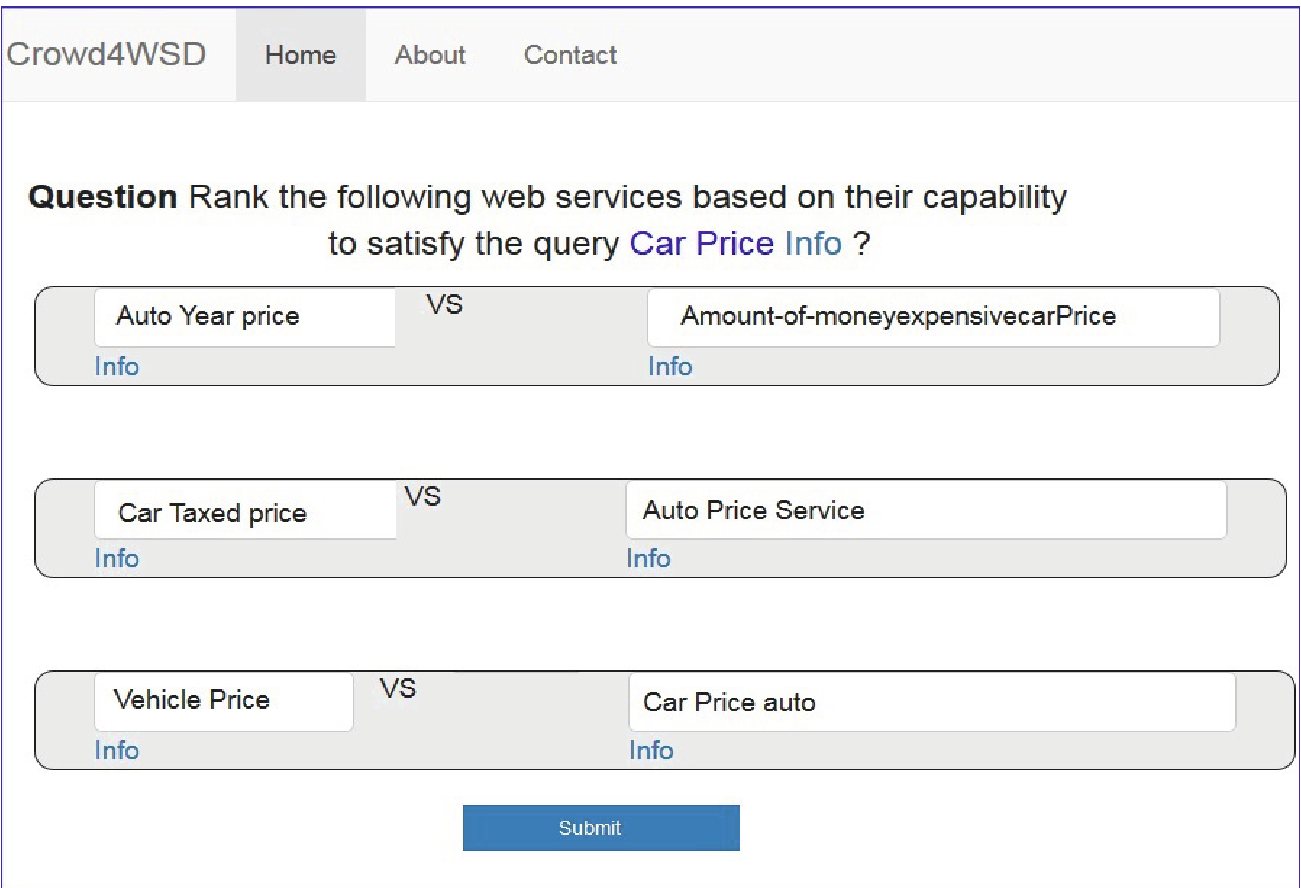
Once irrelevant services are discarded, the crowd performs pairwise comparisons (e.g., "Is Service A more relevant than Service B?").
- Bradley-Terry Model: To convert these binary preferences into a total order, the system employs the Bradley-Terry model. This probabilistic model estimates a hidden "relevance score" for each service, where the probability of preferring over is .
Ensuring Quality: The Expertise Quiz
Crowdsourcing for Web services is harder than tagging images of cats; it requires a "service-aware" crowd. To solve the "Expertise Gap," the authors implemented a qualification quiz (Figure 6). If a worker fails the basic concepts of service discovery, their data is discarded. This ensures the "wisdom of the crowd" isn't drowned out by the "noise of the uninformed."
Experimental Insights
Testing on the hREST-TC13 dataset (25 queries, 895 services) revealed several critical findings:
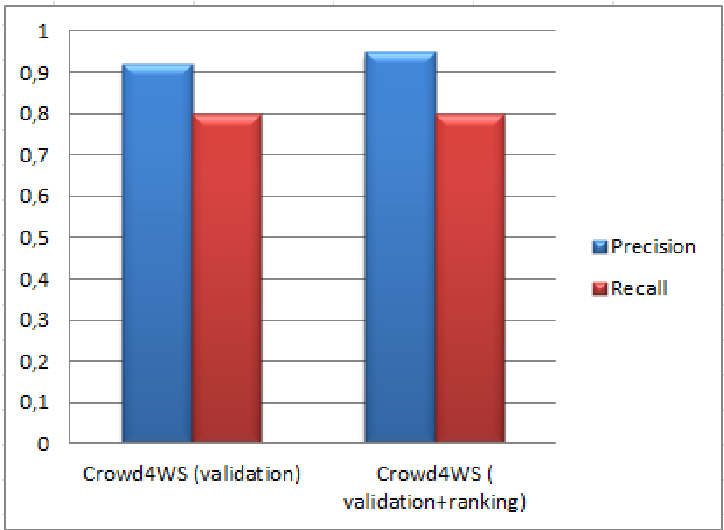
- Precision vs. Recall: The Ranking microtask dramatically improves precision by moving high-quality services to the top (Top-K accuracy), though it does not improve recall (as it only evaluates what the matchmaker already found).
- Cognitive Load: User performance stayed stable up to 10 microtasks per group but degraded significantly thereafter (Figure 5), suggesting that service discovery is a high-cognition task.
Critical Analysis & Conclusion
While Crowd4WS successfully demonstrates that humans can "clean up" algorithmic messes, the study has limitations:
- Scalability: Using humans for every query is slow and potentially expensive compared to pure AI.
- Expertise Scarcity: Finding experts in REST/WADL is significantly harder than finding general MTurk workers.
Future Outlook: The real value of this work may lie in using the crowdsourced labels as a ground-truth dataset to train better Machine Learning models or to fine-tune Large Language Models (LLMs) to mimic human judgment in service discovery. Crowd4WS provides the blueprint for "Hybrid Human-Automatic" systems that may define the future of the Programmable Web.