
crowdsourcing Meets DBSCAN: Solving the Wi-Fi Fingerprint Maintenance Nightmare
Maintenance of Wi-Fi Fingerprint Database by Crowdsourcing for Indoor Localization
This paper introduces a crowdsourcing-based framework for the maintenance of Wi-Fi fingerprint databases in indoor localization. By utilizing a DBSCAN clustering-based error detection mechanism, the system allows users to provide feedback and corrections to localization results while filtering out malicious or erroneous data.
TL;DR
Maintaining an indoor localization database is notoriously difficult due to the "time-varying" nature of Wi-Fi signals. This paper proposes a crowdsourcing framework where users act as "human sensors." By integrating a DBSCAN clustering algorithm to filter out erroneous user feedback, the system maintains high localization accuracy over time without the need for professional re-surveys.
The "Stale Fingerprint" Problem
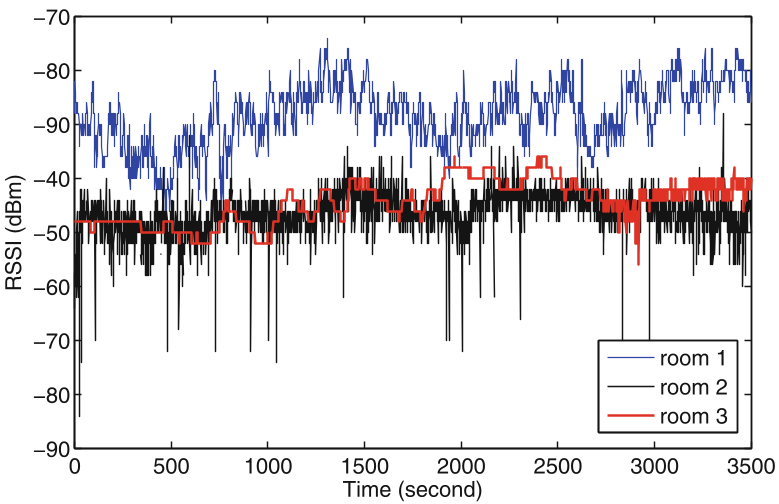
Indoor localization relies on Fingerprinting: a database of Received Signal Strength (RSS) values mapped to specific coordinates. However, indoor environments are dynamic—moving furniture, human traffic, and hardware changes cause RSS patterns to drift.
- The Dilemma: Professionals are too expensive to hire for weekly updates.
- The Trap: Crowdsourcing is cheap but introduces "noise"—users might give wrong location feedback either accidentally or maliciously, which eventually ruins the database (contamination).
Methodology: Trust through Density
The authors propose a system architecture that uses DBSCAN to determine the "vicinity" of trust. Unlike K-Means, DBSCAN doesn't require a predefined number of clusters, making it perfect for irregular indoor layouts.
1. The Similarity Metric
The system calculates similarity between RSS vectors using a normalized ratio of minimum to maximum signal strengths across all detected Access Points (APs).
2. The Clustering Filter
When a user corrects their location, the system asks: "Is this new location logically close to where I thought the user was?"
- Physical Intuition: If the user corrects their location to a spot halfway across the building, it's likely an error or a malicious act.
- Logic: Use the existing database to form clusters. If the user's input and the system's estimate fall into the same density-connected cluster, the correction is accepted.
Tuning the "Bullshit Detector" (DBSCAN Parameters)
The effectiveness of the system hinges on two parameters:
- (Radius): Set to half of the smallest room's diagonal length. Too large, and it accepts everything; too small, and it rejects valid user feedback.
- MinPts (Minimum Points): The authors used a Neyman-Pearson decision model to find that MinPts = 3 provides the optimal balance between Detection Rate () and False Alarm Rate ().
Experimental Battle-test
The researchers deployed an Android-based system in a large office building.
Crowdsourcing vs. Static Database
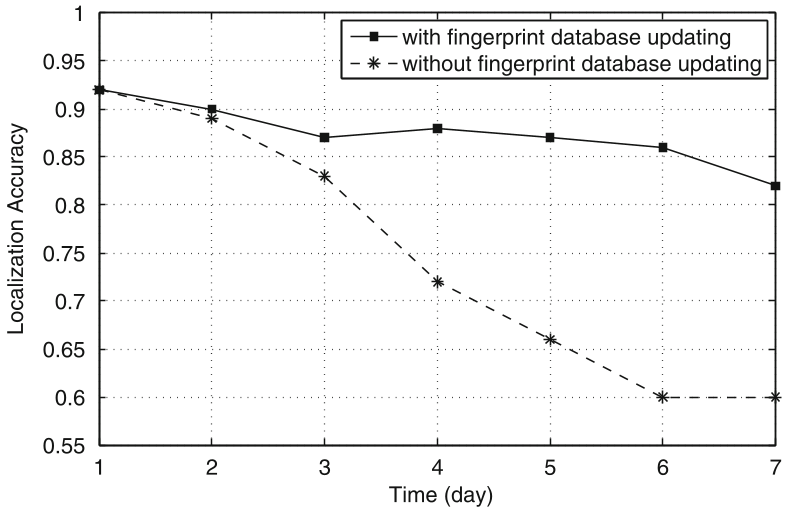
Over a one-week period, the static (non-updating) database saw its accuracy plummet as environmental conditions changed. In contrast, the crowdsourcing approach kept accuracy consistently above 80% by constantly "refreshing" its fingerprints.
Resilience to Malice
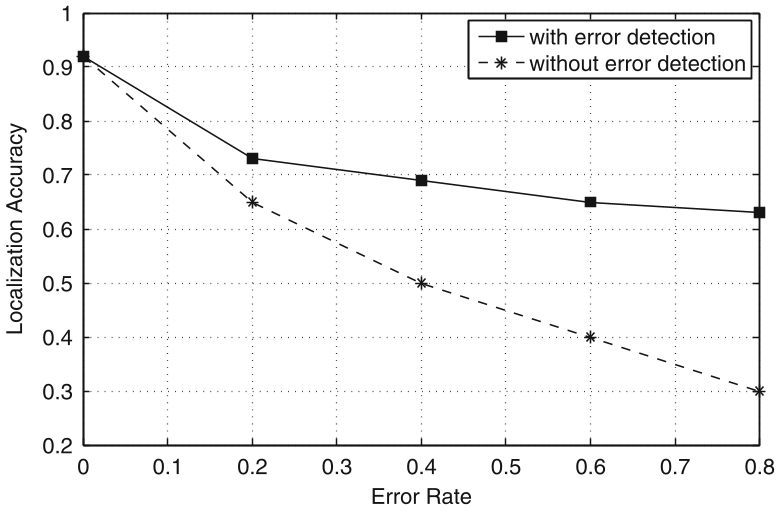
To test the "Error Detection" capability, the team simulated "malicious" users. As shown in the results, even when 80% of the input was "garbage," the DBSCAN filter maintained the system's integrity far better than a naive update approach (Non-Error-Detection).
Critical Insight & Conclusion
The brilliance of this work lies in treating spatial density as a validation tool. Instead of complex cryptographic trust scores for users, they rely on the physical reality that Wi-Fi fingerprints change gradually, not sporadically.
Limitations:
- The method still requires a "high quality" initial survey by professionals.
- If the environment changes so drastically that the 90% initial accuracy drops significantly, the "vicinity" logic might start rejecting valid updates.
Future Outlook: Integrating this with Active Learning (where the system asks specifically for feedback in "uncertain" zones) could further reduce the initial professional burden.