
The Energy Bank: A New Paradigm for Crowdsourcing in Wireless-Powered Networks
Crowdsourcing in Wireless-Powered Task-Oriented Networks: Energy Bank and Incentive Mechanism
This paper introduces an energy bank-based crowdsourcing framework and a Stackelberg game-theoretic incentive mechanism for Wireless-Powered Task-Oriented Networks (WPTNs). The proposed system enables employer devices to outsource subtasks to workers using harvested energy as payment, achieving significant energy conservation through a lossless virtual bookkeeping system.
TL;DR
Researchers have proposed a "Virtual Energy Bank" framework that treats harvested RF energy as a digital currency. By allowing devices to "outsource" tasks (like data relaying) to neighbors in exchange for energy credits, the system avoids the massive losses associated with direct wireless energy transfer while significantly extending the battery life of IoT nodes.
Background: The Price of Wireless Power
Wireless Energy Transfer (WET) is the "Holy Grail" for the Internet of Things (IoT), promising eternal life for billions of sensors. However, reality is harsher: RF energy attenuates rapidly over distance. Transferring energy from a source to a transmitter, and then again from that transmitter to a receiver, creates a "secondary loss" that makes direct energy trading between small sensors almost impossible.
This paper shifts the focus from trading energy to trading service.
The "Energy Bank" Architecture
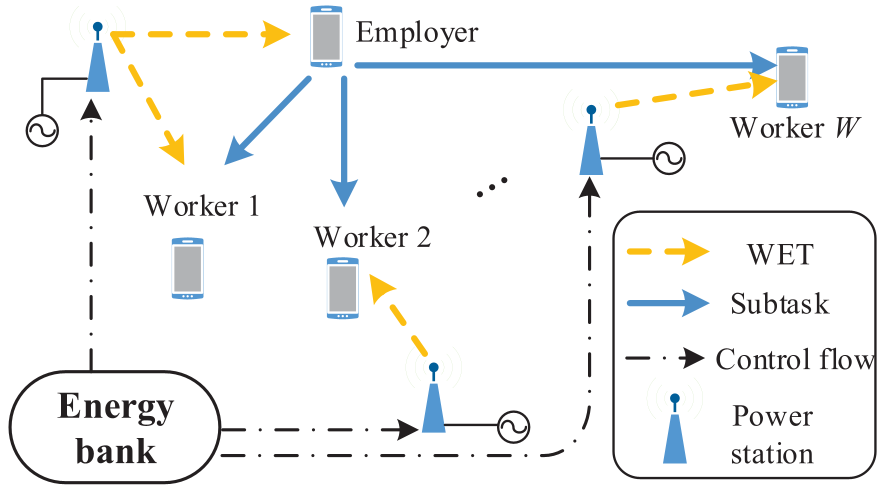
The core innovation is the Energy Bank, a decentralized accounting entity. Instead of Device A trying to beam power to Device B (highly inefficient), Device A tells the Bank to transfer "Energy Credits" to Device B's account.
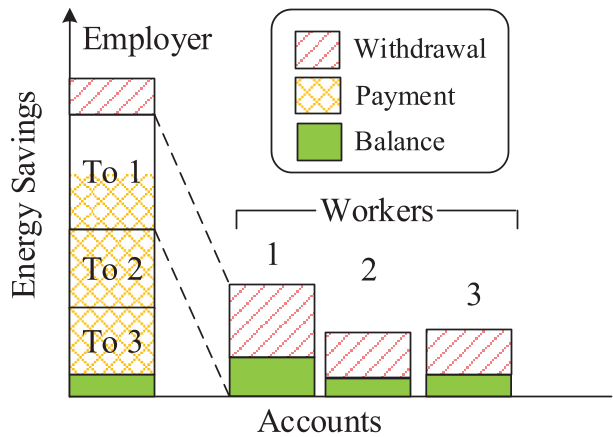
Why this works:
- Lossless Settlement: Transfers are just numbers in a ledger—no RF energy is lost during payment.
- Flexible Charging: Workers can choose when to withdraw their energy (recharge) from a nearby power station, optimizing for channel conditions and avoiding battery overflow.
- Honesty: The bank acts as an escrow, freezing the employer's prepayment until task completion is verified.
Methodology: The Stackelberg Game
The paper models this as a Stackelberg Game. The Employer (Leader) sets a "Unit Energy Price" (e), and the Workers (Followers) decide how much labor (subtask size) they are willing to provide to maximize their profit.
Breaking Down the Math:
- Worker Profit: . They only join if profit > 0.
- Employer Expense: The sum of their own transmission costs and the energy paid to workers.
The problem is technically NP-hard because it requires selecting the optimal subset of workers (Admission Control). The authors developed the EMGC (Energy Minimization for General Case) algorithm to solve this iteratively, moving the network toward a "Win-Win" equilibrium.
Application: Relay-Based Sensor Networks
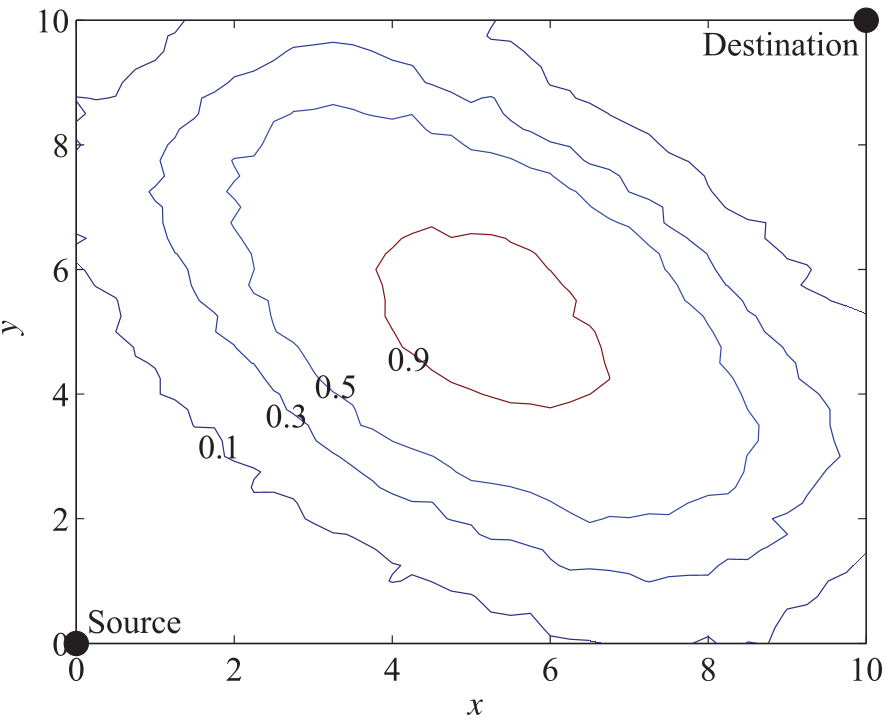
To prove the theory, they applied it to a network where a Source needs to send data to a Sink.
Experimental results show that:
- Dynamic Outsourcing: As bandwidth increases, employers prefer outsourcing larger subtasks to fewer, more efficient relays.
- Efficiency: The heuristic algorithm (CHA) performs almost as well as a centralized "God-mode" controller, saving massive amounts of energy compared to traditional direct transmission.
Critical Insight & Conclusion
The true value of this work lies in decoupling the physical transfer of energy from the economic incentive. By using an Energy Bank, the network achieves a "Virtual Energy Cooperation" that circumvents the physical laws of RF attenuation.
Limitations: The current model assumes the Energy Bank is a trusted entity with zero overhead. In future work, implementing this on a Blockchain could provide the necessary decentralization and security, though the energy cost of the blockchain itself would need to be accounted for.
Final Takeaway
The future of IoT isn't just about better batteries; it's about better markets. If devices can trade labor for energy credits efficiently, the entire network becomes more resilient and sustainable.