
RBMC: Beyond Skills — Leveraging Multi-Community Insight for Crowdsourcing Success
A Recommendation of Crowdsourcing Workers Based on Multi-community Collaboration
This paper introduces the Recommendation of workers Based on Multi-community Collaboration (RBMC), a novel framework for crowdsourcing platforms that categorizes workers into intersecting communities. By leveraging Bayesian Networks and K-means clustering, it identifies optimal Top-N worker groups based on a multidimensional profile of reputation, preference, and activity.
TL;DR
The paper introduces RBMC (Recommendation Based on Multi-community Collaboration), a system that stops looking at crowdsourcing workers as isolated entities. Instead, it groups them into specialized "communities" based on their Reputation, Task Preference, and Activity Levels. By analyzing the intersection of these communities, the system achieves significantly higher recommendation accuracy than traditional Collaborative Filtering or skill-based methods.
Background & Motivation: The "Fuzzy" Worker Problem
Crowdsourcing platforms like Amazon Mechanical Turk (AMT) face a persistent challenge: Information Asymmetry. Requesters don't know who the best workers are, and workers are often overwhelmed by irrelevant tasks.
The authors point out that current SOTA methods are too one-dimensional—focusing solely on skills or interests. They argue that worker behavior is social and multifaceted. A worker might be highly skilled but inactive, or highly active but prone to "malicious passing" (providing low-quality answers). To solve this, we need a way to model the latent "human" relations and categorical preferences of the workforce.
Methodology: High-Dimensional Worker Profiling
The RBMC framework operates through a three-stage community construction process:
1. The Ability & Reputation Matrix
Using a Bayesian Network, the authors aggregate worker tags to build an ability matrix. They calculate the Kappa coefficient () of a worker's confusion matrix to determine their reputation.
- The Logic: Based on Gaussian distribution features, workers are categorized via T-check into four distinct reputation tiers: Malicious, Normal, Normal-High, and Excellent.
2. Preference Community Discovery
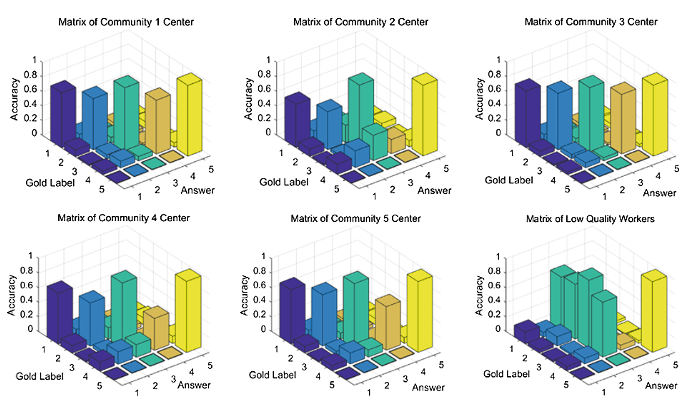
Not all "good" workers are good at everything. By applying K-means clustering to the task history, the researchers identified distinct preference communities.
- Visual Evidence: As shown in the matrix below, the diagonal represents the precision of workers in specific task types. Community 2, for instance, shows a clear peak in performance for task types 3 and 5.
3. Activity Assessment
Finally, workers are segmented by their engagement frequency into "Less Active," "Normal," and "Highly Active" groups.
The Crossover Synthesis
The "secret sauce" of RBMC is the Crossover Analysis. Instead of picking the person with the highest skill, the algorithm looks for the intersection: Which workers belong to the High-Reputation community, ARE in the High-Activity group, AND match the task's specific Preference community?
Experimental Validation
The authors tested RBMC against traditional indicators using the WS-AMT public dataset.
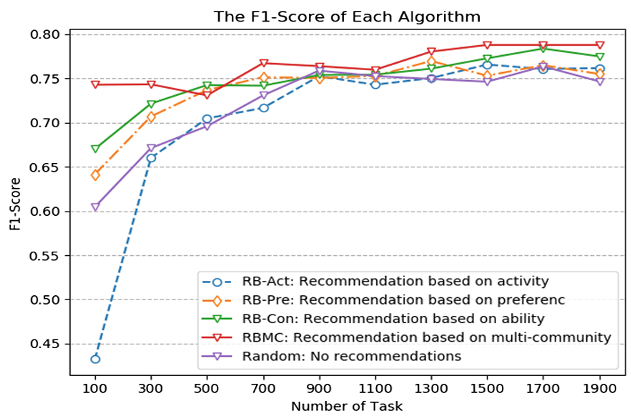
Key findings from the data include:
- Holistic Value: Accuracy improved when any single characteristic (precision, activity, or preference) was added, but the composite RBMC model consistently outperformed them all.
- Top-N Performance: In Top-10 recommendation scenarios, RBMC demonstrated superior stability, ensuring that recommended workers were not just capable, but also likely to accept and complete the task promptly.
Critical Analysis & Conclusion
Takeaway
The shift from "worker-as-a-node" to "worker-as-a-member-of-multiple-communities" is a significant step forward. It acknowledges that human performance is context-dependent and socially grounded.
Limitations & Future Work
While the results are promising, the current model relies on historical data, which may present a "cold start" problem for new workers. The authors acknowledge this and plan to optimize the process for real-time recommendations. Furthermore, the tag aggregation precision is a bottleneck that future iterations using more advanced NLP might address.
Ultimately, RBMC provides a robust blueprint for the next generation of intelligent crowdsourcing platforms, where the "Crowd" is treated as a structured ecosystem rather than a random assembly of individuals.