
Beyond the Micro-Task: The Evolving Economics of the Gig Economy
Crowdworker Economics in the Gig Economy
This paper investigates the longitudinal economic status of Amazon Mechanical Turk (MTurk) workers in the US, analyzing four large-scale surveys (N > 10,000) over a six-year period (2012–2018). It reveals a significant shift where crowdworkers, despite facing high unemployment rates, are increasingly using the platform for supplemental rather than primary income as they integrate into the broader gig economy.
TL;DR
Is crowdworking a primary livelihood or a strategic side-hustle? By analyzing six years of longitudinal survey data from Amazon Mechanical Turk (MTurk), this study finds that while crowdworkers face high unemployment, they are becoming "richer" and more selective. The rise of the broader gig economy (Uber, GrubHub, etc.) is providing workers with more leverage, potentially ending the era of "ultra-cheap" academic crowd labor.
Background: The Opacity of Digital Labor
For years, Human-Computer Interaction (HCI) researchers have treated MTurk as an inexhaustible pool of low-cost labor, often citing a "reservation wage" of roughly $2/hour. However, this perspective ignores the why behind the work. Are these individuals working out of desperation, or are they maximizing flexibility?
The authors argue that we cannot understand worker behavior without placing it in the context of National Economic Trends. As the "gig economy" expands, the line between an "at-will" employee and a "contingent contractor" blurs, fundamentally changing the labor supply for platforms like MTurk.
Methodology: Bridging the Gap to National Statistics
The study’s strength lies in its scale: four surveys over six years with over 10,000 unique respondents. The goal was to make MTurk data comparable to the US Bureau of Labor Statistics (BLS) and Census Bureau data.
Key Metrics Captured:
- Unemployment vs. Joblessness: Using BLS-style logic to distinguish between those "out of work" and those "not in the labor force."
- Poverty Estimation: Moving beyond simple income bins by using interpolated CDFs and mean matching to calculate the "near poor" (1.25x poverty threshold).
The Shifting Landscape
The results provide a fascinating look at the "professionalization" and subsequent "diversification" of the crowd.
1. The Unemployment Paradox
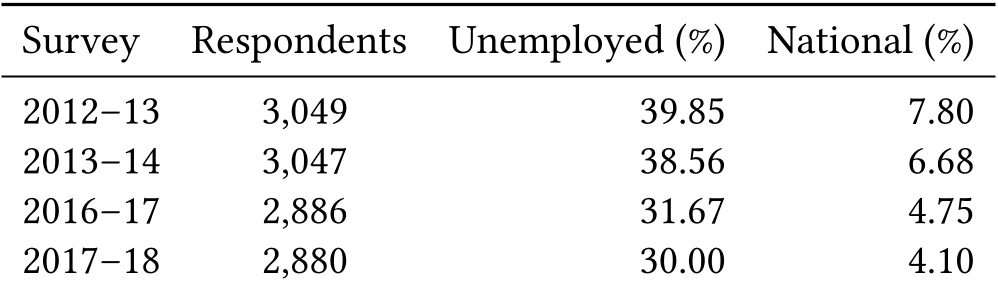
Crowdworkers consistently show unemployment rates 5-7x higher than the US national average (see Table below). However, many "unemployed" workers are actually putting in 30+ hours a week on the platform, effectively making MTurk their full-time job.
2. The Reversal of "Full-Time" Crowdwork
Interestingly, the most recent data (2017-18) showed a decrease in the number of people working 35+ hours on MTurk.
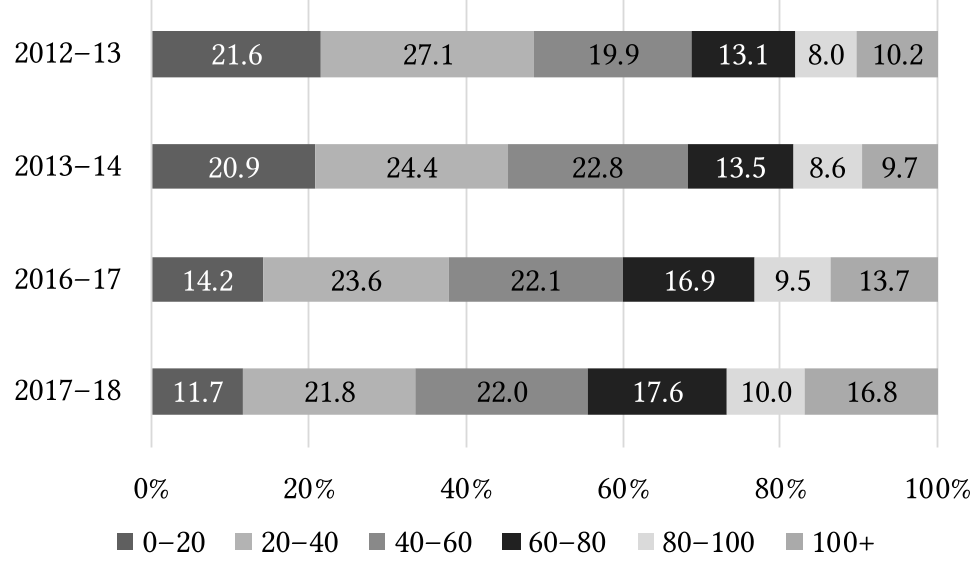 Figure 1: Percentage of respondents reporting using MTurk at least x hours per week.
The Insight: This reversal suggests that as the national labor market improved and more "gig" options (like delivery or ride-sharing) appeared, the most active crowdworkers "leveled up" to better-paying opportunities, reducing their reliance on micro-tasks.
3. Poverty Levels are Dropping
In 2012, MTurk poverty levels were well above the national average. By 2018, they fell below national levels.
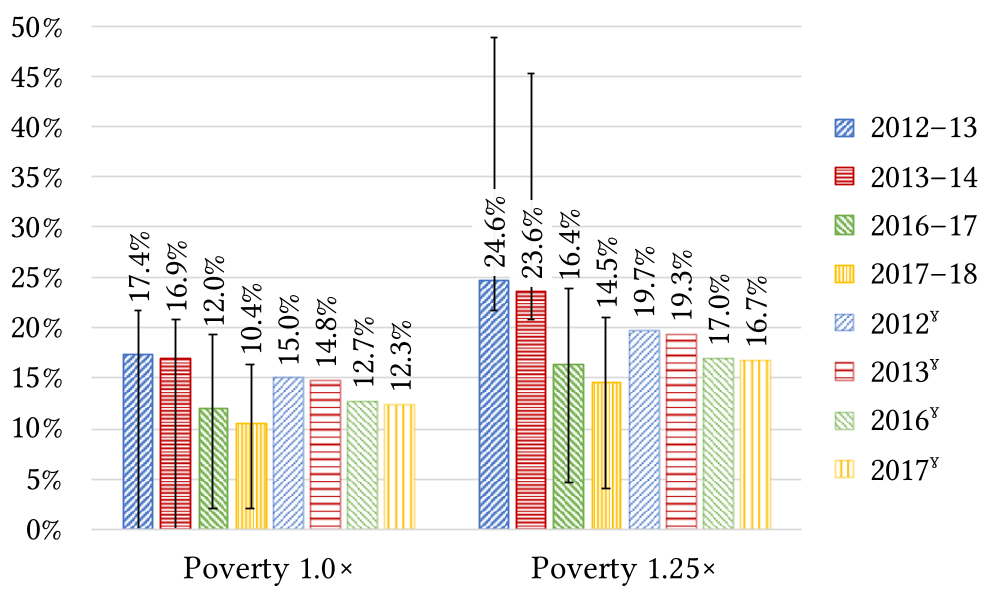 Figure 2: Estimated poverty rates modeled against national thresholds. Note the downward trend in MTurk poverty significantly outpacing the national decline.
Critical Insight: The Death of the "Ready and Waiting" Workforce
The most profound impact of this study is its challenge to existing models of crowdwork:
- Wage Pressure: The "median $2/hour" figure is likely obsolete. Workers today have higher "hourly worth" and more alternatives.
- Availability Erosion: Models like Soylent or Adrenaline that rely on keeping workers "on retainer" for near-instant responses may fail as the workforce becomes more opportunistic and less tied to a single platform.
Conclusion & Future Outlook
The study concludes that crowdworkers are not a static population of "online laborers" but a dynamic, flexible workforce. For researchers, this means the era of "rapid, low-cost" studies is under threat. As workers capitalize on their flexibility to maximize income across multiple gig platforms, the cost of their time will—and should—continue to rise.
Takeaway for the Industry: Designing for the crowd now requires acknowledging their worth in a competitive, multi-platform gig economy. Altruism might keep some workers around, but economic reality will drive the many.