
CRSM: Democratizing Road Surface Monitoring via i-GMM and Crowdsourcing
CRSM: a practical crowdsourcing-based road surface monitoring system
CRSM (Crowdsourcing-based Road Surface Monitoring) is a low-cost, decentralized system designed for real-time road pothole detection and roughness evaluation. It utilizes an improved Gaussian Mixture Model (i-GMM) on distributed vehicle-mounted modules to achieve 90% detection accuracy while significantly reducing data transmission costs.
TL;DR
Road maintenance is a multi-million dollar challenge for cities. CRSM is a production-quality system that turns a fleet of ordinary vehicles into a distributed sensor network. By using a $50 hardware module and a velocity-adaptive algorithm called i-GMM, it achieves industrial-grade pothole detection (90% accuracy) and roughness assessment while solving the "data deluge" problem inherent in mobile sensing.
Background & Motivation: Beyond the Fixed Threshold
Traditional vibration-based monitoring systems typically use a "Z-peak" method: if the vertical acceleration exceeds a threshold, mark it as a pothole. However, this is fundamentally flawed because vehicle vibration is a function of velocity. A smooth road at 80 km/h might vibrate more than a deep pothole at 10 km/h.
The authors identify two critical gaps in current research:
- The Cost Barrier: Professional monitoring equipment is too expensive for wide-scale deployment.
- The Transmission Bottleneck: Uploading 100Hz raw accelerometer data over GSM is financially unsustainable for large fleets.
Methodology: Intelligence at the Edge
The heart of CRSM is the i-GMM (improved Gaussian Mixture Model). Unlike a static threshold, i-GMM learns the "background noise" of the road surface online.
1. Velocity-Adaptive i-GMM
Standard GMMs fail when the vehicle speed changes rapidly. CRSM introduces:
- Dynamic Learning Rates: The model updates faster when velocity changes, allowing the "background" to adapt to new vibration patterns instantly.
- Variable Detection Thresholds: The threshold scales linearly with velocity , preventing false alarms at high speeds.
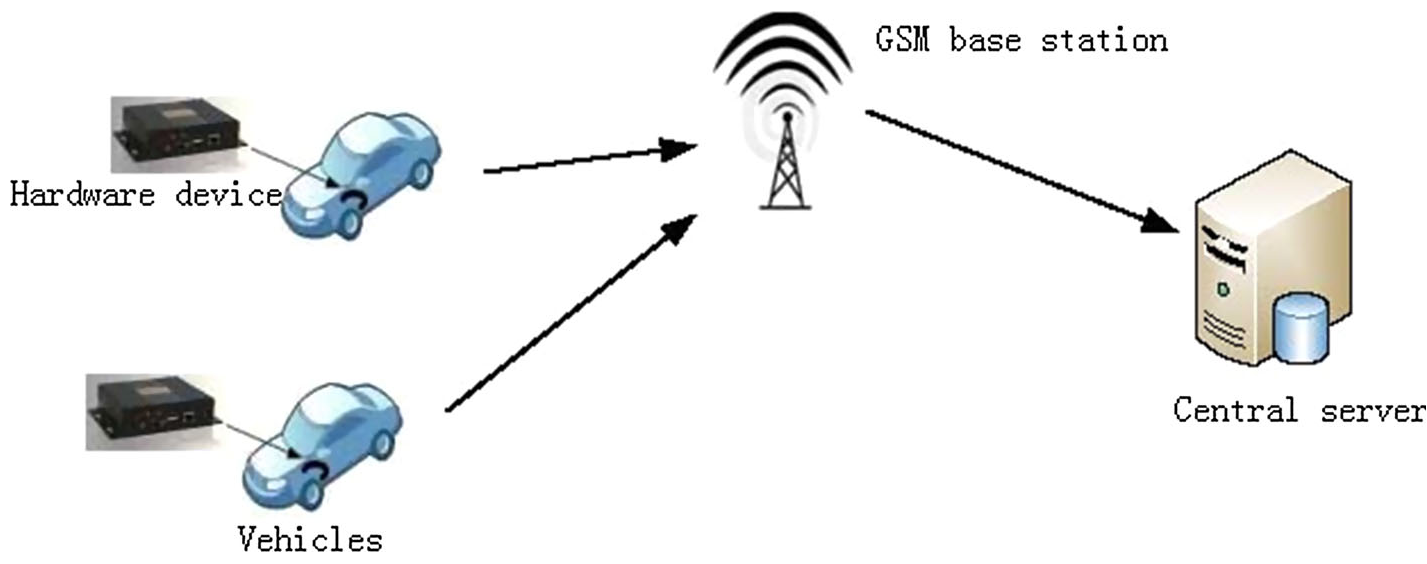 Fig 1: The CRSM Architecture, showing the flow from low-end sensors to the central fusion server.
2. EEMD-based Pothole Extraction
On the server side, the system must distinguish between a pothole and a decelerating belt (speed bump). Both create high-amplitude vibrations. CRSM uses Ensemble Empirical Mode Decomposition (EEMD) to break the signal into Intrinsic Mode Functions (IMFs). Potholes exhibit higher Energy Entropy (uncertainty) because they impact tires unevenly, whereas speed bumps produce more concentrated, structured energy signals.
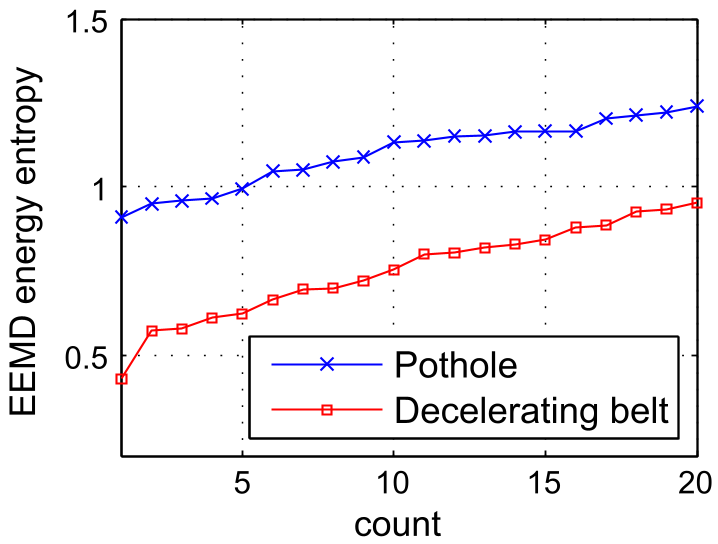 Fig 2: Differing energy entropy profiles of potholes vs. decelerating belts.
Experiments & Results: Real-world Impact
The system was deployed on 100 taxis in Shenzhen for over two years.
- Accuracy: The combination of i-GMM and multi-vehicle data fusion reached a 90% detection rate.
- Efficiency: By processing data locally and only sending "vibration events," the system stays within a strict 15MB-30MB monthly data budget per vehicle.
- Roughness Leveling: CRSM successfully classified roads into "Excellent" to "Unqualified" categories, aligning with the International Roughness Index (IRI) and Chinese urban road standards (CJJ36-2006).
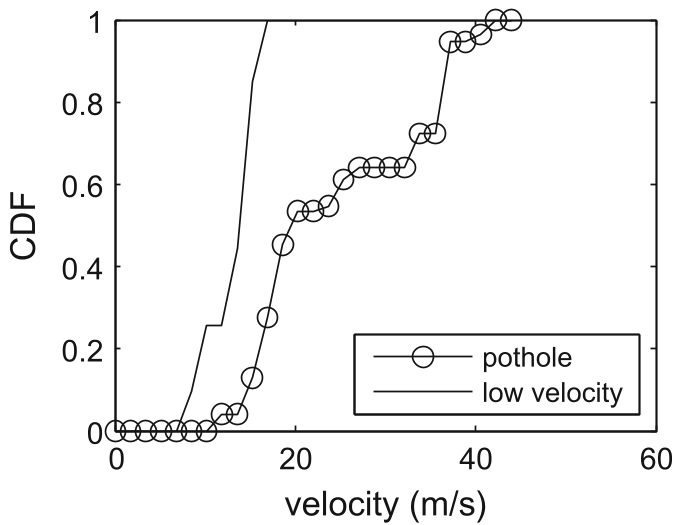 Fig 3: Real-world pothole density map generated for the Longgang District, Shenzhen.
Critical Insight: The Value of "Good Enough" Hardware
CRSM proves that in crowdsourced sensing, the quantity of data points from many low-end sensors (STM32 + MEMS accelerometers) plus superior algorithms beats a few points from high-end equipment. By shifting the complexity from hardware to "intelligence at the edge" (i-GMM) and "fusion at the center" (EEMD), CRSM creates a scalable model for smart city infrastructure.
Limitations & Future Work
While CRSM is highly effective, the authors note that manholes and continuous decelerating belts still present a classification challenge. Future iterations may require incorporating urban traffic databases or more advanced deep learning filters to eliminate these structural road features from the "damage" reports.
Conclusion (Takeaway)
CRSM is a masterclass in practical engineering: it respects the real-world constraints of bandwidth and cost while using advanced statistical modeling to deliver high-fidelity results. For municipalities, it represents a path to 24/7 autonomous road inspection at a fraction of the traditional cost.