
Cryptagram: Reclaiming Photo Privacy via Compression-Resilient Encryption
Cryptagram: Photo privacy for online social media
Cryptagram is a privacy-enhancing system for Online Social Networks (OSNs) that converts sensitive photos into encrypted images resilient to JPEG compression. By utilizing specialized image encoding protocols and Reed-Solomon error correction, it achieves an effective embedding efficiency of 3.06 bits per pixel while maintaining decodability on platforms like Facebook and Google+.
TL;DR
Cryptagram is a research-backed system that allows users to share photos on social media that are completely unreadable to the platform (Facebook, Google+) yet perfectly viewable to friends. It solves the "recompression problem" by embedding encrypted data directly into pixels using a novel method that survives JPEG transformation, achieving a high-density payload of 3.06 bits per pixel.
The Core Conflict: Convenience vs. Privacy
Every day, users upload petabytes of imagery to Online Social Networks (OSNs). We faces two primary threats:
- Systemic Failures: Glitches or complex settings often expose "private" photos to the public.
- Facial Data Mining: OSNs use automated algorithms to index our lives, locations, and social circles through uploaded pixels.
Traditional encryption (like PGP) doesn't work because OSNs don't store "files"; they process images. When you upload a PNG, Facebook converts it to a JPEG, changing pixel values and destroying any standard encrypted bitstream.
Methodology: The Art of Surviving JPEG
The authors define q, p-Recoverability: a mathematical guarantee that if an OSN recompresses an image at quality q, the user can recover the original data with probability p.
1. Spatial Domain Embedding
Instead of hiding data in the file's metadata, Cryptagram hides it in the Spatial Domain (the actual colors of the pixels). It groups pixels into Cryptagram Pixel Blocks (CPBs).
- Luminance (Y): Highly resilient. Cryptagram uses discretization (mapping bit sequences to specific brightness levels) to ensure that even if the OSN shifts the brightness slightly, the decoder can "round" it back to the correct bit.
- Chrominance (Cb/Cr): Less resilient due to 4:2:0 subsampling, but Cryptagram manages to squeeze extra bits here using 2×2 blocks.
2. Architecture & Workflow
The process follows a clean pipeline:
Photo -> AES Encryption -> Error Correction (ECC) -> Spatial Mapping -> OSN Upload -> Transformation -> Browser Extension Decryption.
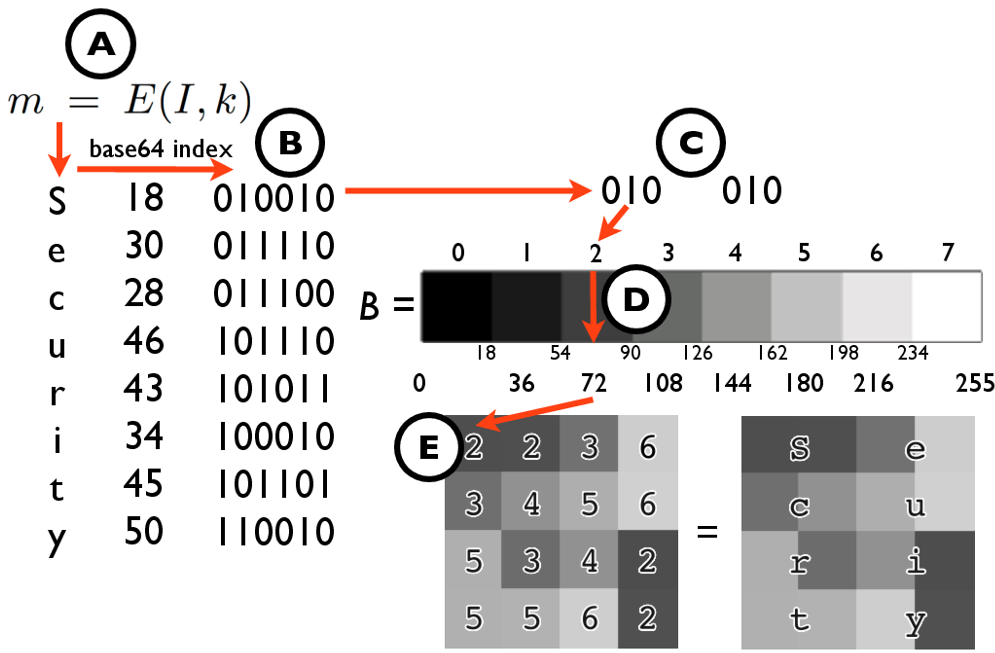 Figure: The encoding flow from cleartext to the embedded "fuzzy" image.
Experimental Validation
The researchers "battle-tested" the system against real-world OSNs. They discovered that Facebook's recompression for high-entropy images (like Cryptagrams) stays within the 76-86 quality range.
By applying Reed-Solomon (255, 223) Error Correcting Codes, Cryptagram can lose up to 6.27% of its data to compression noise and still reconstruct the original photo perfectly.
| Method | Efficiency (bits/pixel) | Resilience |
|---|---|---|
| Cryptagram (Octature + ECC) | 3.06 | High (Survives FB) |
| X-pire! | 2.00 | Moderate |
| Steganography (α = 0.42) | 0.42 | Low |
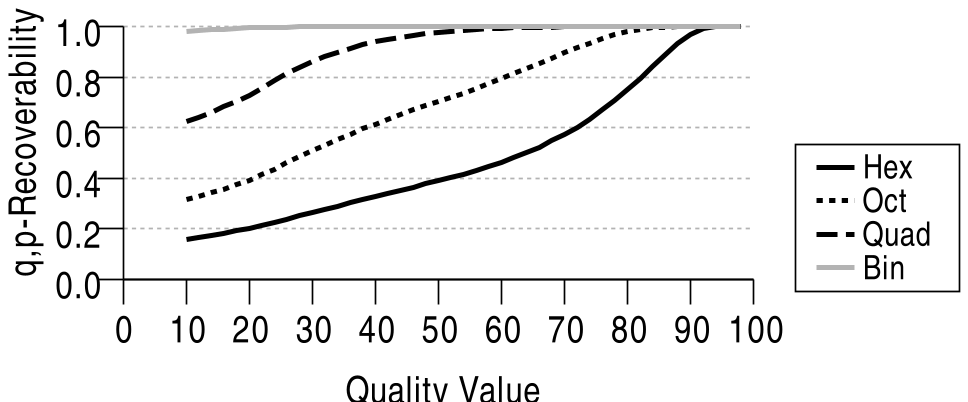 Figure: Probability of recovery (p) vs. JPEG quality (q). The curves show how ECC pushes performance into the "perfect recovery" zone even at lower qualities.
Deep Insight: Beyond Steganography
Unlike steganography, which tries to stay invisible, Cryptagram is "loud." The images look like gray noise or textured patterns. This is a deliberate trade-off: by not caring about being "hidden," Cryptagram achieves 7.5x the data density of traditional steganography. It isn't hiding the fact that an image exists; it's protecting the content of the image with the full strength of AES encryption.
Conclusion & Future Outlook
Cryptagram has already seen real-world deployment with a Chrome extension and hundreds of active users. While it currently struggles with transformations like cropping or rescaling, it provides a robust blueprint for "User-Controlled Privacy."
As social networks move toward more advanced formats like WebP, the authors show that Cryptagram actually becomes more efficient, offering higher recovery rates at smaller file sizes. This suggests that the "arms race" between privacy tools and compression algorithms is currently tipped in favor of the users.
Note: This post is based on "Cryptagram: photo privacy for online social media" published in COSN'13.