
Cryptic Circulation: Why Mpox is 33 Times More Prevalent Than Official Stats Suggest
Extensive cryptic circulation sustains mpox among men who have sex with men
2026-01-01
Summary
Problem
Method
Results
Takeaways
Abstract
This prospective cohort study reveals that clade IIb mpox (MPXV) infections among men who have sex with men (MSM) in Los Angeles exceeded reported cases by a staggering 33-fold margin. By combining anorectal swab surveillance, phylogenetic reconstruction, and meta-analysis, the authors demonstrate that a vast majority of transmission is driven by undiagnosed, subclinical infections.
## TL;DR
A groundbreaking study published in *Nature Communications* reveals that the mpox (clade IIb) outbreak is far from contained. By testing asymptomatic individuals, researchers found that for every one reported case, there are roughly **32 undiagnosed infections**. This "cryptic circulation" means that subclinical cases—often in vaccinated individuals—are the primary drivers of transmission, rendering current symptom-based elimination targets obsolete.
## The Illusion of Elimination
Since the 2022 emergency phase, global health agencies like the WHO and CDC have aimed for the elimination of human-to-human mpox transmission. The metric for success? A window of three months without a reported case.
However, the academic community has long been puzzled by a contradiction: if we are close to elimination, why do new cases almost always lack an "epidemiological link" to known patients? The answer provided by Lewnard et al. is sobering: we are looking at the tip of an iceberg, while the vast majority of the viral population circulates invisibly in the community.
## Methodology: Peering into the "Hidden" Reservoir
The researchers leveraged a unique cohort of 7,930 MSM in the Kaiser Permanente Southern California (KPSC) system. They did something traditional surveillance doesn't: they tested **remnant anorectal specimens** collected during routine STI screenings, regardless of whether the patient reported mpox symptoms.
### 1. The Reporting Multiplier
By comparing the rate of positive PCR tests in these "symptom-agnostic" swabs to the rate of clinical diagnoses, the team calculated a **reporting multiplier**.
* **Finding**: Only 1 in 33 infections is actually caught by the healthcare system.
* **Context**: This makes MPXV incidence comparable to common bacterial STIs like Gonorrhea and Chlamydia.
### 2. Phylogenetic Confirmation
To ensure this wasn't an anomaly, the team performed a **birth-death skyline model** analysis of 497 MPXV genomes from Los Angeles.
* **The Logic**: If the virus is spreading more than we see, the "genetic diversity" of the sampled viruses will be much higher than a small, controlled outbreak would suggest.
* **The Result**: The genetic data perfectly mirrored the swab data, confirming a massive under-reporting of ~28x to 33x.
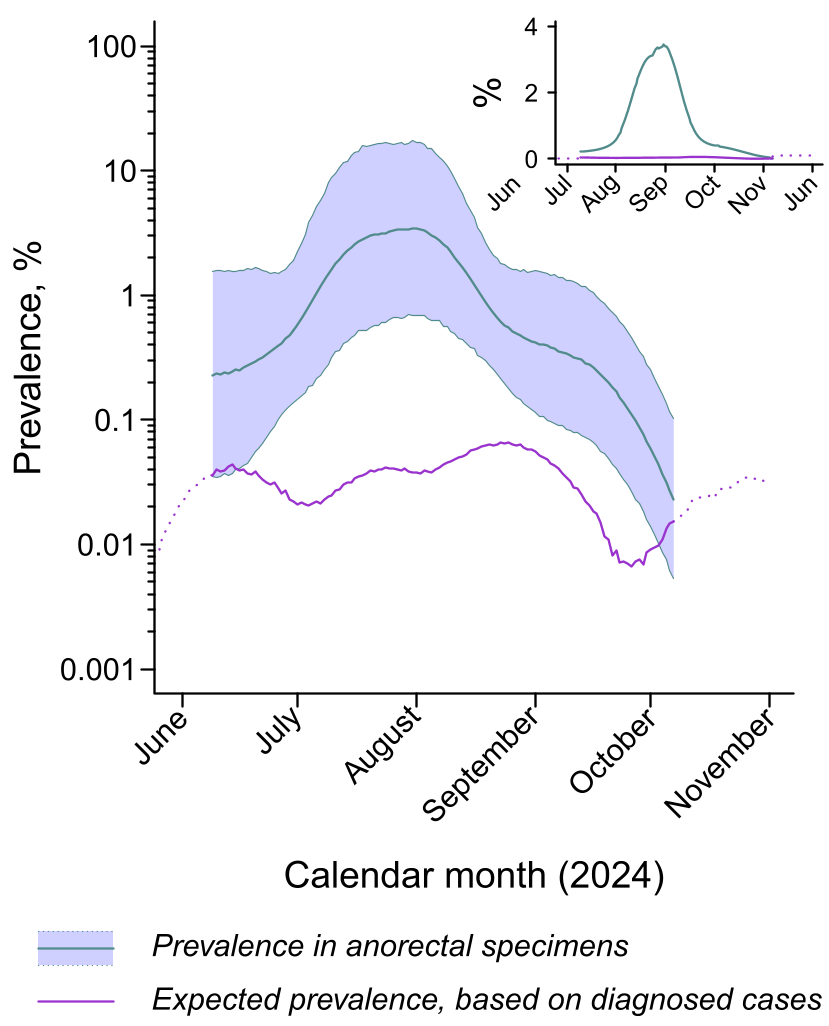
*Fig 1. Comparisons between expected prevalence (based on cases) and observed prevalence (based on the study) show a massive gap.*
## Why is this happening? The "Vaccine Paradox"
The study offers a fascinating insight into the role of the JYNNEOS vaccine. While the vaccine is highly effective at preventing *severe* disease and painful lesions, it is less effective at preventing *infection* and viral shedding.
* **The Shift**: Vaccinated individuals who get infected often experience "paucisymptomatic" (very mild) cases.
* **The Result**: Because they don't have the classic painful lesions, they don't seek care. Yet, they continue to shed the virus in the anorectal mucosa, potentially spreading it to sexual partners.
## Modeling the "Superspreading" Dynamics
The paper uses the **dispersion parameter (k)** to model transmission. In epidemiology, a low *k* means "superspreading" (a few people cause many infections), while a higher *k* means more uniform spread.
If *only* diagnosed cases were spreading the virus, the *k* value would have to be implausibly low (around 0.04). However, phylogenetic evidence shows *k* is closer to 0.3. The only way to reconcile these numbers is if **undiagnosed infections account for 61% to 94% of all transmission events.**
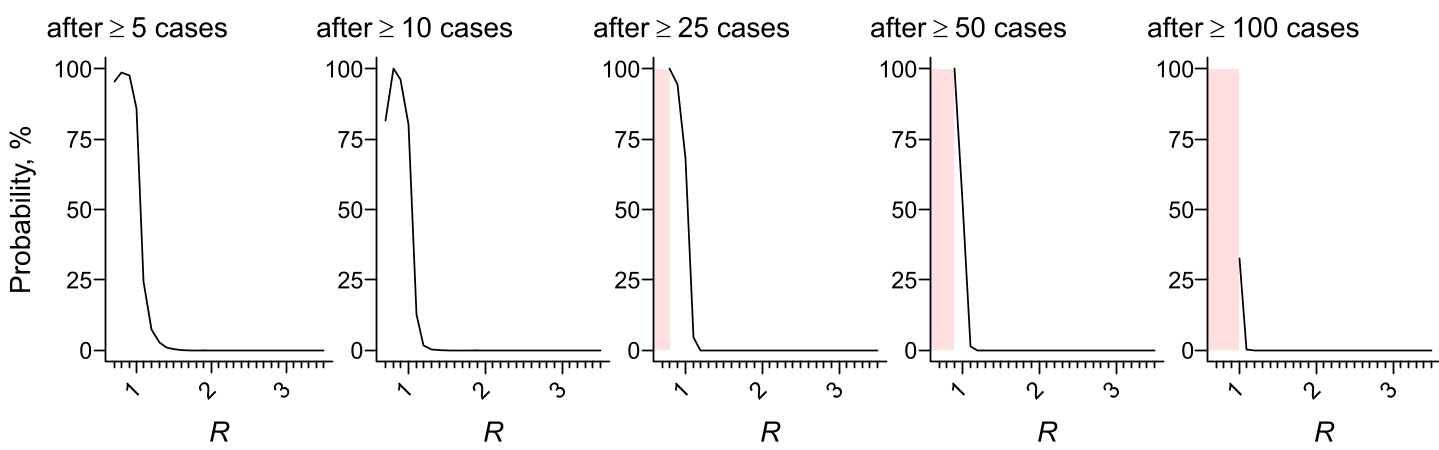
*Fig 2. The probability of an outbreak truly ending (Containment) even after 3 months of zero reported cases is dangerously low if R > 1.1.*
## Critical Insight: The Elimination Myth
The most significant takeaway for public health policy is the debunking of the "3-month elimination" rule.
* At a 1-in-33 reporting rate, there is a **50% chance** that you would see **zero cases** for months even while there are 20+ active infections circulating in the community.
* By the time a single case is clinically "detected," it is likely that dozens of transmission events have already occurred.
## Conclusion & Future Outlook
This study marks a paradigm shift in our understanding of mpox. It transitions the disease from a "lesion-based" outbreak to a "cryptic STI" dynamic.
**The Way Forward:**
1. **De-emphasize the "Zero Case" Metric**: It creates a false sense of security.
2. **Broadened Screening**: Incorporate MPXV testing into routine STI screening for high-risk groups.
3. **Vaccine Equity**: Renewed efforts to vaccinate younger MSM who entered the "sexual market" after the 2022 rush and have low coverage.
**Limitations**: The study is specific to MSM in a high-access healthcare setting (KPSC). Reporting multipliers might vary in regions with less robust STI screening programs, potentially meaning the "iceberg" is even larger elsewhere.