
CS-CMOS: Harmonizing High-Speed Digital Logic with Sensitive Analog SoCs
CS-CMOS: A Low-Noise Logic Family for Mixed Signal SoCs
This paper introduces CS-CMOS (Current-Steering CMOS), a low-noise logic family designed for mixed-signal SoCs. By integrating a decoupling capacitor and a current-steering mechanism into standard CMOS, CS-CMOS achieves a 10x reduction in switching noise and 5x higher speed compared to existing CSL and CBL families.
TL;DR
Integrating digital and analog circuits on a single chip is a notorious design challenge due to "switching noise." While standard CMOS is efficient, its transient current spikes act as a noise pollutant for analog blocks. This paper presents CS-CMOS, a hybrid logic family that combines the constant-current benefits of current-steering logic with the high-speed switching of standard CMOS. The result? A 10x reduction in noise and a 5x boost in speed over previous low-noise logic families.
The "Loud" Neighbor Problem in SoCs
In modern Systems-on-Chip (SoCs), digital logic is the noisy neighbor. Every time a CMOS gate switches, it draws a sudden pulse of current to charge or discharge parasitic capacitances. These pulses, known as displacement currents, create voltage drops and "ground bounce," which propagate through the shared silicon substrate. For a nearby Analog-to-Digital Converter (ADC) or a Voltage-Controlled Oscillator (VCO), this noise is catastrophic, reducing dynamic range and increasing jitter.
Previous solutions like Current-Steering Logic (CSL) solved the noise problem by drawing a constant current from the supply, effectively "silencing" the switching. However, they paid a heavy "speed tax"—these families are often 10 times slower or more power-hungry than standard CMOS because their pull-up transitions are limited by a fixed bias current.
Methodology: The CS-CMOS Architecture
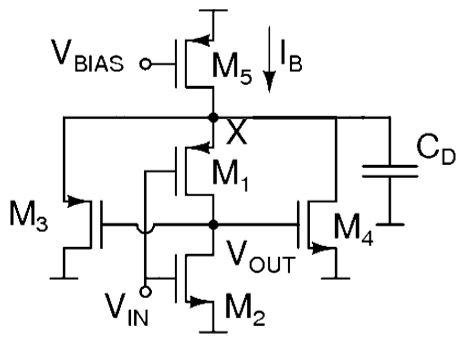
The genius of CS-CMOS lies in its "local supply" concept. Instead of trying to make the whole system constant-current at the cost of speed, the authors added a decoupling capacitor () and a current-steering path to a standard CMOS core.
1. The Core Innovation
As shown in the architecture below, CS-CMOS adds three transistors (, , ) and a capacitor to the standard CMOS inverter:
- Constant Current (): Acts as a current source, ensuring the total current drawn from remains steady.
- Current Steering (, ): When the output doesn't need current, these transistors "steer" the bias current to ground, maintaining a constant load on the supply.
- The Local Reservior (): This capacitor provides the quick burst of charge needed for a fast pull-up transition. Since the charge comes from and not , the supply line never "sees" the spike.
2. Positive Feedback for Sharp Transitions
By using Dual-Threshold Voltage () devices, the authors engineered a Schmitt-trigger effect. When the input switches, the circuit experiences positive feedback, which sharpens the voltage margins and accelerates the switching speed. This "regenerative" action is a significant upgrade over CSL, which generally lacks such high-gain transition mechanisms.
Experimental Results: Speed and Efficiency
The researchers didn't just stop at theory; they fabricated a test chip using a 0.18 m process. The comparison with CSL and CBL (Current-Balanced Logic) was stark.
Performance Comparison
In ring oscillator tests, CS-CMOS outperformed its predecessors across nearly every metric:
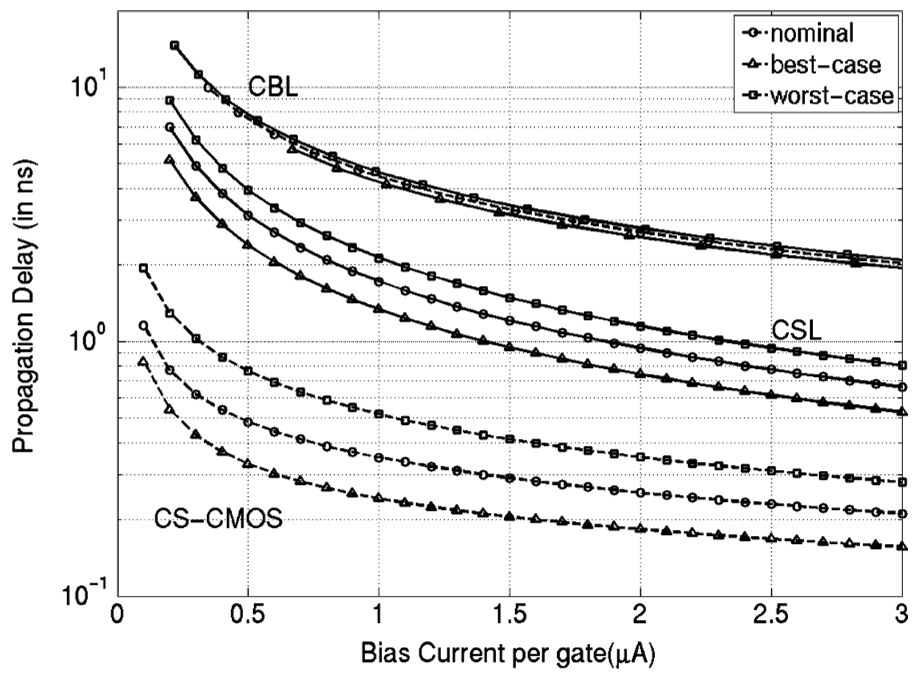
- Propagation Delay: CS-CMOS achieved delays under 1 ns at low bias currents, whereas CSL and CBL lagged significantly behind.
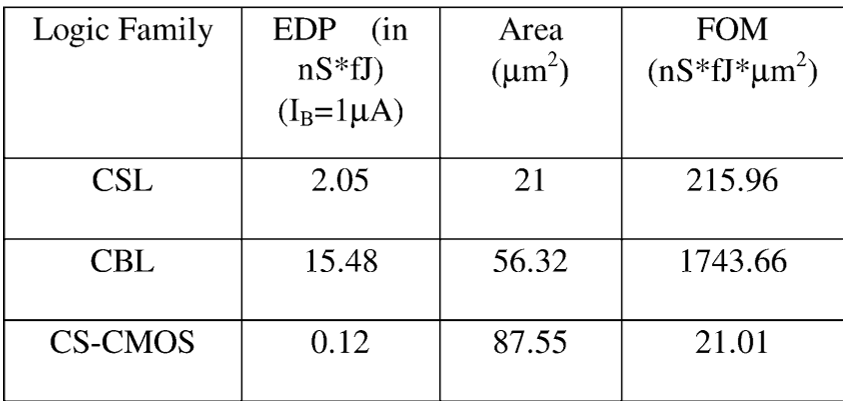
- Energy-Delay Product (EDP): The EDP of CS-CMOS was found to be roughly 10x lower than CSL and 100x lower than CBL.
The table below (Table II from the paper) highlights the Figure of Merit (FOM) which accounts for Area and Noise Margin. Despite a larger area footprint (due to the added capacitor), the overall FOM for CS-CMOS is order-of-magnitude superior.
Critical Insight & Conclusion
The beauty of CS-CMOS is that it respects the "Principle of Locality." By keeping transient currents local to the gate via , it satisfies the requirements of sensitive analog components without sacrificing the digital speed that CMOS is known for.
Takeaway for Designers: CS-CMOS is a prime candidate for the high-activity, high-speed blocks of a mixed-signal SoC (like frequency dividers or decimation filters). While it requires more area than standard CMOS, the "noise insurance" it provides allows researchers to push the limits of analog precision on the same die.
Future Outlook: As we move toward 30nm and below, the authors suggest the positive feedback mechanism in CS-CMOS could be even more vital, helping to compensate for the inherent gain loss in short-channel transistors.