
Structuring the Backbone of Industrial Safety: An Ontology for Pressure Component Design
The 9th International Conference on Computer Supported Cooperative Work in Design Proceedings Research on Pressure Component Design Ontology Building Based on Knowledge Sharing and Reusing
This paper presents a formal ontology building process for pressure component design to facilitate knowledge sharing and re-using in Computer-Supported Cooperative Work (CSCW). It integrates Protégé-3.0 for hierarchy management and Formal Concept Analysis (FCA) to resolve multi-disciplinary concept conflicts and mathematically derive taxonomic structures.
TL;DR
In the high-stakes world of nuclear and industrial equipment, knowledge fragmentation is a silent productivity killer. This paper introduces a systematic framework for building a Pressure Component Design Ontology. By combining Protégé-3.0 with Formal Concept Analysis (FCA), the authors provide a machine-readable architecture that allows engineers to share, reuse, and validate complex design knowledge across conflicting disciplinary terminologies.
Background: The Semantic Chaos in Engineering
The design of pressure components is not a solitary task. It is a multi-disciplinary effort spanning materials science, structural mechanics, and rigorous safety standards like the ASME Boiler and Pressure Vessel Code.
The core problem is Semantic Heterogeneity:
- Ambiguity: The same term might mean different things to a material scientist and a mechanical engineer.
- Redundancy: Different domains use diverse names for identical concepts.
- Rigidity: When engineering codes update, manually updating disconnected CAD/KAE tools is error-prone and costly.
Methodology: Frames, Logic, and Lattices
The authors propose an iterative ontology building process. Unlike simple databases, this ontology uses a Frame-based representation, where concepts inherit properties in a taxonomic hierarchy, ensuring cognitive consistency.
1. The Four Layers of Knowledge
The system categorizes knowledge into four distinct tiers:
- Fact Knowledge: Results from tables, curves, and FEA calculations.
- Concept Knowledge: The "What" – entities like "Design Pressure" or "Service Conditions."
- Procedural Knowledge: The "How" – rules and processes derived from manual guides.
- Meta Knowledge: The "Expertise" – the strategic logic used by senior engineers to apply codes.
2. Formal Concept Analysis (FCA): The Mathematical Backbone
To avoid the "human-subjectivity" trap in hierarchy design, the authors employ FCA. FCA uses lattice theory to derive conceptual structures from data automatically. By using the FcaTab plug-in, they transform design contexts into a mathematical lattice, revealing hidden patterns and resolving conflicts in stress categories.
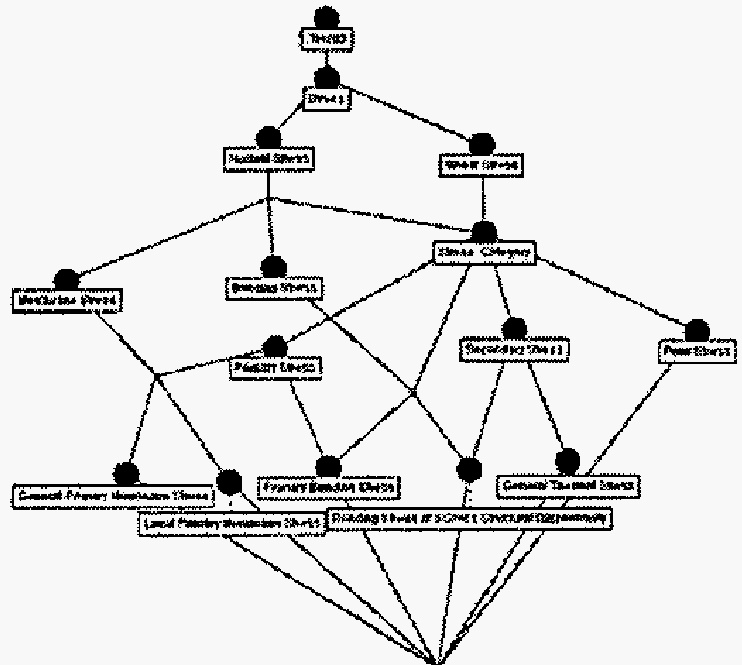 Figure: The Stress Concept Hierarchy derived via FCA ensures mathematical rigor in taxonomic classification.
System Architecture
The proposed ontology is divided into seven critical compositions. This modularity ensures that if a material property changes, the overall design logic remains intact because the relationships are decoupled.
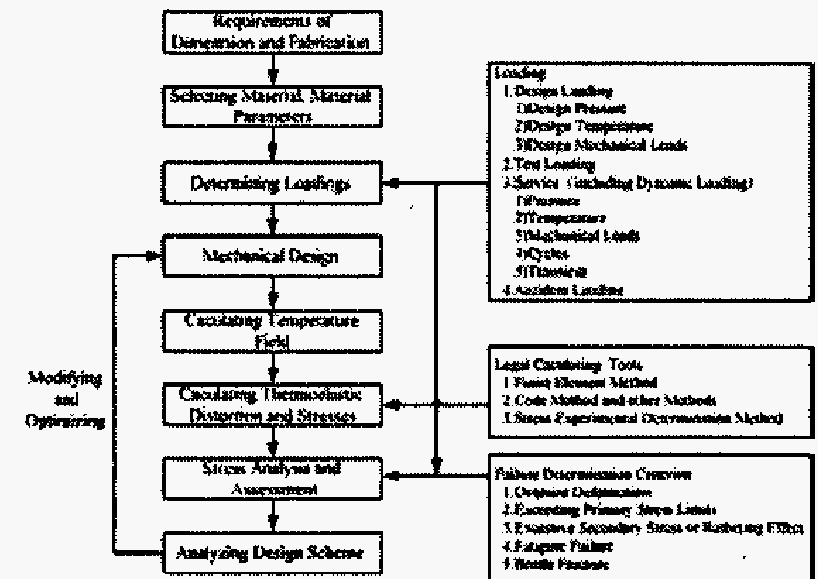 Figure: The modular structure of the Pressure Component Ontology.
Ensuring Consistency with PAL
Consistency is paramount in nuclear safety. The authors utilize Protégé Axiom Language (PAL) to write logical constraints. For example, PAL can automatically verify if a specific nuclear component class satisfies the rigorous requirements of its corresponding ASME subsection, acting as an automated "regulatory auditor."
Critical Insight: Why This Matters
The shift described here is from Document-Centric design to Knowledge-Centric design. By formalizing the "Standard Codes" as part of the ontology, the system moves beyond mere geometry (CAD) and enters the realm of Intelligent CAD (ICAD).
The use of FCA is particularly brilliant because it provides an objective arbiter for defining concepts in multi-disciplinary teams. It removes the "opinion" of the engineer and replaces it with the "logic" of the domain's mathematical attributes.
Summary & Future Outlook
This work establishes a robust foundation for CSCW in heavy industry. However, the authors admit that for global adoption, the ontology must transition to OWL (Web Ontology Language) and integrate more deeply with international data standards like STEP.
Key Takeaways:
- Consistency: PAL constraints prevent design violations early.
- Objectivity: FCA mathematically structures complex hierarchies like stress analysis.
- Efficiency: Knowledge reuse shortens the design cycle and reduces the cost of maintaining specialized ICAD systems.