
CSFinder: Short-cutting the Cold-Start Problem in Social Networks via Experience-Based Critiquing
CSFinder: A cold-start friend finder in large-scale social networks
CSFinder is a conversational recommendation system designed to find friends for new users in large-scale social networks like Twitter. It utilizes a critiquing-based approach combined with case-based reasoning (CBR) to solve the cold-start problem, significantly reducing the interaction steps required to find a target user compared to baseline methods like Incremental Critiquing (IC).
TL;DR
When you join a new social network, the system knows nothing about you—no followers, no tweets, no data. CSFinder bridges this vacuum by initiating a "conversation" where you critique suggested profiles. By leveraging the successful "experience paths" of previous users, CSFinder cuts the time it takes to find your interests by up to 67%, turning a tedious search into a streamlined discovery process.
Problem & Motivation: The Empty Profile Paradox
Traditional recommendation engines (Collaborative Filtering) rely on your past behavior to predict your future interests. But for a "Cold-Start" user, there is no past.
Previous solutions used Critiquing-based Recommendation, where a user looks at a suggestion and says, "Show me someone like this, but with more followers" or "Someone who tweets in English instead." While effective, this "Unit Critiquing" is often painfully slow, requiring dozens of back-and-forth interactions—a major friction point that leads to user abandonment.
The researchers at Queen’s University Belfast asked: Why reinvent the wheel for every user? If a new user's critique path matches a path someone else took successfully in the past, shouldn't we just jump to the end of that successful journey?
Methodology: Mining Human Experience
CSFinder transforms recommendation from a search task into a Case-Based Reasoning (CBR) task.
1. The Interaction Model
The system presents a user profile with features like location, language, and tweet frequency. The user provides a critique (e.g., Followers > 5000).
2. Identifying Relevant Sessions
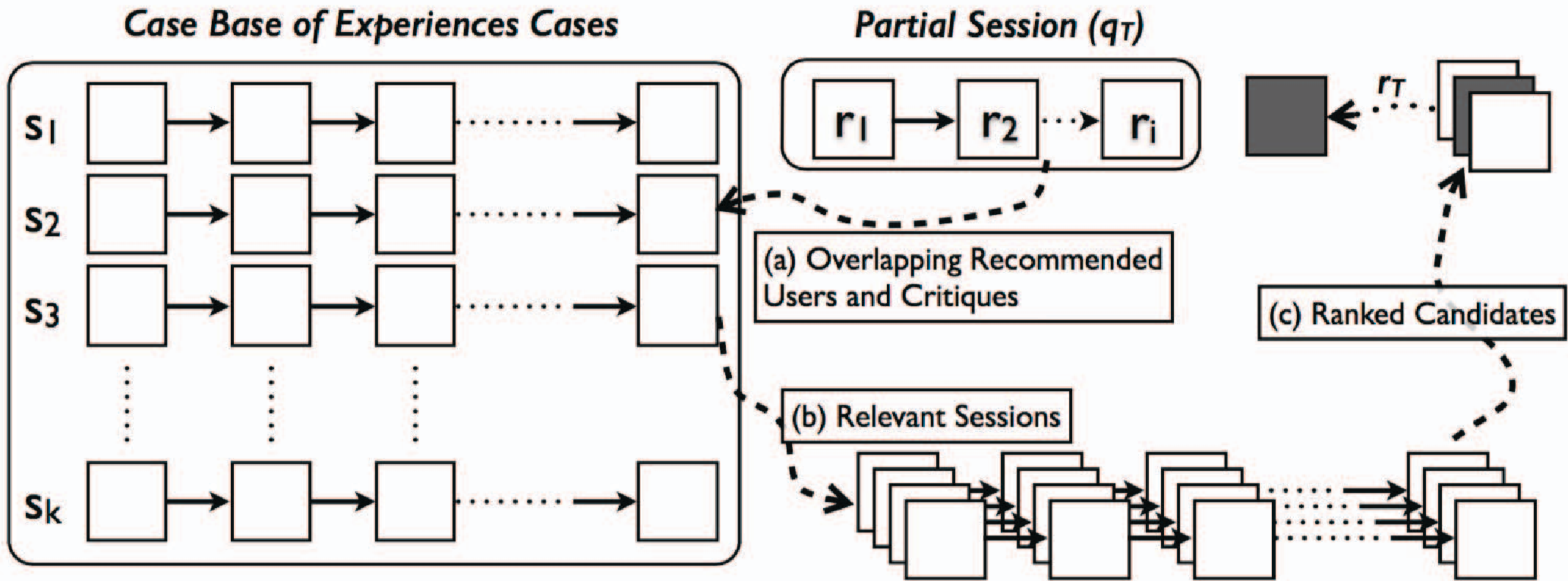
Instead of just filtering the database for the next most similar item, CSFinder treats the current sequence of critiques as a Query (). It searches a Case Base of "Successful Past Sessions."
- Overlap Score: The system calculates how much the current session matches historical ones, giving higher weight to matches that include both the item and the specific critique.
3. Ranking and Filtering
The terminal items (the users eventually accepted/followed) of these historical sessions become the top candidates for the current user. The system filters out any candidates that conflict with the user's most recent critiques to ensure immediate relevance.
Experiments & Results: Slashing Session Lengths
The authors tested CSFinder against Incremental Critiquing (IC)—the standard baseline for conversational systems. Using a crawled dataset of 124,545 active Twitter users, they simulated "rational" users seeking a target profile.
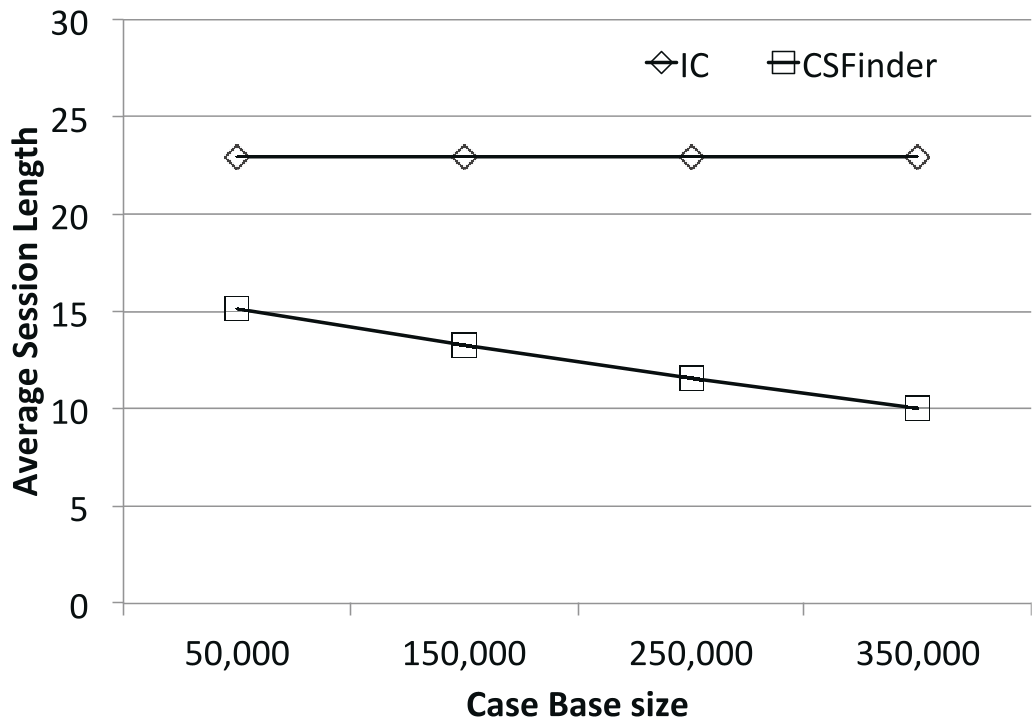
- Significant Efficiency Gains: On a 10,000-user dataset, CSFinder cut session lengths in half (from ~30 cycles to <15).
- Scalability Benefit: As the dataset grew to 125,000 users, the performance gap widened. CSFinder's efficiency stayed high because it could draw from a richer library of past human experiences.
- Success Rate: As shown in the "Percentage of Target Reached" chart, CSFinder hits a >50% success rate in just 6 cycles when using a large case base.
Critical Analysis & Conclusion
The Takeaway
CSFinder proves that interaction data is as valuable as item data. By treating a successful recommendation session as a "case" to be reused, the system effectively "remembers" how previous users navigated their own uncertainty. This is a significant step forward for any platform dealing with high-dimensional items (like social profiles with dozens of metadata attributes).
Limitations & Future Work
- Dependency on Case Base Quality: The system's "intelligence" is strictly capped by the diversity of successful sessions it has recorded. If no one has searched for a specific niche before, CSFinder reverts to standard IC.
- Privacy Considerations: While the paper focuses on the algorithm, reusing interaction sessions requires careful anonymization to ensure that one user's path to a "friend" doesn't leak personal preferences or sensitive metadata.
Future iterations might incorporate Deep Learning to represent these critique paths in a latent space, allowing for "soft matches" between sessions that aren't identical but share the same underlying intent.