
CSNA: Bridging the Chasm Between Telco RCS and Social Media Giants
CSNA: A Social networking solution for RCS and mobile user
This paper introduces CSNA (Community and Social Network Aggregator), a middleware framework designed to bridge the gap between IP Multimedia Subsystem (IMS) / Rich Communication Suite (RCS) networks and mainstream Social Networks like Facebook and Gtalk. By acting as a protocol gateway, CSNA consolidates disparate social feeds, presence info, and messaging into a single RCS-enabled mobile interface.
TL;DR
The CSNA (Community and Social Network Aggregator) solution is a strategic framework designed for Telecommunication operators to integrate IMS/RCS architectures with dominant Social Networks (SN) like Facebook and Gtalk. By merging contact books and synchronizing presence across platforms, it transforms the mobile operator from a "dumb pipe" into a central communication hub, driving data growth and subscriber retention.
Problem & Motivation: The Identity Crisis of RCS
For years, Telco operators have witnessed their traditional SMS/MMS revenues cannibalized by Social Networks. While the Rich Communication Suite (RCS) was intended to be the industry's answer, it faced a cold-start problem: a lack of user density.
The authors identify a critical insight: RCS cannot succeed in a vacuum. Users are "addicted" to their existing social circles on Facebook or LinkedIn. The challenge is not to compete against these networks, but to aggregate them. Currently, most universal chat clients (like Pidgin or Meebo) are web-centric and lack integration with the carrier's native IMS core, leaving a gap for a robust, network-side gateway.
Methodology: The CSNA Architecture
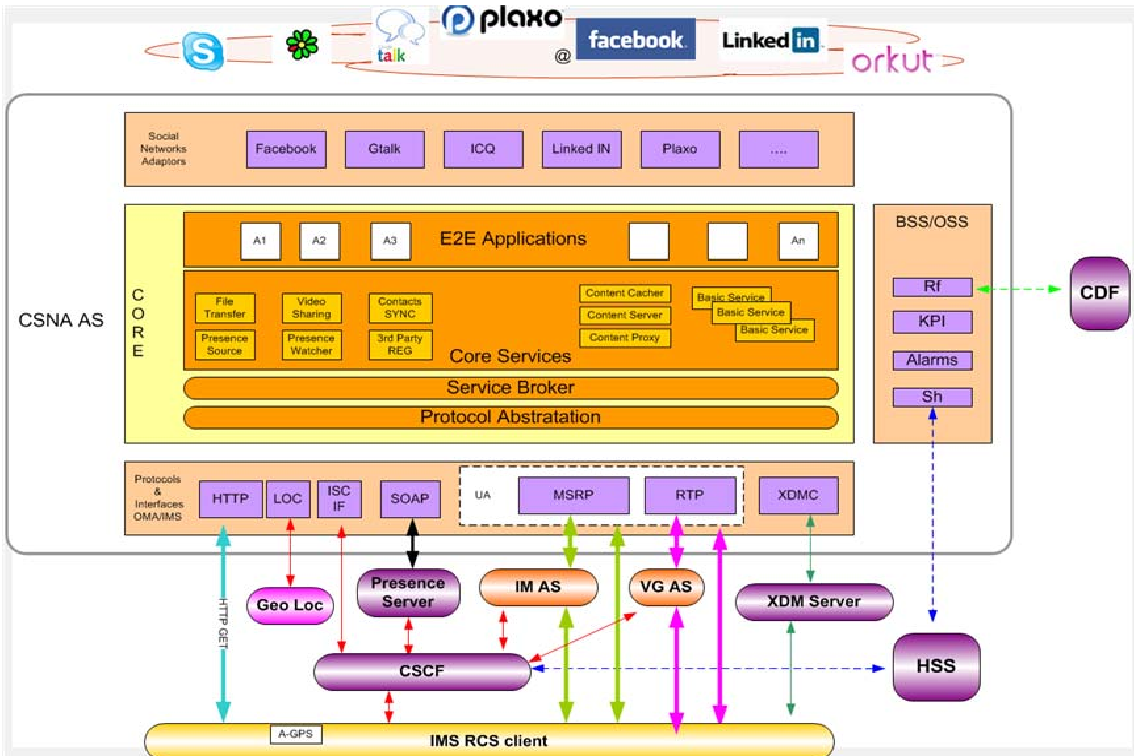
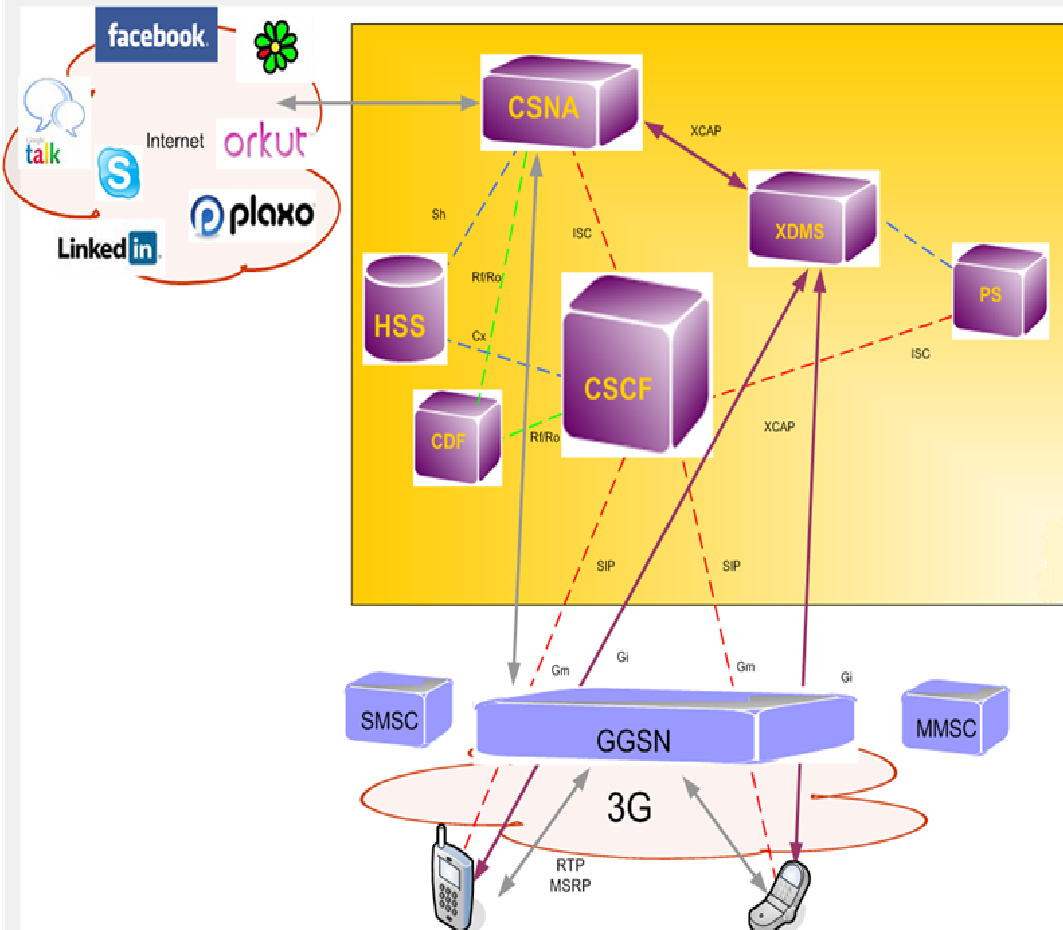
The CSNA is not just a client app; it is a sophisticated Application Server (AS) hosted within the IMS network. Its core logic resides in its ability to perform high-speed protocol conversion and identity mapping.
1. The Modular Framework
The architecture is built on five pillars:
- SIP Application: The brain that interprets RCS requests.
- XCAP & MSRP Adaptors: Connecting to IMS standard nodes (XDM/Presence) for list management and session-based media transfer.
- SN Adaptors: Pluggable modules for specific platforms. For example, the Facebook Adaptor translates MSRP (Telco) to XMPP or REST (Web).
2. Unified Presence & Contact Discovery
When a user registers via their mobile network, CSNA triggers a background synchronization. It pulls contacts from sources like LinkedIn and Facebook, merging them into the Network Address Book. This is achieved through OMA Presence standards, mapping social "moods" and "avatars" into Telco-compatible states.
Key Use Cases & Experimental Evidence
The paper outlines how CSNA facilitates a "single point of entry" for the user:
- Converged Social Feed: Seeing a friend’s Facebook status directly within the phone's native contact list.
- Protocol-Agnostic Chat: Sending a message from an RCS client that appears as a Gtalk IM.
- One-Shot Upload: Uploading a photo once and having the CSNA distribute it across multiple registered social platforms simultaneously.
Critical Insight & Conclusion
The CSNA framework represents a shift in Telco strategy: Evolution over Revolution. By positioning the operator as the anchor for all communication (both legacy and social), it addresses the "ARPU pressure" (Average Revenue Per User) directly.
Takeaway for the Future: The integration of RCS with Social Networks is the only viable path for Telco relevance. However, the authors rightly acknowledge the volatility of Social Network APIs as a major hurdle. For developers and architects, the lesson is clear: building a generic "Abstraction Layer" (like the SN Framework in CSNA) is essential to protect the core network from the fast-changing world of Web 2.0.
Limitations
- API Sensitivity: Frequent unannounced changes in Facebook or Google APIs can break adaptors.
- Policy Constraints: Commercial agreements between Telcos and SN operators remain a non-technical bottleneck.