
cTADA: Powering Dietary AI with Crowdsourced Precision Segmentation
cTADA: The Design of a Crowdsourcing Tool for Online Food Image Identification and Segmentation
The paper introduces cTADA, a specialized crowdsourcing tool designed for the large-scale collection and annotation of online food images. It bridges the gap between raw web-crawled data and high-quality training sets for automatic dietary assessment, enabling precise food item localization and GrabCut-based segmentation.
TL;DR
Accurate dietary assessment is a cornerstone of preventative healthcare, yet training AI to "see" what we eat requires massive, high-quality datasets. This paper presents cTADA, a custom crowdsourcing platform that transforms messy online food photos from Flickr and Google into a rigorous scientific dataset. By combining human intuition for "noise removal" with algorithmic precision for segmentation, the authors have built a pipeline that scales the creation of ground-truth data for food volume and nutrient estimation.
Background & Motivation: The Problem with "Food Porn"
In the realm of Computer Vision for health, more data isn't always better. The authors identify a critical "Domain Gap":
- The Aesthetic Trap: Online images are often "aesthetic"—perfectly lit, re-touched, and shot from creative angles. These differ fundamentally from the "natural" photos taken by patients in clinical studies.
- The Labeling Dilemma: Most datasets label "Pizza" as a single dish. However, for nutritional analysis, we need to segment the crust, the cheese, and the toppings separately to map them to nutrient databases like the USDA FNDDS.
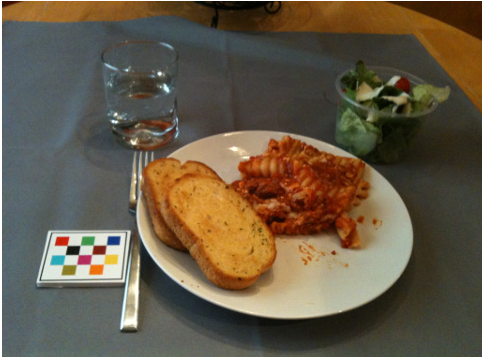 Figure 1: Comparison between naturalistic study images (left) and professional online "aesthetic" images (right) which cTADA filters out.
Methodology: Human-in-the-Loop Segmentation
The cTADA tool is built on three core pillars designed to maximize throughput while maintaining scientific rigour.
1. Systematic Noise Filtering
To handle the scale of tens of thousands of images, the authors implemented a high-speed interface. Users filter out watermarks, faces, and "overly professional" shots using keyboard shortcuts. This process averaged just one second per image, rapidly distilling 40,000 usable samples.
2. Hierarchical Annotation
Rather than free-form tagging, cTADA uses a hierarchical dropdown (e.g., Meats -> Poultry -> Chicken Breast). This ensures that every tag directly corresponds to a nutritional entry in the FNDDS database, making the dataset "nutrient-aware."
3. Interactive Segmentation (The GrabCut Edge)
The "How" of obtaining pixel-level masks is the paper's technical highlight. Instead of asking users to painstakingly trace edges (which is slow and error-prone), cTADA uses a semi-automatic approach:
- Bounding Box: The user drags a box around the food item.
- Strokes: The user draws a quick green line for "Foreground" and a red line for "Background."
- GrabCut Algorithm: The server uses these hints to run an iterative Graph Cut algorithm, snapping the mask to the food's actual edges.
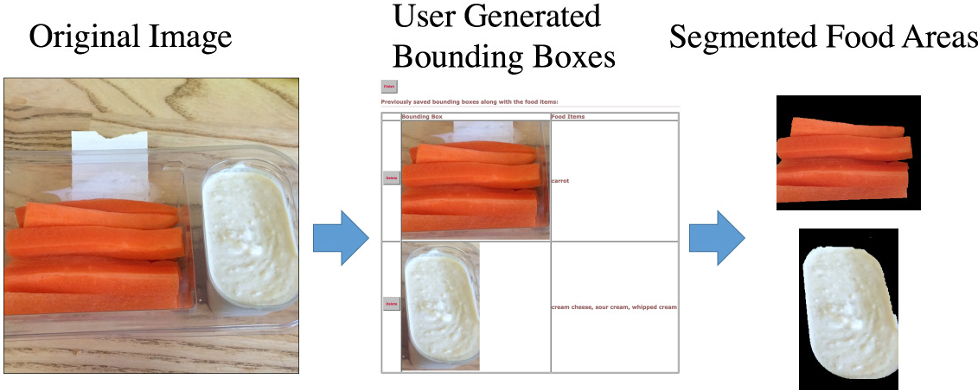 Figure 2: The process of drawing bounding boxes and using "strokes" to generate high-precision masks for multiple food items.
Experimental Results & Insights
By deploying cTADA to a pool of engineering students, the researchers demonstrated that:
- Scalability: The tool effectively managed the transition from a few thousand "in-lab" images to a massive 40,000+ image repository.
- Multi-Item Logic: The system handles complex plates with multiple ingredients by allowing iterative "Add Item" flows, generating separate masks and labels for every component on a plate.
- Efficiency: The combination of human filtering and GrabCut drastically reduced the "man-hours" required compared to manual polygon annotation (like those used in ImageNet or COCO).
Critical Analysis & Takeaways
The genius of cTADA lies in its Inductive Bias toward clinical utility. By explicitly defining what "noise" looks like in a nutritional context (i.e., professional photography), the authors ensure that the models trained on this data will perform better on the messy, poorly-lit photos actually taken by users in their daily lives.
Limitations: The authors admit that "unintentional mistakes" still happen during the high-speed filtering phase. Future iterations could benefit from Active Learning, where the model identifies which images it is most "confused" by and prioritizes those for human review.
Conclusion
cTADA represents a vital infrastructure layer for the next generation of dietary AI. It proves that with the right UI/UX design (shortcuts, hierarchical lists) and the right algorithmic assistance (GrabCut), we can turn the vast, chaotic landscape of the internet into a structured, labeled, and scientifically actionable dataset.