
CTMS-SIOT: Revolutionizing Trust in Social IoT via Contextual Intelligence
CTMS-SIOT: A context-based trust management system for the social Internet of Things
CTMS-SIOT is a centralized Trust Management System (TMS) designed for the Social Internet of Things (SIOT) that integrates context-awareness and Social Relationship modeling. It leverages a C4.5 Decision Tree for behavior prediction and the Jaccard Similarity Index to evaluate credibility, achieving a 91.5% classification accuracy in detecting malicious vs. honest nodes.
TL;DR
CTMS-SIOT is a breakthrough Trust Management System for the Social Internet of Things (SIOT) that addresses the static limitations of prior models. By combining context-aware Dirichlet distributions with C4.5 Decision Trees, it predicts node behavior with over 91% accuracy, ensuring that trust is not just a historical average but a dynamic reflection of current conditions.
Problem & Motivation: The Context Vacuum
In the Social IoT, devices (objects) are not just passive sensors; they are social entities with relationships (friendship, ownership, co-location). Existing Trust Management Systems (TMS) often suffer from "context blindness." They treat a node's trust score as a monolithic value.
However, a smart camera might be trustworthy when providing security footage to its owner (Ownership relationship) but potentially malicious when sharing data with a third-party application at night. The authors argue that without considering context (Time, Service Type, Capacity), trust evaluations remain unrealistic and vulnerable to sophisticated attacks like "On-off" malicious behavior.
Methodology: The Core Mechanics
The architecture of CTMS-SIOT is centralized to offload heavy computation from resource-constrained IoT devices to a robust Trust Server.
1. The Contextual Trust Module
Instead of simple binary success/failure rates, the system uses the Dirichlet distribution. This allows for a three-state evaluation: Success, Uncertain, and Failure.
- The Forgetting Factor (): To prevent malicious nodes from "banking" good reputation by behaving well initially and then attacking, the system introduces a decay constant. Recent interactions carry more weight than old ones.
2. Decision Tree Learning (Behavioral Prediction)
This is the system's "Brain." When a node has no history with another, the server uses a C4.5 Decision Tree to predict behavior. It looks at:
- Object Relationships: Is it an "Ownership" or "Social" link?
- Object Capacity: High-resource devices like smartphones generally pose higher risks than simple sensors.
- Context: Is it currently day or night? Is the service weight high or low?
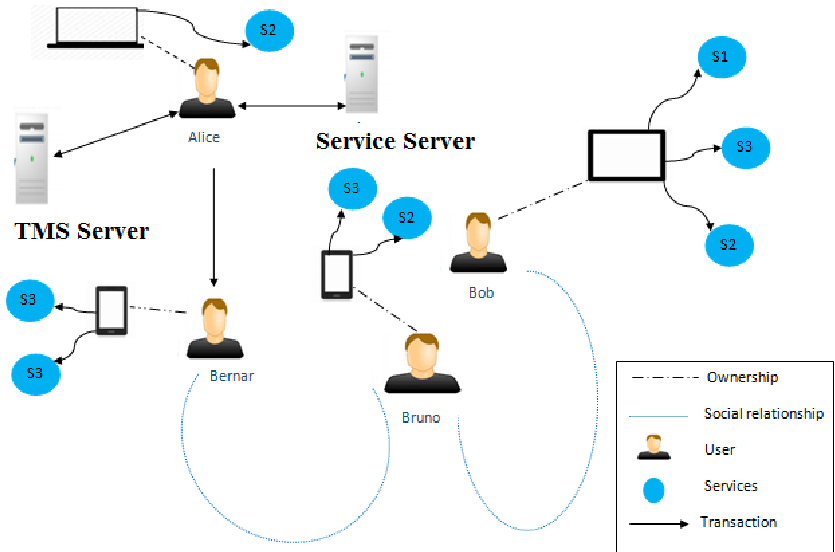 Figure 1: The centralized architecture showing the interaction between the Trust Server and SIOT objects.
3. Jaccard Similarity for Credibility
To ensure that recommendations are reliable, the system uses the Jaccard Similarity Index. It compares the Friendship-lists and Community-of-Interest (CoI) lists of the requester and the provider. High social similarity equals higher credibility for the predicted trust value.
Experiments & Results
The authors validated CTMS-SIOT using a simulated network of 100 objects.
- Classification Accuracy: The C4.5 algorithm achieved a 91.5% correct classification rate, significantly outperforming baseline models that do not account for context.
- Resilience to Attacks: By punishing failed transactions double () and utilizing the forgetting factor, the system rapidly depressed the trust values of malicious nodes.
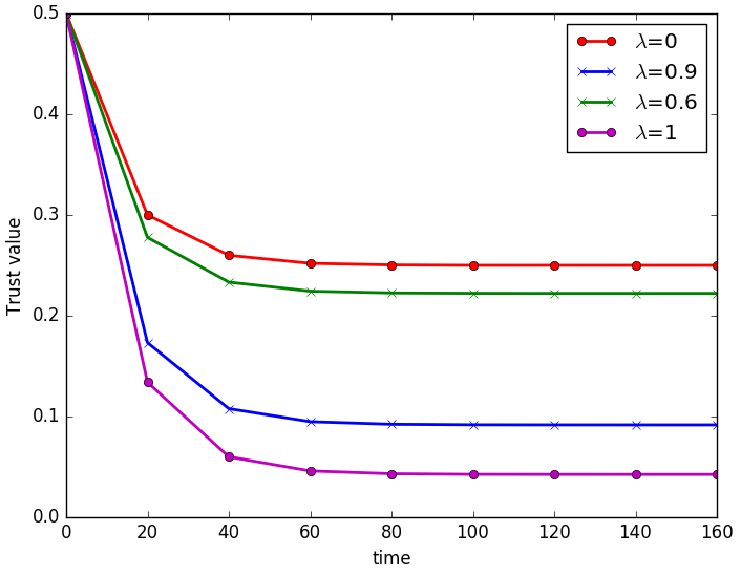 Figure 2: Analysis showing how trust values for malicious nodes drop sharply when recent bad behavior is prioritized.
| Metric | Value |
|---|---|
| Correctly Classified | 91.5% |
| Mean Absolute Error | 0.095% |
| Root Mean Squared Error | 0.232 |
Critical Analysis & Conclusion
CTMS-SIOT successfully bridges the gap between social networking and IoT security. Its primary contribution is the shift from reactive trust (based on history) to predictive trust (based on context and machine learning).
Limitations:
- Centralization: While necessary for resource-constrained devices, a centralized server is a single point of failure and a target for DDoS attacks.
- Dataset: The study uses simulated data; real-world SIOT datasets are still scarce and might introduce more noise.
Takeaway: This work highlights that trust in the future of IoT will be multi-faceted. We must stop asking "Is this device trustworthy?" and start asking "Is this device trustworthy for this specific service under these specific conditions?"