
Cuckoo: Decentralizing Microblogging through Socio-Aware P2P Networks
Cuckoo: Towards Decentralized, Socio-Aware Online Microblogging Services and Data Measurements
Cuckoo is a decentralized, socio-aware microblogging architecture designed to address the scalability and reliability limitations of centralized services like Twitter. It leverages the Pastry DHT for peer-to-peer (P2P) routing and incorporates a hybrid push/gossip mechanism for efficient data dissemination, effectively reducing server bandwidth costs and eliminating central points of failure.
TL;DR
Cuckoo is a hybrid, decentralized framework designed to offload the massive traffic of microblogging services (like Twitter) onto a Peer-to-Peer (P2P) overlay. By utilizing the inherent social structure of users—distinguishing between close friends, followers, and influencers—Cuckoo eliminates single points of failure and significantly reduces server-side bandwidth costs without requiring a total overhaul of existing service infrastructures.
Background: The Price of Centralization
Back in 2010, the "Fail Whale" was a common sight for Twitter users. Centralized architectures struggle with three core issues:
- Blind Polling: Millions of clients constantly refresh their feeds, wasting bandwidth even when no new updates exist.
- Scalability Walls: As user bases grow, the cost of maintainence and hardware grows non-linearly.
- Fragility: A single database maintenance error can paralyze global communication.
While Peer-to-Peer (P2P) systems seem like a natural fit, typical P2P designs (like those for file sharing) don't account for the unidirectional nature of microblogging (you follow a celebrity, but they don't follow you back) and the extreme churn of mobile users.
Methodology: The Socio-Aware Design
Cuckoo's "secret sauce" is its awareness of social relationships. It doesn't treat every node in the network as an equal; instead, it organizes them based on their social status.
1. Structured Overlay & Virtual Nodes
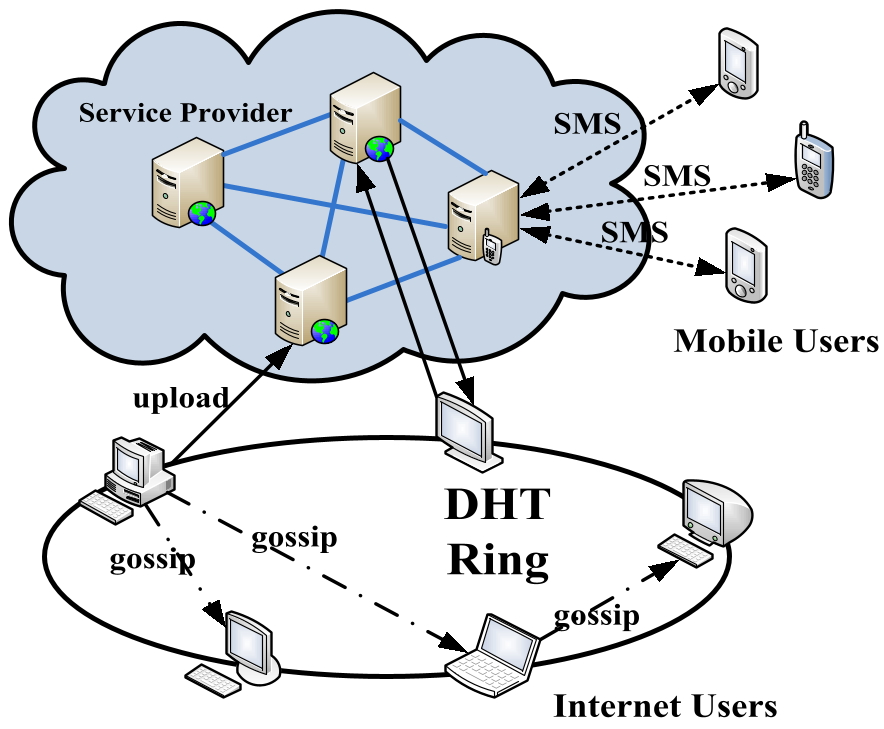
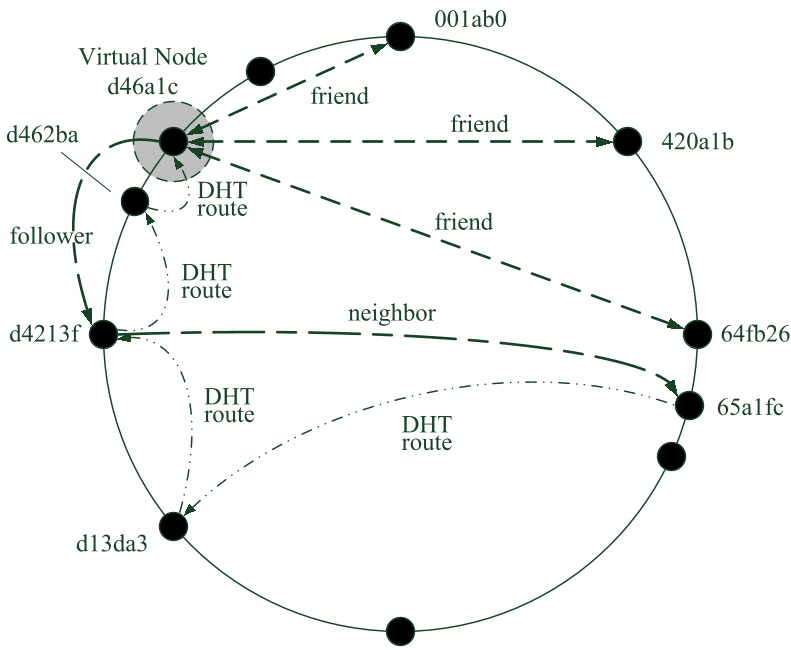
Cuckoo uses Pastry, a Distributed Hash Table (DHT), for routing. To solve the problem of node offline-ness (churn), Cuckoo introduces Virtual Nodes (VN). If a user is offline, their "Friends" (reciprocal links) act as proxies to store and serve their recent microblogs.
2. Hybrid Dissemination: DHT meets Gossip
One of the paper's key insights is that a "one-size-fits-all" routing strategy fails in social networks:
- For Normal Users: Data is pushed directly to followers or found via DHT lookup.
- For Influencers (Broadcasters): Since a celebrity cannot push to millions of peers simultaneously, Cuckoo uses Gossip-based Push. Users exchange updates with their "neighbors"—peers who follow the same accounts—creating an epidemic style of information spread that is highly resilient.
Experiments & Comparisons
The authors compared Cuckoo against several contemporary decentralized Social Network (OSN) designs:
| System | Target | Socio-Aware | Compatible | Struc. Overlay |
|---|---|---|---|---|
| Cuckoo | Microblogging | Yes | Yes | Yes |
| FETHR | Microblogging | No | No | No |
| PeerSoN | OSN | No | No | Yes |
Cuckoo stands out because it is Compatible. It doesn't try to "kill" Twitter; it aims to augment it. The centralized server remains as a "backup of last resort," ensuring that even if a P2P lookup fails, the data is never lost.
Critical Insight: Why This Matters
The shift from Pull (client asks server) to Push/Gossip (peers tell peers) represents a fundamental change in network efficiency. Cuckoo reduces the "sluggishness" of the web by allowing users to fetch content from geographically closer neighbors rather than a distant central data center.
Conclusion & Future Look
Cuckoo provided an early blueprint for what we now see in decentralized protocols like Mastodon or Nostr, although it leaned more on DHTs than modern gossip or relay-based protocols. Its focus on socio-awareness remains a vital lesson: distributed systems perform best when they mirror the real-world human connections they are built to serve.
Limitations: The 2010-era design primarily focused on desktop users. In today's mobile-first world, the high energy consumption of maintaining a DHT on a smartphone remains a significant hurdle that future iterations (Cuckoo 2.0?) would need to solve via "super-nodes" or more efficient wake-on-LAN strategies.