
Hybrid Cultural Algorithms: A New Frontier in Economic-Emission Load Dispatch
Solution to Economic – Emission Load Dispatch by Cultural Algorithm Combined With Local Search: Case Study
2018-01-01
Summary
Problem
Method
Results
Takeaways
Abstract
This paper presents a hybrid optimization approach for the Economic-Emission Load Dispatch (EELD) problem using a Cultural Algorithm (CA) combined with Simulated Annealing (SA) and Tabu Search (TS). The method aims to minimize both fuel costs and pollutant emissions while satisfying complex power demand constraints, achieving state-of-the-art results on a real 10-generator power plant and the IEEE 13-unit system.
## TL;DR
Modern power plant management is no longer just about the bottom line; environmental compliance is now a critical constraint. This paper introduces a high-performance optimization framework that fuses **Cultural Algorithms (CA)** with **Simulated Annealing (SA)** and **Tabu Search (TS)**. By leveraging dual-inheritance evolution and local exploitation, the authors achieved a staggering **50% reduction in emissions** and significant cost savings in real-world scenarios.
## The Multi-Objective Conflict: Cost vs. Environment
The Economic-Emission Load Dispatch (EELD) problem is a classic multi-objective tug-of-war. Minimizing fuel costs (quadratic function $F_1$) often leads to higher emissions (quadratic function $F_2$), and vice-versa.
Prior works using standard Genetic Algorithms or Particle Swarm Optimization often lack the "memory" to avoid redundant searches or the precision to fine-tune solutions near the global optimum. The challenge is exacerbated by real-world constraints: transmission losses (B-coefficients) and the physical limits of each generating unit.
## Methodology: Evolution with "Cultural Memory"
The core innovation lies in the **Belief Space** of the Cultural Algorithm. Unlike standard GAs, CA maintains a repository of knowledge that transcends individual generations:
1. **Situational Knowledge**: Remembers specific successful power configurations.
2. **Normative Knowledge**: Tracks the "safe ranges" for generator outputs.
3. **Topographic Knowledge**: A spatial map of the search landscape.
The authors' unique contribution is the **local search integration**. During the mutation phase, instead of a random jump, the algorithm employs SA or TS to "climb the hill" locally. If an area shows promise (the intersection of successful search zones), the Topographic knowledge assigns it a higher probability for future exploration.
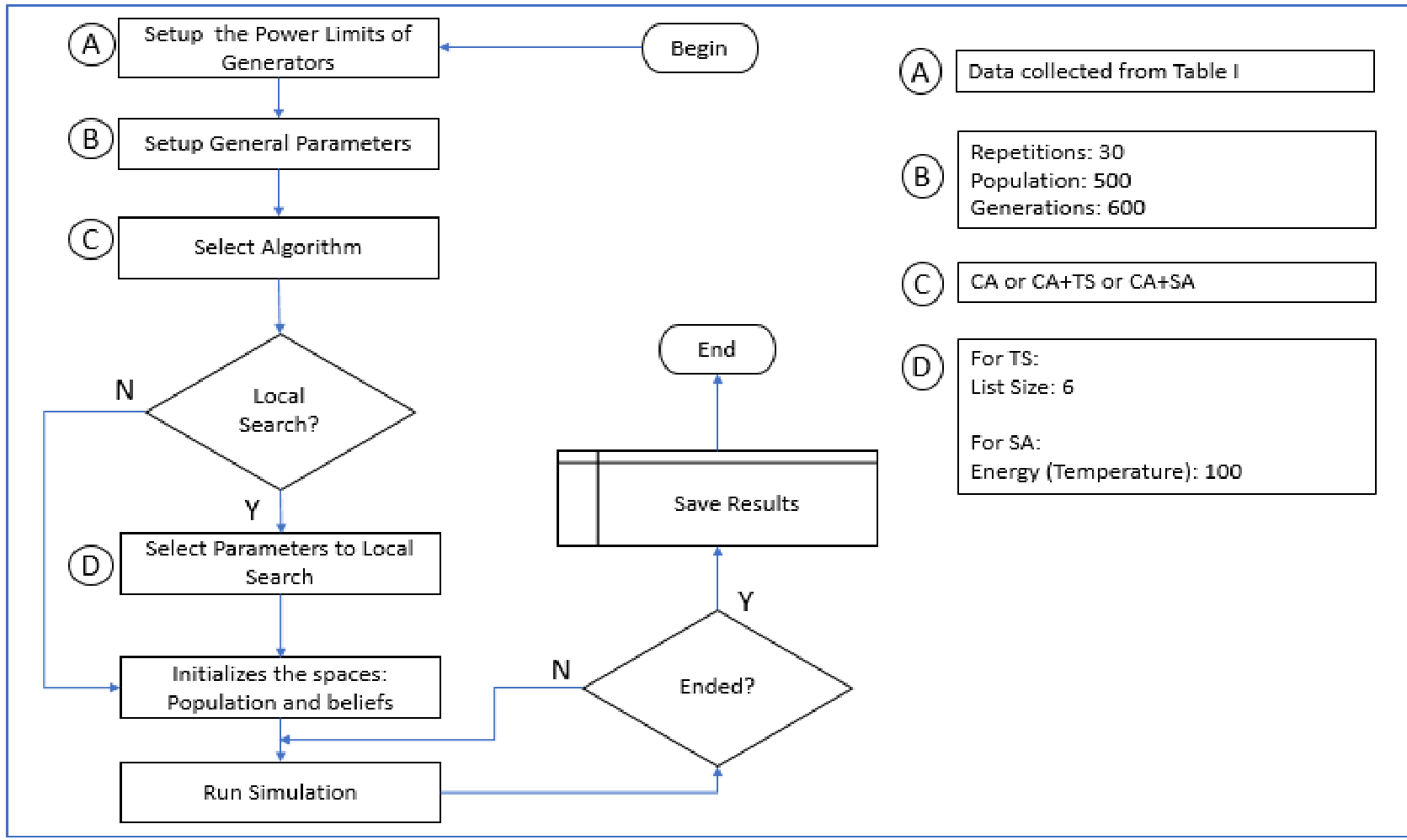
*Figure 1: The flowchart of the proposed Hybrid Cultural Algorithm Method.*
## Experimental Breakthroughs
The researchers tested their approach on two major benchmarks: a real 10-generator plant in Amazonas, Brazil, and the standard IEEE 13-unit system.
### 1. The Strategy of "Controlled Shutdown"
A pivotal finding was the "controlled operation" mode. By identifying and turning off generators with the highest incremental fuel costs while still meeting demand, the system achieved a **16.51% cost reduction** compared to baseline Simulated Annealing.
### 2. SOTA Comparison
In the IEEE 13-unit test, the **CA+TS (Tabu Search)** variant outperformed nearly every major heuristic in the literature, including Harmony Search (HS) and Differential Evolution (DE).
| Algorithm | Total Cost (USD/h) | Total Emissions (kg/h) |
| :--- | :--- | :--- |
| **CA+TS (Proposed)** | **24,046.34** | 27,655.95 |
| Improved Harmony Search | 24,164.32 | N/A |
| Grey Wolf Optimization | 24,202.16 | N/A |
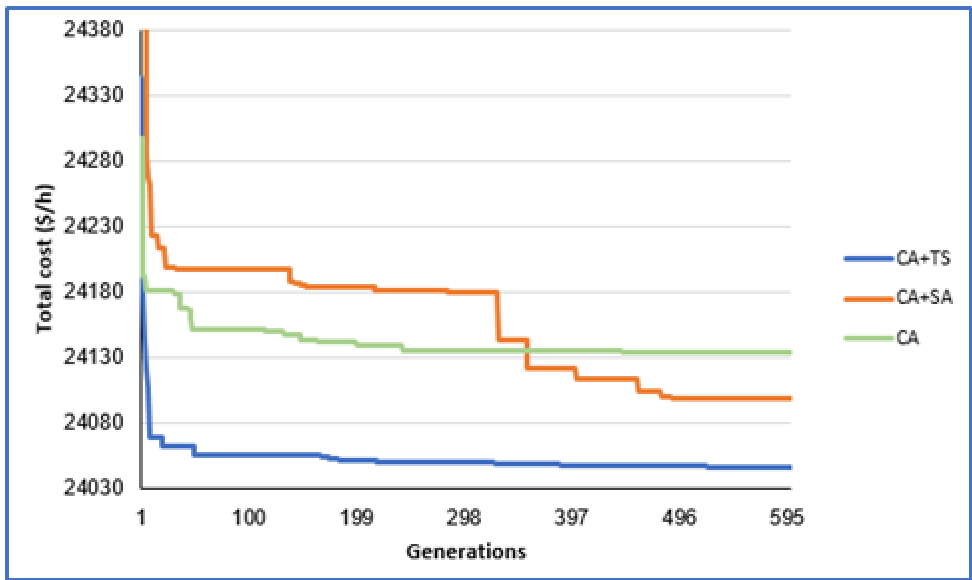
*Figure 2: Convergence characteristic curve showing the rapid and stable optimization of CA+TS.*
## Deep Insight: Why it Works
The success of this method boils down to **Exploitation vs. Exploration**. The Cultural Algorithm provides the "macro-evolution" to stay out of local traps (Exploration), while Simulated Annealing and Tabu Search provide the "micro-evolution" to polish the final output (Exploitation). The use of **Topographic intersections** acts as a heat-map, guiding the "culture" of the algorithm toward the most efficient generation patterns.
## Conclusion & Future Outlook
The paper proves that a hybrid memetic approach—combining social evolution with local heuristics—is remarkably effective for complex engineering constraints. While the results are impressive, future research could explore how these algorithms handle **dynamic load dispatch** where demand fluctuates minute-by-minute, or the integration of intermittent renewable sources like wind and solar, which add stochastic noise to the cost functions.
For plant managers, this isn't just theory; it's a blueprint for reducing the carbon footprint without breaking the bank.