
Cultural Communication 2.0: Bridging the Digital and Physical through Double-Layer Coupled Networks
Cultural communication in double-layer coupling social network based on association rules in big data
The paper proposes a two-layer coupled social network model to predict and analyze cultural information dissemination by integrating online and offline interactions. It utilizes CRF (Conditional Random Fields) for text segmentation and Association Rules for feature clustering, achieving a robust framework for link prediction in big data environments.
Executive Summary
TL;DR: This research addresses the inadequacy of single-layer social network analysis by proposing a two-layer coupled model that integrates online social platforms with offline real-world interactions. By leveraging CRF-based segmentation and Association Rules, the study quantifies how cultural information flows through shared nodes, revealing that the interplay between digital and physical realms significantly accelerates information dissemination.
Academic Positioning: This work sits at the intersection of Complex Network Theory and Natural Language Processing (NLP), moving beyond static topology into dynamic, multi-relational dissemination modeling (SOTA in multi-layer network simulation).
Problem & Motivation: The Single-Layer Fallacy
Most researchers analyze cultural spread as a purely digital phenomenon (e.g., just Twitter or Weibo). However, the author argues that humans are "multi-homed" nodes. We receive information at a lecture (offline) and share it via mobile devices (online).
The Pain Points:
- Dimensionality: Short social media texts are sparse, making traditional similarity metrics (Cosin Similarity) ineffective.
- Isolation: Prior models ignore the "feedback loop" where offline behavior influences online trends.
- Ethics & Privacy: High-speed dissemination in big data environments raises significant copyright and privacy concerns that require structured link prediction to manage.
Methodology: The Core Framework
The paper’s technical backbone consists of three primary components:
1. CRF-Driven Attribute Extraction
Instead of simple keyword matching, the author uses Conditional Random Fields (CRF) within a non-linear kernel-mapped subspace. This reduces feature dimensions while preserving the "trajectory" of cultural terms.
- Formula Insight: The model uses a weighted distribution to label cultural segments, effectively identifying organizational names and domain-specific terms.
2. Double-Layer Topology
The network is split into (Online) and (Offline). The "magic" happens at —the set of shared nodes (users active in both spheres).

3. Dissemination Law & Association Rules
By applying Hierarchical Clustering to feature words, the model identifies "clique cultures." The dissemination is modeled like an infectious disease, incorporating:
- Immune Nodes: Users who ignore specific cultural information.
- Self-Healing: The ability of a node to "forget" or stop spreading information after a time .
Experiments & Results: The Power of Coupling
The study utilizes the Sina Weibo dataset (4,296 nodes, 88,612 edges) to validate the model.
Key Findings:
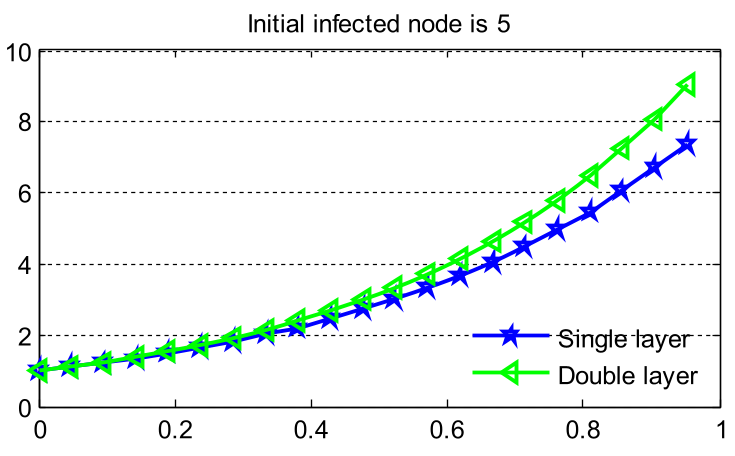
- Speed Advantage: In two-layer networks, cultural "infection" reaches saturation faster than in single-layer networks, provided the initial seed is small.
- The Immune Effect: As shown in the experimental plots, the presence of immune nodes creates a "buffer," where the infection rate stabilizes below 100%, preventing total "lyric culture" dominance.
- Dynamic Efficiency: The Incremental K-clique algorithm proposed shows a significant reduction in computation time compared to traditional methods as the network expands over time.
Critical Analysis & Conclusion
Takeaway: This research proves that cultural communication is not a vacuum. For marketers and policymakers, the "offline-to-online" pipeline is the most potent vector for rapid spread.
Limitations:
- Uniform Velocity: The model assumes all offline nodes move at the same speed, which is a significant simplification of human behavior.
- Parameter Scope: The simulation input ranges (e.g., self-healing time) are based on specific datasets and may not generalize to all cultural contexts.
Future Outlook: The next frontier involves assigning diverse velocities and "interest weights" to nodes to better simulate real-world heterogeneity. As we move further into the Big Data era, understanding these coupled layers will be vital for managing public opinion and protecting intellectual property.