
Harmonizing Social Noise: The Balanced Cultural Consensus Theory
Cultural Consensus Theory: Aggregating Signed Graphs under a Balance Constraint
This paper introduces a novel Cultural Consensus Theory (CCT) model for aggregating expert judgments on complete signed graphs. The core contribution is the integration of a structural balance constraint into the aggregation process, ensuring the consensus graph represents a binary partition of nodes despite individual expert errors.
TL;DR
Researchers have developed a new cognitive model that can extract a perfectly "balanced" social network from a group of experts, even when those experts are individually inconsistent, biased, or wrong. By embedding the mathematical constraint of Structural Balance directly into a Bayesian aggregation framework, the model filters out noise to reveal the underlying "two-faction" structure of a network.
Background: The Wisdom of Crowds meets Graph Theory
Cultural Consensus Theory (CCT) has long been the gold standard for "test theory without an answer key." It answers a fundamental question: If we don't know the truth, but we have 20 experts who do, how do we combine their answers to find that truth?
This paper pushes CCT into the realm of Signed Graphs—networks where the ties between people aren't just "there or not," but are either "Positive" (Friendship/Agreement) or "Negative" (Enmity/Disagreement).
The Problem: Human Inconsistency
In a "balanced" social network, the world is divided into two factions. Within a faction, everyone likes each other; between factions, everyone dislikes each other. This is the "Structural Balance" property.
However, human experts are messy. When asked to judge the relationships in a group:
- Expert A might forget that Bob and Charlie are friends.
- Expert B might have a bias toward assuming everyone is friendly.
- Expert C might simply guess when they are unsure. As a result, if you just take the "average" of their answers, you often end up with an imbalanced, illogical mess that doesn't reflect how real social systems actually work.
Methodology: Building the Mathematical Guardrails
The authors solve this by treating the consensus truth not as a random collection of ties, but as a Partition Vector.
1. The Balance Constraint
Instead of allowing any of the possible graphs, the model only considers graphs that can be split into two sets (). This reduces the search space for "Truth" from billions of possibilities to just a few hundred (specifically ).
2. The Cognitive Model (Signal Detection)
The model assumes that when an expert looks at a tie, they either Detect the truth (with probability ) or they Guess (with bias ). To make this work across different people and items, they use a Rasch Model, where the probability of detection depends on:
- The expert's Ability ()
- The tie's Difficulty ()
3. Bayesian Inference via MCMC
Because the math for "balanced graphs" is discrete and non-linear, the authors designed a custom Markov Chain Monte Carlo (MCMC) sampler. This algorithm "walks" through the space of possible partitions, testing which ones best explain the observed expert data.
 Note: The formula above shows how the model calculates the probability of an expert's response based on whether the underlying tie (T) is positive or negative.
Experiments & Results: Finding the "Ground Truth"
The authors tested this on 19 students judging pairs of 10 athletes (split between Baseball and Basketball).
- The Result: The model identified the correct "Sports" partition with over 99.9% certainty.
- The Logic: Even though "516 out of 855" responses were marked as "don't know" or were incorrect, the collective intelligence—constrained by the rule of balance—filtered out the noise.
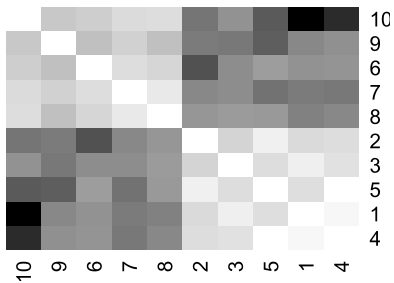 Visualizing the posterior: The clear block-diagonal structure shows the emergence of two distinct factions (the "two-set" structure) from noisy data.
Critical Insight: Why This Matters
The most striking takeaway is that none of the experts were perfectly balanced, yet the consensus was.
This proves that "The Wisdom of Crowds" is most powerful when we give the crowd a logical framework. By telling the computer, "I know the answer must be balanced," we allow it to look past the individual errors of experts and see the structural logic they were trying to describe.
Limitations & Future Work
- Beyond Two Factions: Currently, the model assumes only two groups. In the real world, we often have multiple "clusters."
- Complete Graphs: The model assumes every person knows something about every tie. Future iterations will need to handle "missing data" more robustly.
Conclusion
This work provides a sophisticated bridge between psychometrics (how we measure minds) and graph theory (how we measure networks). It offers a blueprint for any system that needs to aggregate human judgments where the final output must satisfy a rigorous logical or physical constraint.