
Cultural Considerations in Learning Analytics: Beyond the Universal Learner
Cultural considerations in learning analytics
2011-02-27
Summary
Problem
Method
Results
Takeaways
Abstract
This paper investigates the critical role of culture within the field of Learning Analytics (LA), integrating empirical findings from social behavior, communication, and cognitive psychology. It proposes a framework for designing "culturally responsive" technology-enhanced learning environments by moving beyond mono-cultural design assumptions.
## TL;DR
Most Learning Analytics (LA) systems are built on an unstated assumption: that all learners think, communicate, and interact with technology in the same way. Ravi Vatrapu’s research challenges this "universalist" bias. By synthesizing sociology and cognitive science, the paper argues that culture is a "collective programming of the mind" that fundamentally alters how students use learning tools and interact with peers.
## Motivation: The Blind Spot of Modern EdTech
The problem with current SOTA learning environments is their **geographic and cultural insularity**. Most platforms are developed in the West, inheriting Western values like low power distance (questioning the teacher) and individualism. When these systems are deployed globally, they often fail to account for:
* **Conflict Avoidance**: In collectivist cultures, "face-saving" is more important than the "socio-cognitive conflict" required for Western-style collaborative learning.
* **Deference to Authority**: In high power-distance cultures, students may never contradict a "scientist" or "expert" node in a digital knowledge map, even if the data suggests otherwise.
## Methodology: The Trinity of Cultural Influence
The paper breaks down cultural influence into three distinct layers that LA designers must measure and analyze:
### 1. Social Behavior (Hofstede’s Dimensions)
The paper highlights four key dimensions, most notably **Power Distance** and **Individualism vs. Collectivism**.
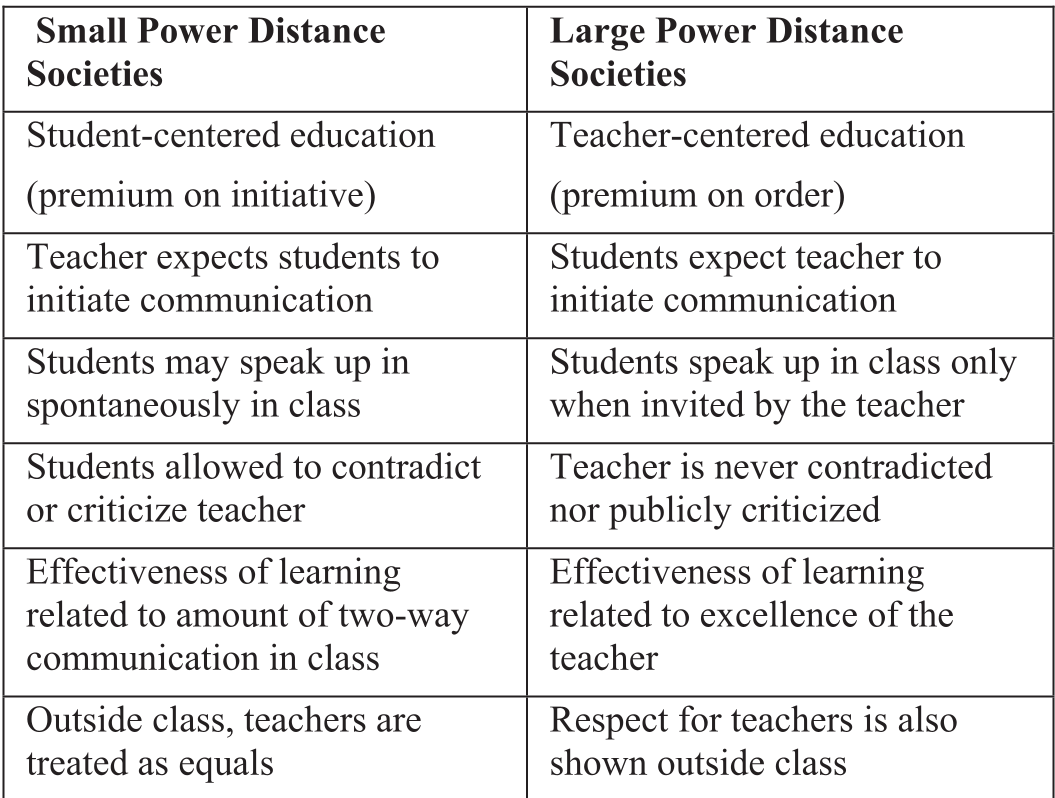
*Table: Differences in student-teacher interaction based on Power Distance.*
### 2. Communication Context (Hall's Theory)
* **High-Context**: Communication is implicit; a lot of meaning is stored in the social "context."
* **Low-Context**: Communication must be explicit and rational.
LA systems often rely on text mining; however, if a culture communicates through "silence" or "indirect hints," a standard NLP model will likely misinterpret their engagement level.
### 3. Cognitive Processes (Nisbett’s Findings)
One of the most profound insights is the **Object vs. Field** distinction.
* **Westerners**: Focus on discrete objects (the nodes).
* **East-Asians**: Focus on the whole field (the links and relationships).
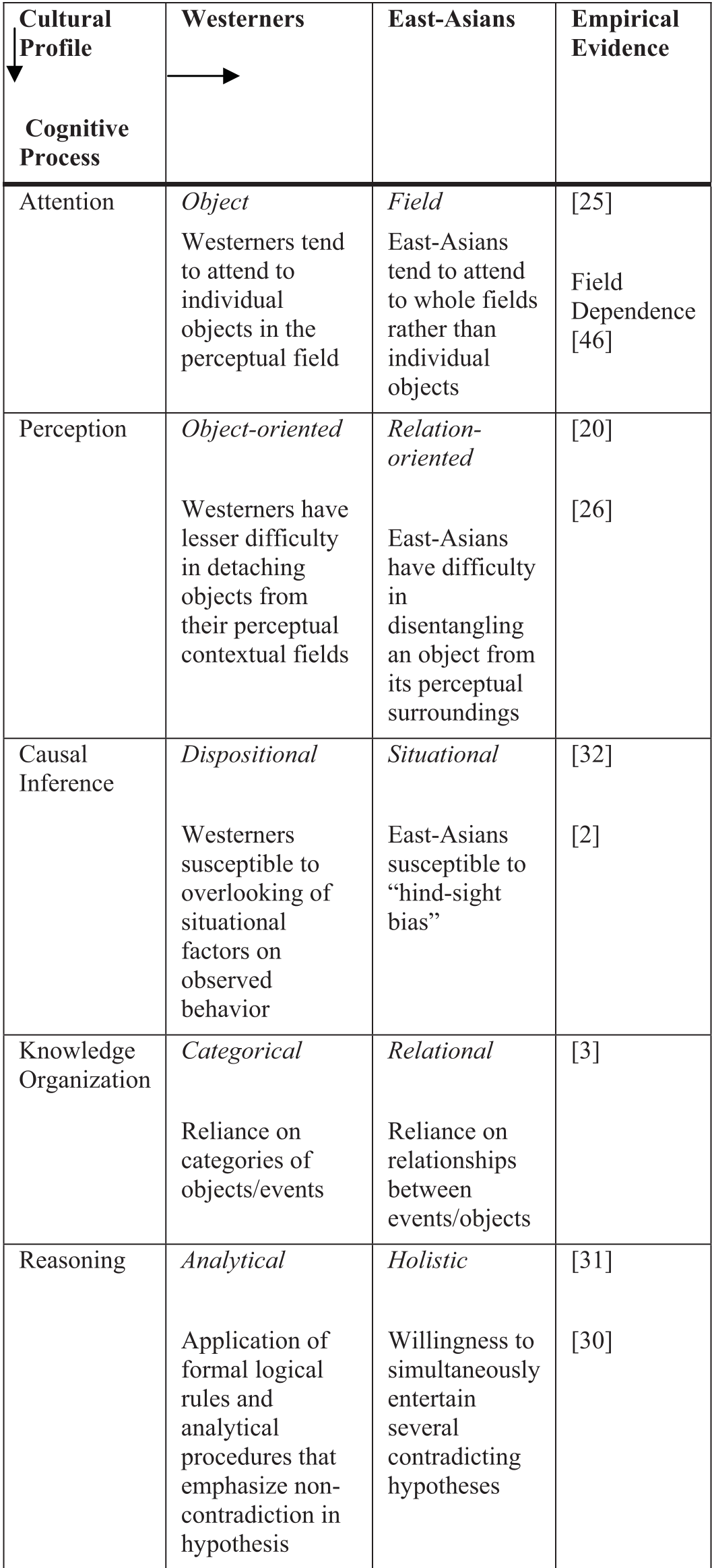
*Table: Summary of cognitive differences in Attention, Perception, and Reasoning.*
## Experimental Insights: Designing for Appropriation
The paper discusses a crucial hypothesis: if you give students a collaborative concept map tool:
* **Western learners** will likely reference and edit individual items (Object-oriented).
* **East-Asian learners** will likely reference whole regions or clusters of the map (Field-oriented).
If the LA system only tracks "individual node edits," it successfully captures Western learning but might **systematically penalize** Eastern styles of holistic knowledge building.
## Critical Analysis & Future Directions
The paper concludes that we need three types of future research in LA:
1. **Culture-specific**: Modeling the "habitus" of a single group.
2. **Culture-comparative**: Identifying gaps between distinct groups.
3. **Culture-interactional**: Studying the friction and synergy in *intercultural* groups.
### Limitations
While the paper provides a robust theoretical framework, it relies heavily on typologies (Hofstede) which some modern sociologists argue can lead to over-generalization or "essentialism." Future LA must balance these broad cultural categories with the unique, idiosyncratic biography of the individual learner.
## Takeaway
Learning Analytics is not just about "data"; it is about "context." To build truly intelligent systems, we must stop treating culture as a "noise" variable to be controlled and start treating it as the "operating system" through which all learning occurs.