
Digital Collectivism vs. Virtual Individualism: Why Culture Trumps Personality in SNS Use
Cultural differences in social networking site use: A comparative study of China and the United States
This comparative study investigates Social Networking Site (SNS) usage patterns between Chinese (collectivistic) and American (individualistic) college students. Utilizing survey data from over 890 participants, it identifies significant cultural divergences in time investment, user motives, and the predictive power of personality traits on digital behavior.
TL;DR
Is your Facebook or Renren profile a reflection of who you are, or where you come from? This study explores how the cultural divide between China (collectivistic) and the US (individualistic) dictates social networking habits. It finds that while Americans use SNS for self-promotion and vast, "loose" networks, Chinese users prioritize real-world family ties, leading to less time spent online.
The Core Conflict: Why Do We Log On?
The study is rooted in the Uses and Gratifications Theory, which suggests users select media to satisfy specific needs. However, these "needs" are not universal.
- In the US (Individualism): The focus is on the Self. SNS is a stage for self-promotion and maintaining large numbers of low-stakes friendships.
- In China (Collectivism): The focus is on the Group. Social needs are traditionally satisfied through intense, enduring real-world relationships (family and close circles), making the virtual world a secondary, often "recreational" space that may conflict with values of hard work and modesty.
Methodology: A Bridge Across the Pacific
The researchers compared 401 students from Southwest University (China) and 491 from a Midwestern US university. They measured:
- SNS Use: Time spent, importance, and number of friends.
- Psychological Profile: The Big Five (Extraversion, Neuroticism, etc.), Loneliness, Shyness, and Life Satisfaction.
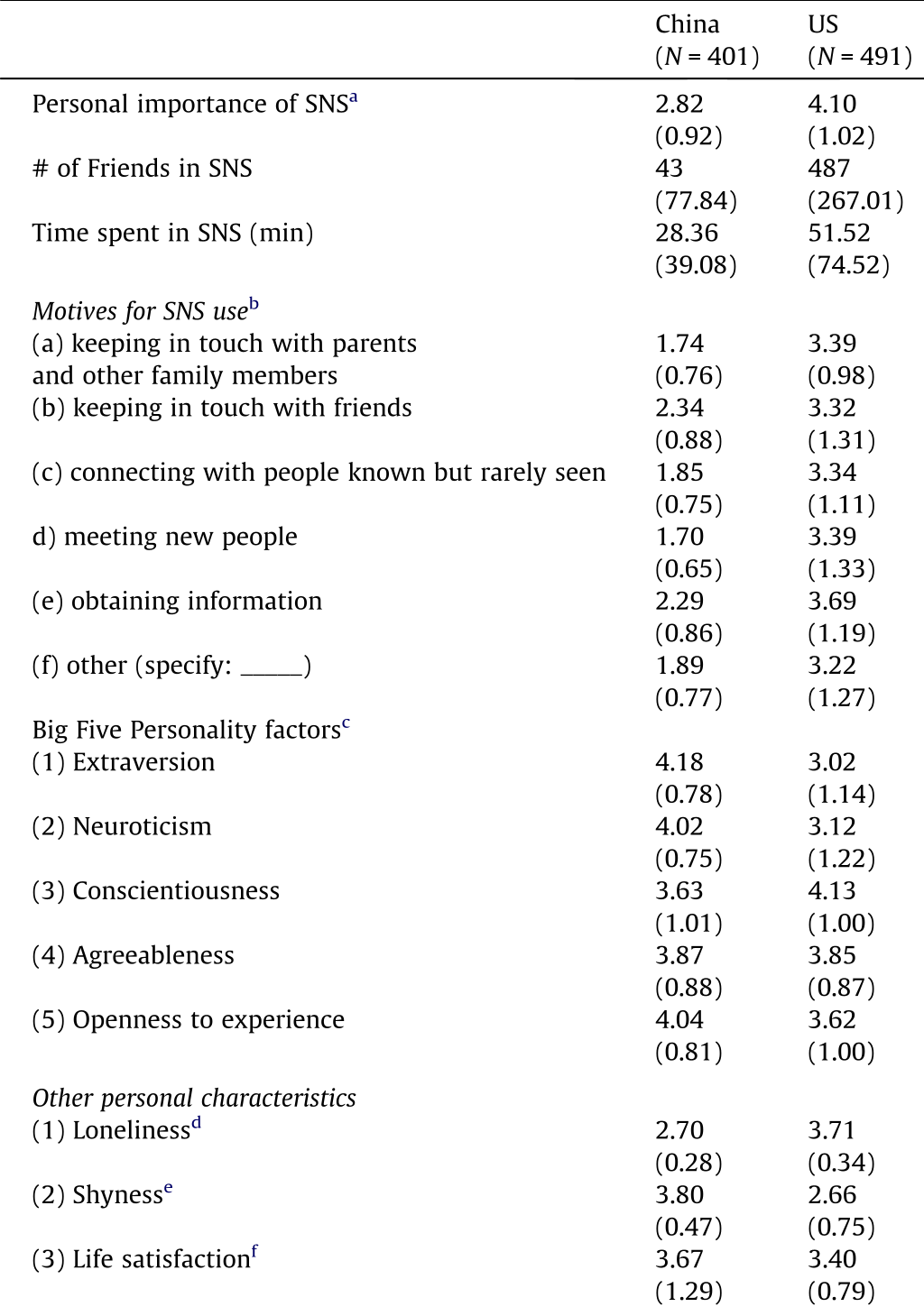
Key Insights: The Data Speaks
The findings reveal a massive disparity in digital social capital. The average US student claimed nearly 11 times more friends than their Chinese counterpart (487 vs. 43).
1. Cultural Values vs. Personality
One of the study's most profound findings is that personality traits matter less in China. In the US, if you are an extrovert or lonely, we can predict your SNS behavior accurately. In China, cultural norms (like the emphasis on academic effort and parental monitoring) act as a "ceiling," making individual personality differences less relevant to how one uses technology.
2. The Parenting Factor
Chinese parenting, often described as strict but warm, emphasizes self-discipline and effort. As a result, recreational SNS use is frequently viewed as a distraction from achievement. In contrast, the US value for privacy and solitary activity allows adolescents more freedom to explore virtual spaces in the seclusion of their bedrooms.
3. Loneliness and Shyness
Interestingly, Chinese participants were found to be shyer but less lonely than US participants. This suggests that the dense social fabric of collectivistic society protects against loneliness, even if individuals feel socially anxious.
Methodology and Architecture of Behavior
The study architecture illustrates that SNS behavior is an output of a complex "Knowledge System" formed by national practices.
Experiments & Results: Cultural Superiority in Prediction
The regression models proved that:
- Agreeableness predicted friend-focused SNS use in China.
- Neuroticism and Conscientiousness were significant predictors for friend counts and importance in the US.
- Life Satisfaction was a strong driver for Chinese users; those more satisfied with life used SNS more efficiently to maintain existing family/friend ties.
Deep Insight: Is the Virtual World Truly "Borderless"?
The conclusion is a resounding No. The digital world is not a "blank slate" where we all behave the same. It is an extension of our of offline reality.
Takeaway for Tech Developers: Global products cannot assume universal motives. A platform designed for "self-promotion" (US style) may face friction in a culture that values "modesty and group-sharing" (China style).
Limitations & Future Work
The study’s data (collected around 2010-2013) captures the early boom of Facebook and Renren. Future research must address whether the rise of mobile-first, algorithm-driven platforms like TikTok has erased these cultural boundaries or simply created new ways for old values to manifest.