
Decoding Culture through the Screen: A Multimodal AI Analysis of Global TV Series
Cultural Differences Demonstrated by TV Series: A Cross-Cultural Analysis of Multimodal Features
This paper proposes an enhanced cross-cultural analysis method by extracting multimodal features (facial expressions, native textual subtitles, and audio) from American, Japanese, and Korean TV series. By combining 1656 features, the study achieves a 100% classification accuracy in identifying cultural origins using Random Forest and SVM models.
Executive Summary
TL;DR: Researchers from Tsinghua University developed an automated pipeline to analyze cultural differences by processing facial expressions, native subtitles, and audio signals from 90 American, Japanese, and Korean TV dramas. The system doesn't just "watch" TV; it maps the data against established sociological theories, achieving a perfect 100% classification accuracy.
Context: This work bridges the gap between traditional social sciences and modern machine learning. It moves cross-cultural research from subjective questionnaires to objective, data-driven multimodal signal processing.
The Problem: The "Translation Trap" in Social Science
Traditional cross-cultural studies often fall into the "translation trap." When a Japanese character says "I think..." (と思う), it often implies a polite, non-absolute opinion. A literal translation into Chinese or English might strip away this cultural nuance, making the speaker appear more assertive than intended. Furthermore, questionnaires are prone to "response bias," where members of certain cultures avoid extreme scores on a scale.
The authors argue that TV series are the perfect dataset—they are curated representations of a society’s social norms, daily habits, and emotional "display rules."
Methodology: The Multimodal Lens
The study extracted 1656 features across three distinct modalities:
- Textual (Verbal): Unlike prior work that used translated subtitles, this study used native scripts (English, Japanese, Korean) to analyze emotional frequency, pronoun usage (I vs. We), and part-of-speech distribution.
- Visual (Nonverbal): Utilizing facial expression recognition to track primary emotions (joy, sadness, etc.).
- Audio (Acoustic): Using the OpenSMILE toolkit to extract 1581 features including pitch, intensity, and loudness, which reflect the "emotionality" or "neutrality" of a culture's speech.
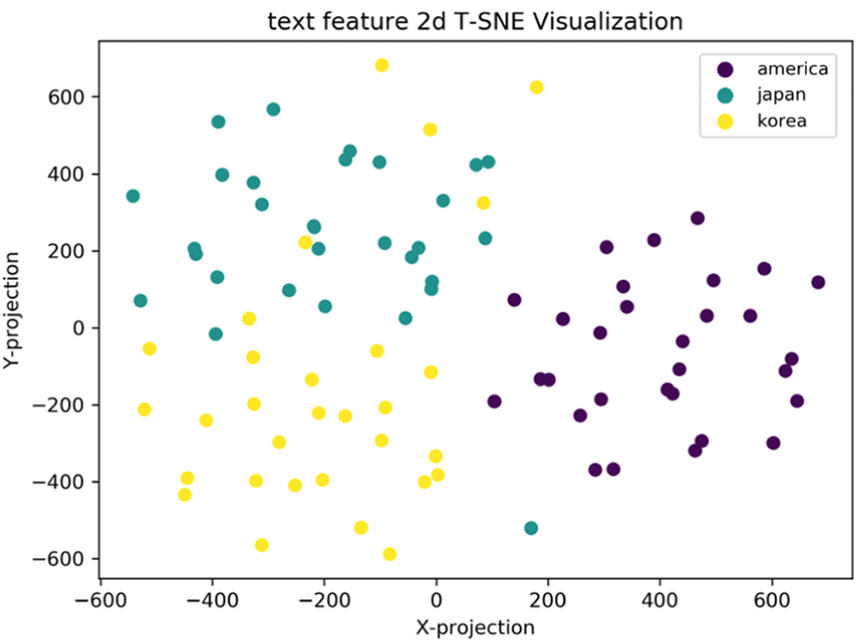 The T-SNE plot above clearly demonstrates how textual features alone can cluster dramas by their country of origin, highlighting distinct linguistic signatures.
Key Insights: Why AI Agrees with Sociology
1. High-Context vs. Low-Context Communication
The research utilized Hall's Theory to explain communicative differences.
- Japanese Dramas: Showed the highest ratio of nonverbal-to-verbal emotional expression. This aligns with "High-Context" cultures where much of the meaning is felt rather than said.
- American Dramas: Exhibited higher verbal emotional frequency and more direct word usage (approval/disapproval), typical of "Low-Context" cultures where information must be explicitly stated.
2. Emotional Display Rules
- Americans: Tend to highlight positive emotions (Joy, Surprise), reflecting an Independent Self-Construal where personal success is celebrated.
- Koreans: Showed a higher frequency of expressing negative emotions (Fear, Sadness, Anger) in scripts.
- Japanese: Were found to suppress verbal emotional expression more than the others, often relying on subtle facial cues—consistent with a "Neutral Culture" profile.
3. The Power of Personal Pronouns
Reflecting Hofstede's Individualism vs. Collectivism:
- American scripts had the highest frequency of personal pronouns (especially the singular "I").
- Korean and Japanese scripts used more plural pronouns ("We"), reinforcing the collectivist emphasis on the group over the individual.
Experimental Results
Using Random Forest and Support Vector Machines (SVM) with L1 regularization (to manage the high feature-to-sample ratio), the models achieved:
- 100% Accuracy in country classification.
- Feature Importance: Textual features (polarity and pronouns) were the most predictive, followed by specific audio markers like pitch contour (F0) and spectral frequency.
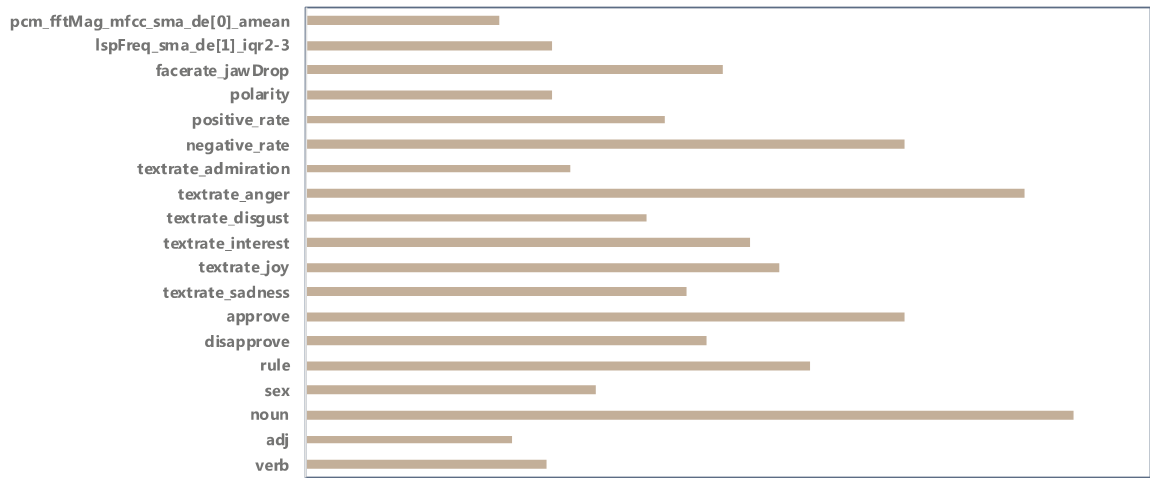 The chart above illustrates that textual polarity and word-rate were the heaviest hitters in the Random Forest model for distinguishing cultures.
Critical Insight & Conclusion
The true value of this paper lies in its validation of non-verbal vs. verbal ratios. By proving that AI can detect the "unspoken" (high-context) nature of Japanese communication through facial-to-textual discrepancies, the authors provide a template for future AI systems to understand cultural context.
Limitations: The study is limited by its dataset size (90 dramas) and the presence of background music in audio files, which can "pollute" the speech signals. Future work will likely involve unsupervised learning to disentangle actor voices from the cinematic environment.
The Takeaway: Next time you binge-watch a foreign series, remember that the "vibe" you're feeling is actually a measurable byproduct of deep-seated cultural dimensions—and AI can now measure it with 100% precision.