
Beyond Text: Decoding Cultural and Visual Cues in Hotel Rating Prediction
Cultural difference and visual information on hotel rating prediction
The paper introduces the CCU hotel dataset, focusing on hotel rating prediction by integrating heterogeneous data sources. It proposes a multimodal approach using Factorization Machines (FM) that incorporates cultural differences (nationality) and visual information (cover photos) to achieve SOTA performance in predicting specific and overall hotel ratings.
TL;DR
Why do Japanese travelers rate cleanliness differently than Russians? Does an "outdoor" cover photo actually predict higher location scores? This paper moves beyond traditional text-mining by introducing cultural backgrounds and visual semantic analysis into a Factorization Machine framework. The result is a staggering 83%+ improvement in rating prediction accuracy compared to basic collaborative filtering.
The "Hidden" Signals: Problem & Motivation
Most hotel recommender systems treat users as a homogeneous mass or rely solely on past ratings (User-Item Matrix). However, the authors argue that two massive dimensions are being ignored:
- Cultural Bias: A "4-star" experience in one culture might be a "3-star" in another.
- Visual First Impressions: Travelers are highly visual. The cover photo of a hotel sets expectations that directly influence subsequent ratings.
The challenge lies in the Sparsity Problem: most users only rate a handful of the millions of hotels available. To solve this, the authors moved from simple "what" analysis to "why" analysis by looking at the person's origin and the hotel's visual DNA.
Methodology: The Multimodal Fusion
The researchers extended the UIUC dataset to create the CCU hotel dataset, featuring 12,773 hotels and 1.3 million users. They employed a three-pronged approach:
1. Visual Feature Engineering
They didn't just use raw pixels. Instead, they extracted:
- Contextual Classification: Using AlexNet (CNN) to determine if a cover photo is Indoor (focused on comfort) or Outdoor (focused on location/prestige).
- Semantic Concepts: Detecting 33 specific concepts like "swimming pool," "bed," or "lobby" using VIREO-374 detectors.
2. Cultural Trend Mapping
By analyzing "Rating Trends" (the probability distribution of scores 1-5), they found fascinating insights:
- Japan: Extremely high standards for Cleanliness.
- Russia: Unique divergence in Check-in/Front Desk service ratings.
- US/UK: More likely to give "5" scores compared to European counterparts.
3. Factorization Machines (FM)
To handle the high-dimensional, sparse data, the authors used Factorization Machines. Unlike standard SVMs, FMs model the interaction between every variable (e.g., how "User Nationality" interacts with "Hotel Visual Concept").
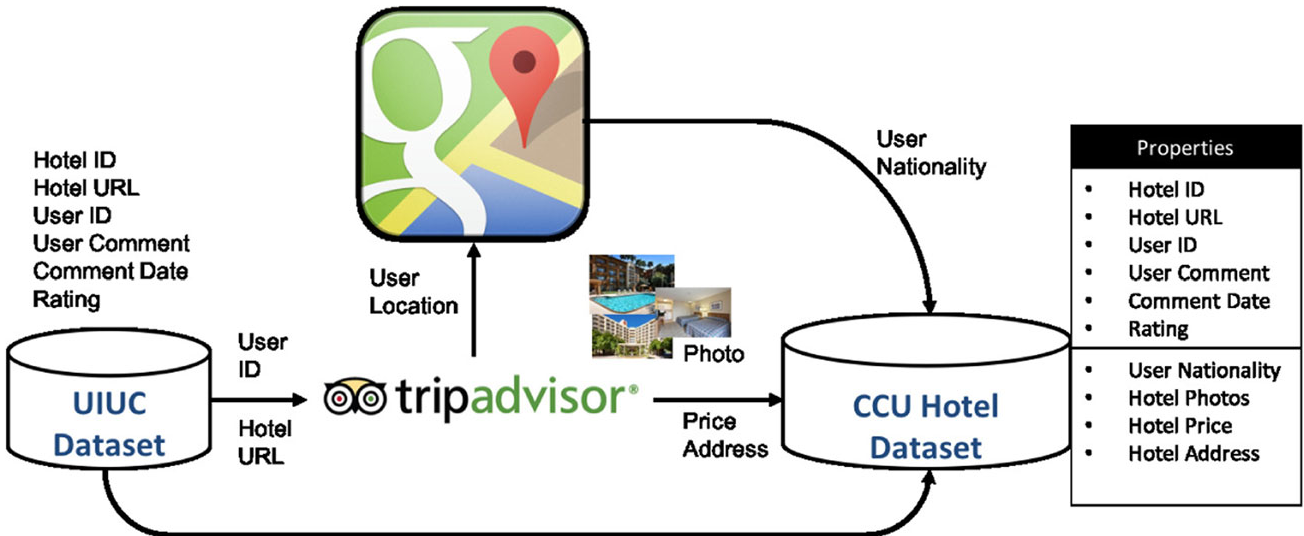 Figure: The data collection and analysis framework developed for the CCU dataset.
Experiments & Results: The Power of Multimodality
The integration of these features led to a massive boost in performance.
| Feature Combination | MAD | MSE (Lower is better) | Pearson Corr. |
|---|---|---|---|
| Basic (User + Hotel + Price) | 2.867 | 9.793 | 0.024 |
| Basic + Visual (xV) | 1.132 | 2.828 | 0.068 |
| Basic + Nationality (xN) | 1.230 | 2.325 | 0.166 |
| Full Model (Multimodal) | 0.821 | 1.132 | 0.373 |
The reduction in MSE from 9.79 to 1.13 proves that visual signals and nationality are not just "extra info"—they are primary drivers of user satisfaction.
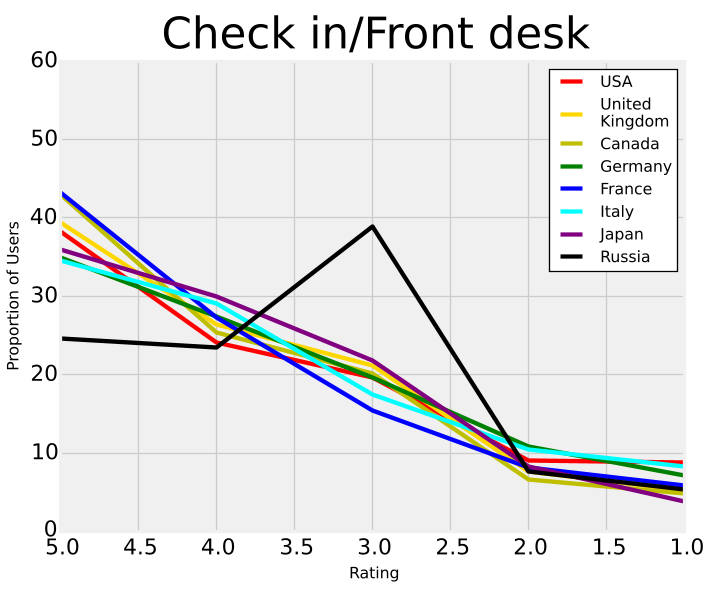 Figure: Visualizing the distinct "Rating Trends" across different G8 countries, highlighting the cultural influence on specific hotel aspects.
Critical Insight & Conclusion
This work provides two major takeaways for the industry:
- Visual Alignment: If a hotel has an "Outdoor" cover photo, users are statistically more likely to give higher Location ratings. Administrators can use this to align expectations with reality.
- Adaptive Personalization: Recommender systems should "de-bias" ratings based on the user's culture. A 4-star from a Russian traveler might be equivalent to a 5-star from a US traveler.
Limitations: The study relies on "Resident Country" as a proxy for nationality, which may introduce noise in a globalized world. Furthermore, the visual analysis was limited to cover photos; future work could leverage user-uploaded images for a more authentic "grounded" view of hotel quality.
Overall, this paper is a landmark in transition from Collaborative Filtering to Content-Aware Multimodal Prediction.