
Evolving Expertise: How Cultural Evolution and Ensemble Learning Conquer Optimization
8293_Cultural Evolution of Ensemble Learning for Problem Solving.
This paper proposes a novel framework that integrates Ensemble Learning into Cultural Algorithms (CA) to solve complex optimization problems. By treating the five distinct knowledge sources in the CA Belief Space as an ensemble of experts, the system evolves subcultures that collectively guide the population toward optimal solutions, achieving SOTA-level results in engineering design tasks.
TL;DR
The paper investigates the synergy between Cultural Algorithms (CA) and Ensemble Learning. By treating different types of symbolic knowledge (Normative, Situational, etc.) as a committee of experts, the authors developed a system that evolves "subcultures" within a population. This ensemble approach effectively mitigates the common pitfalls of single-classifier systems—bias and variance—and achieves rapid, robust convergence on difficult engineering constraints.
Background: The Limits of a Single Mind
In the landscape of optimization, we often rely on a single heuristic or a specific evolutionary strategy. However, as Thomas Dietterich famously noted, single classifiers suffer from three major issues:
- Statistical: Too many hypotheses fit the data equally well; we might pick the wrong one.
- Computational: Heuristics like gradient descent get stuck in local minima.
- Representational: The true solution might lie outside the reach of a single model's hypothesis space.
Ensemble Learning solves this by gathering a "committee" of experts. But how do we decide which experts to use and how they should interact? The authors turn to Cultural Evolution.
Methodology: The Cultural Ensemble Framework
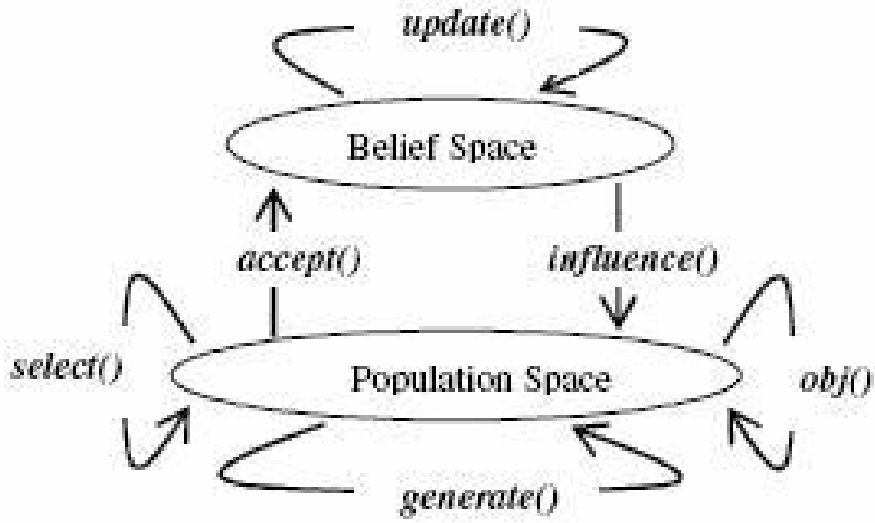
The core innovation lies in the Belief Space of the Cultural Algorithm. Instead of seeing the Belief Space as a simple database, this paper treats it as a dynamic ensemble.
The Five Experts
The ensemble is composed of five specialized knowledge sources:
- Normative: Defines "good" ranges for variables.
- Situational: Keeps track of specific exemplary cases (best solutions).
- Topographical: Reasons about the functional patterns of the landscape.
- Domain: Incorporates problem-specific constraints.
- Historical: Records significant moves and trajectory changes over time.
Subculture Dynamics
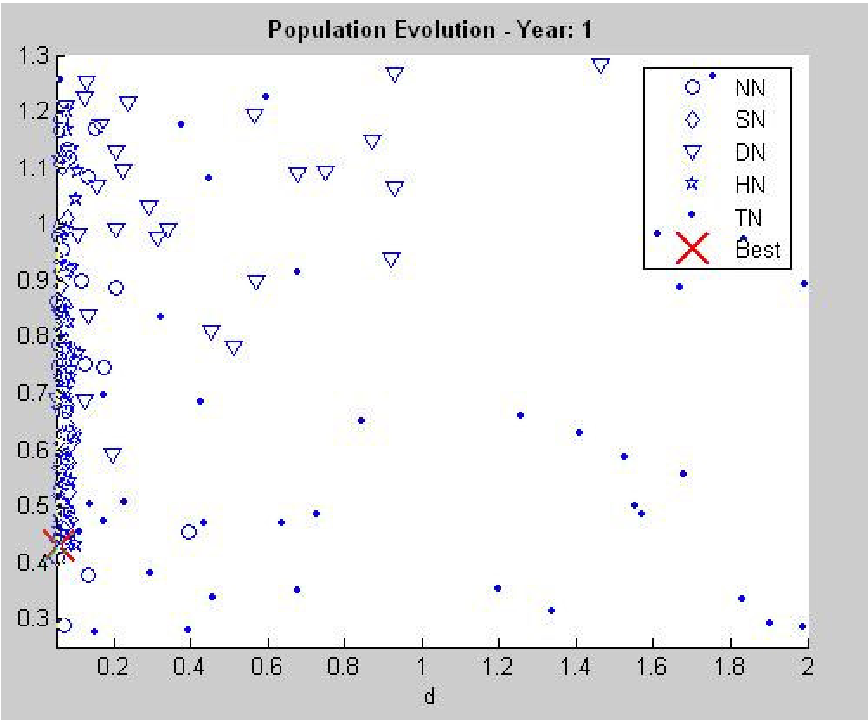
Each expert guides a subculture within the agent population. Unlike rigid systems, individuals here can migrate between subcultures using a "roulette wheel" selection based on the relative performance of the experts.
Experiments: The Spring Design Challenge
To test the "Cultural Ensemble," the authors chose a classic engineering benchmark: Tension/Compression Spring Weight Minimization. This problem is notoriously difficult because it involves three continuous variables and four non-linear constraints (shear stress, surge frequency, etc.).
Constraint Handling
The authors utilized a Penalty Function Method. If an individual violates a constraint, it is assigned a high "Un-Feasible" value. This forces the "Culture" to learn rapid survival strategies—essentially "teaching" the population to stay within the feasible region of the search space.
Performance and Visualization
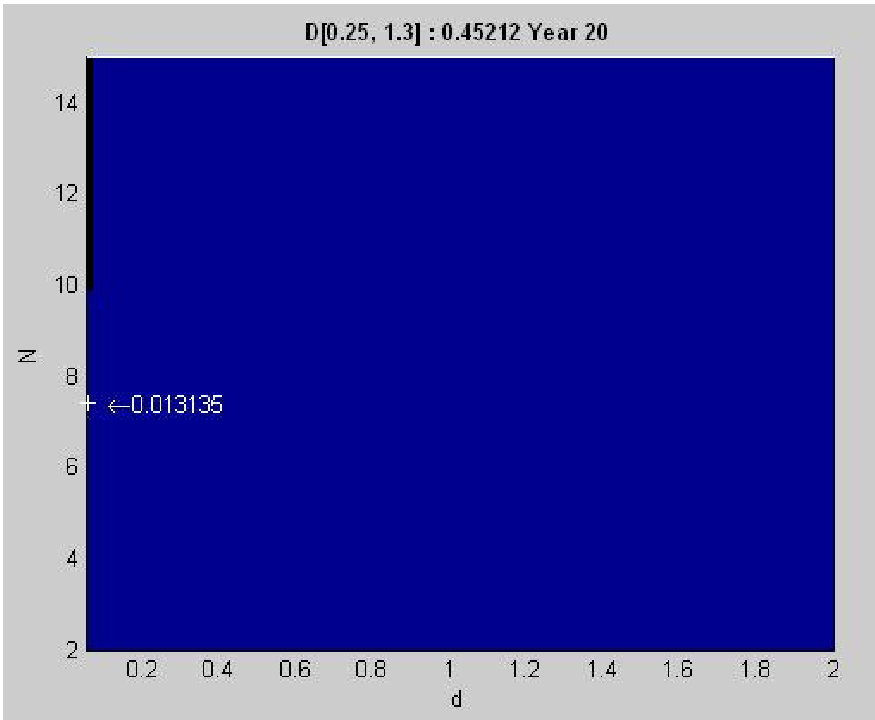
The results showed that different experts dominated different phases of the search. By generation 20, the ensemble had already pinpointed the high-performance regions of the manifold.
As seen in Table 1 above, the "Simplified Model" produced by this ensemble approach achieved a weight of 0.013077, which is remarkably close to highly specialized and computationally expensive SOTA methods like those by Hu et al. (0.01266) and Coello (0.01270).
Critical Analysis & Conclusion
The real value of this work is the verification that diversity in knowledge sources creates a natural "Inductive Bias" that helps evolutionary agents navigate "rugged" fitness landscapes.
Takeaways:
- Diversity is Key: An ensemble is only as good as its members' ability to make different types of mistakes. By using 5 distinct knowledge types, this CA ensures high diversity.
- Social Meta-Learning: This isn't just optimization; it is a form of social learning where the "culture" (Belief Space) learns which expert is currently most trustworthy.
Future Outlook: The authors suggest that the next step is a more complex Network of Subcultures, where experts don't just vote but actively negotiate and interact. This aligns with modern trends in Multi-Agent Reinforcement Learning (MARL) and hierarchical AI architectures.
Subject: Evolutionary Computation / Machine Learning
Key Terminology: Cultural Algorithms, Ensemble Learning, Constraint Optimization, Belief Space.