
Beyond Fact-Checking: How Cultural Heuristics Drive Rumor Acceptance in Crisis
Do I Prefer It?: The Role of Cultural Heuristics in Chinese Citizens' Atitudes to COVID-19 Rumors
This paper introduces the concept of Cultural Heuristics to explain how Chinese citizens' attitudes toward COVID-19 rumors are shaped by unique cultural and historical backgrounds. Utilizing Grounded Theory through semi-structured interviews, the study identifies that traditional medicine beliefs and collective memories (e.g., the 2003 SARS outbreak) fundamentally drive rumor acceptance and behavior.
TL;DR
In the hyper-connected era of social media, rumors spread faster than viruses. This paper argues that Chinese citizens don't just process rumors logically; they use Cultural Heuristics—subconscious mental shortcuts rooted in history and tradition—to judge credibility. Through a grounded theory study of COVID-19 rumors (like the "Shuanghuanglian" craze), the research demonstrates that cultural loyalty often trumps scientific evidence during public health emergencies.
Background: The Limits of Algorithmic Truth
Most rumor research focuses on what is said or how it spreads via AI algorithms. However, the human element—the "Why do I believe this?"—remains a black box, especially in non-Western contexts. The author positions this study at the intersection of Human-Computer Interaction (HCI) and Crisis Informatics, moving beyond technical detection to cultural cognition.
The Problem: Why Official Refutations Fail
The paper identifies a persistent gap: despite official media debunking rumors in real-time, collective behaviors (like panic buying) continue. The author suggests this is because traditional psychological models (stress, anxiety, uncertainty) don't fully capture the Inductive Bias provided by a thousand-year-old cultural background. For instance, the memory of the 2003 SARS outbreak serves as a "cultural template" for reacting to COVID-19.
Methodology: Listening to the "Cognitive Misers"
To explore these hidden drivers, the author employed Grounded Theory, a qualitative method used to build theory from data.
- Recruitment: 12 participants across diverse age groups (20-55).
- Process: Three-stage coding (Open, Axial, Selective) was used to extract categories like "Social Media for News," "TCM as a Heuristic," and "Collective Behavior."
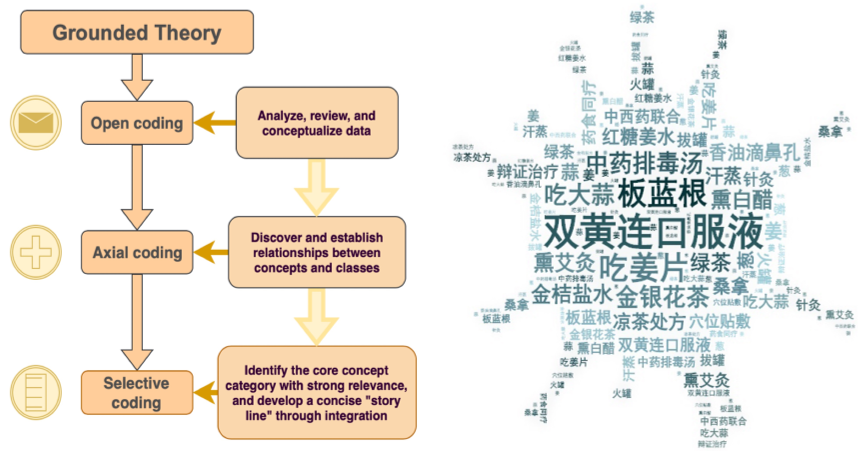 Figure 1: The qualitative workflow and the prevalence of traditional medicine keywords in social media discourse.
Key Insight: Traditional Medicine as a Shortcut
The most striking finding involves Traditional Chinese Medicine (TCM). When rumors suggested TCM could "inhibit" the virus, citizens didn't wait for clinical trials. They relied on a "Fast and Frugal" heuristic:
- Cultural Validity: "TCM is the essence of our culture; therefore, it must be useful."
- Experience-Based Trust: Personal success with TCM for minor ailments (like rhinitis) was extrapolated to global pandemics.
- Historical Echoes: The similarity to the SARS-era "Isatidis root" rush created a sense of "I've seen this before, and this is how we survived."
 Figure 2: The physical manifestation of cultural heuristics: citizens lining up at pharmacies despite digital refutations.
Deep Insight: The Power of the "Public Self"
The research confirms that Eastern cultures place high value on the Public Self. This leads to a strong "peer influence" effect. Even if an individual is skeptical, seeing friends and family buying herbal tea on platforms like JD.com (Figure 3) triggers a "Safety in Numbers" instinct, causing them to override their rational judgment to maintain pace with the collective.
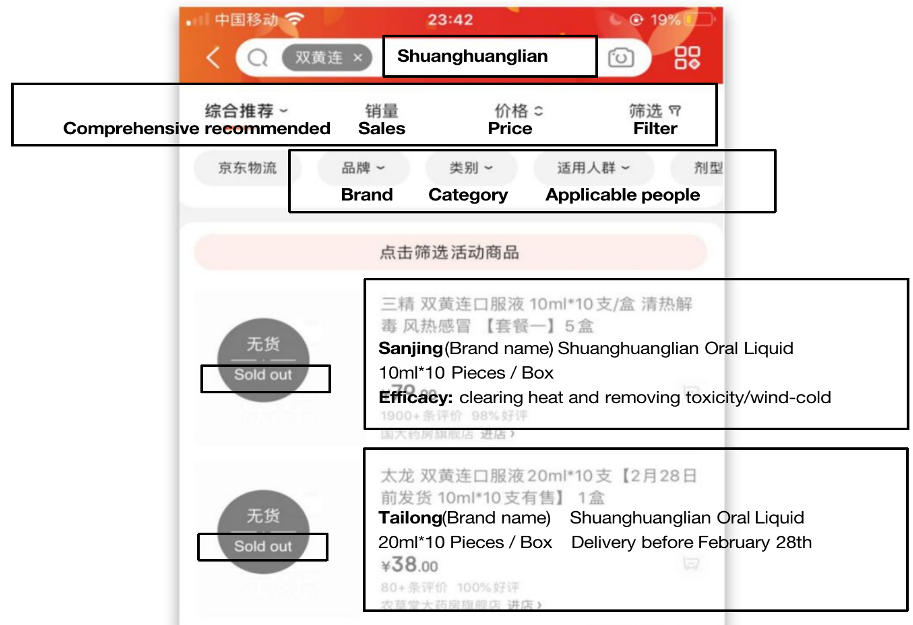 Figure 3: E-commerce platforms reflecting the rapid sell-out of TCM products based on social rumors.
Critical Analysis & Conclusion
Takeaway
The core contribution of this work is the formalization of Cultural Heuristics. It highlights that in crisis informatics, "Truth" is not just factual—it is culturally mediated. For HCI researchers, this means that designing "Fake News" warnings needs to be culturally sensitive to be effective.
Limitations
- Sample Size: With only 12 interviewees, the findings are deep but not statistically generalizable across the entire Chinese population.
- Age Bias: While the study included various ages, the intensity of "cultural loyalty" appears stronger in middle-aged and elderly groups, requiring more granular segmentation.
Future Work
This paper opens the door for "Cultural-Aware AI" in rumor management—systems that can identify whether a rumor activates a specific cultural heuristic and tailor the debunking message to address that specific cultural root rather than just providing a generic fact-check.