
Beyond the Bro-Culture: Data Mining the Androgynous Identity of CS Students
Cultural representations of gender among u. s. computer science undergraduates: statistical and data mining results
This paper investigates gender role perceptions among US Computer Science (CS) undergraduates using the Bem Sex Role Inventory (BSRI) and C4.5 data mining. It challenges the "masculine culture" stereotype by demonstrating that CS students are statistically more likely to endorse androgynous traits than those in non-computing disciplines.
TL;DR
Is the "masculine culture" of Computer Science (CS) a reality or a lingering stereotype? This study utilizes statistical modeling and the C4.5 data mining algorithm to analyze how 907 US undergraduates perceive their own gender roles. Contrary to popular belief, CS students—regardless of sex—exhibit higher levels of androgyny compared to their peers in other majors.
Background: Distinguishing Sex from Gender
For decades, the "shrinking pipeline" of women in computing has been blamed on a hostile, hyper-masculine environment. However, the authors of this paper argue that we must distinguish between biological sex and cultural gender roles. While CS is statistically "male-dominated," ascribing it a "masculine culture" assumes that the men in the field exclusively endorse masculine traits (like aggressiveness or self-reliance) while rejecting feminine ones (like sensitivity or gentleness).
Methodology: The Bem Sex Role Inventory (BSRI)
The researchers used a modified version of the BSRI, a psychological tool that classifies individuals into four categories:
- Masculine: High endorsement of masculine traits, low feminine.
- Feminine: High endorsement of feminine traits, low masculine.
- Androgynous: High endorsement of both sets of traits.
- Undifferentiated: Low endorsement of both.
The study specifically targeted a diverse demographic, sampling from both Historically Black Colleges and Universities (HBCUs) and Predominantly White Institutions (PWIs).
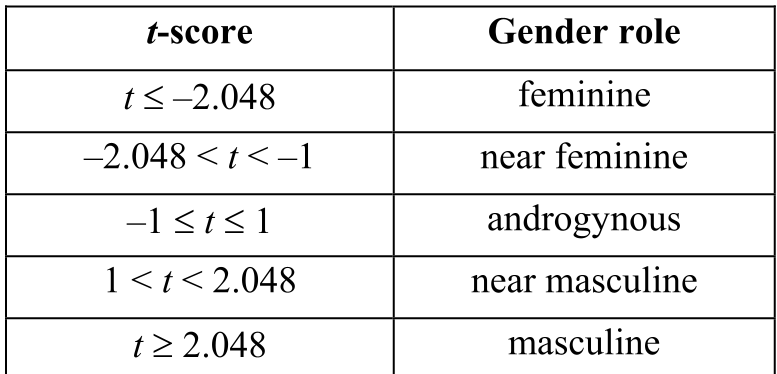 Table 1: The t-score classification system used to define gender roles in the study.
The "Androgyny" Surpise
The statistical results were striking. When comparing CS majors to Non-Computing Discipline (NCD) majors, the CS cohort was found to be significantly more androgynous.
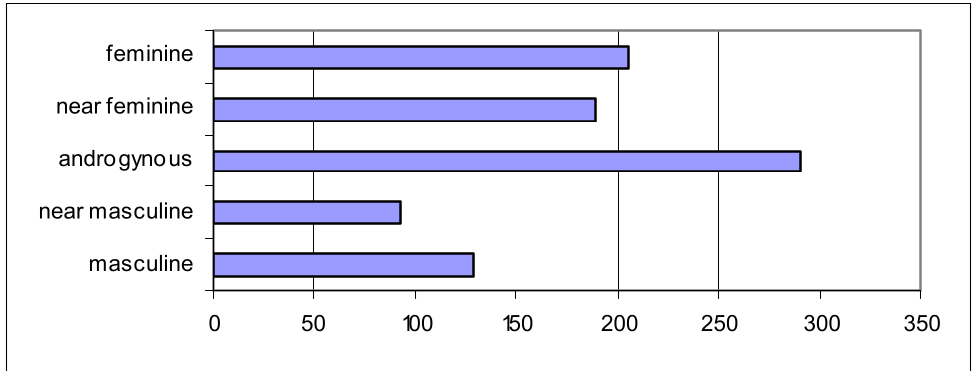 Figure 1: Frequencies showing that the androgynous group is the largest within the sample.
While males in the sample were generally more androgynous than females (who leaned closer to the feminine side of the scale), the CS group as a whole showed a stronger balance of personality traits. This suggests that the "hacker" or "geek" persona may actually be more flexible and less traditionally "macho" than external stereotypes suggest.
Data Mining: Predicting a CS Major
To go beyond simple averages, the team applied the C4.5 decision tree algorithm to identify which specific traits predicted a CS major. They found that traits often viewed as opposites actually coexist in successful CS students:
- Rule 1: If you are highly "Analytical" but only moderately "Affectionate," there is a 60.4% chance you are a CS major.
- Rule 4: A strong endorsement of "Loves Children," "Cheerful," and "Understanding" (traditionally feminine) combined with "Analytical," "Competitive," and "Self-reliant" (traditionally masculine) is a strong predictor for CS.
Critical Insight: The Culture vs. Composition Gap
The core takeaway is profound: CS has a composition problem (low number of women), but its internal culture may already be more inclusive of diverse gender roles than we think.
The prevailing image of the "anti-social, aggressive male coder" doesn't match the self-perception of the students actually in the labs. By highlighting that CS is a space where being "Analytical" and "Tender/Understanding" are not mutually exclusive, educators might be able to break down the psychological barriers that prevent women from entering the field.
Future Outlook
While this study provides a robust snapshot, it remains limited by its 2008 timeframe. As the "Silicon Valley" archetype has evolved and "Bro-culture" has become a more publicized critique, it is vital to see if these androgynous traits still hold true in the era of modern AI and Big Tech. Furthermore, expanding this research to include non-binary gender identities would provide a more complete picture of the current computing landscape.