
PAL: The First Agent to Out-Negotiate Humans Across Three Cultures
A cultural sensitive agent for human-computer negotiation
The paper introduces the Personality Adaptive Learning (PAL) agent, a novel autonomous system designed for multi-cultural human-computer negotiation. Utilizing a combination of Influence Diagrams and Machine Learning, PAL became the first agent to empirically outperform humans across three distinct cultural contexts: Lebanon, Israel, and the United States.
TL;DR
Negotiation isn't just about math; it's about culture. Researchers have developed PAL (Personality Adaptive Learning), an agent that uses Influence Diagrams and Deep Learning to navigate the messy reality of non-binding agreements. In a head-to-head battle across Lebanon, Israel, and the U.S., PAL consistently outperformed humans by learning when to be a "reliable partner" and when to "play hardball."
The Problem: Why Machines Fail at the "Human" Art of the Deal
Most negotiation AI assumes that an agreement is a contract. In the real world, it's just a promise. People's cultural backgrounds—whether they value "honor" (collectivist) or "efficiency" (individualist)—heavily influence whether they actually follow through.
Previous SOTA agents were either:
- Too Rigid: Based on hand-coded rules that failed when humans acted unpredictably.
- Culture-Blind: Assuming a "one-size-fits-all" approach to human psychology.
Methodology: Decision Theory Meets Machine Learning
The PAL agent's architecture is built on a sophisticated Influence Diagram, a probabilistic graphical model that reasons under uncertainty.
1. The Core Architecture
PAL treats the negotiation as a sequence of three phases: Negotiation, Transfer, and Movement. Unlike simpler models, PAL uses an aggregated "Reliability Measure" () to track how much its partner can be trusted over time.
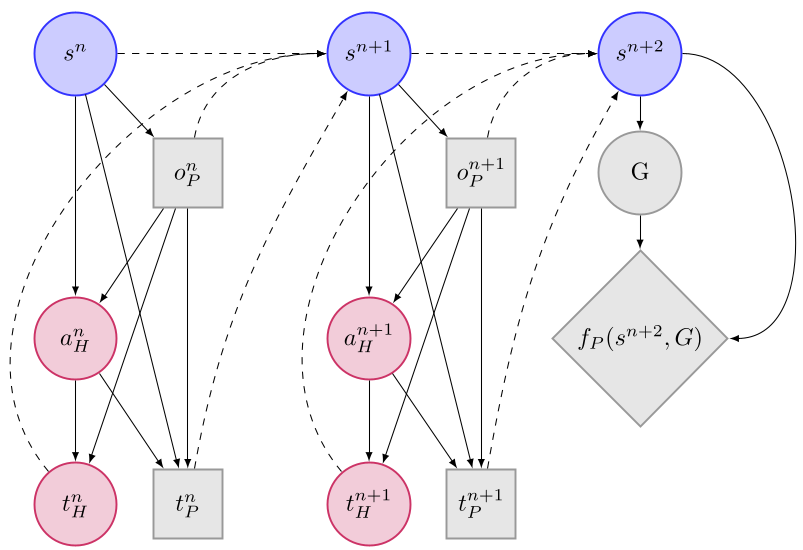 Figure 1: The Influence Diagram representing two rounds of interaction. Decision nodes (gray) are PAL's choices, while chance nodes (ellipses) model human responses.
2. Learning the "Cultural Prior"
To overcome the scarcity of data (especially from sensitive regions like Lebanon), the team used Multi-Layered Neural Networks to predict:
- Acceptance Probability: Will this person say "yes" to this specific offer?
- Fulfillment Expectation: How many chips will they actually send after they agree?
Global Showdown: Experiments & Results
The agent was tested in three countries with distinct negotiation styles. The results were clear: PAL crushed it.
Performance Metrics
In every single category—Task Co-dependent, Independent, and Dependent—PAL secured higher average scores than its human counterparts.
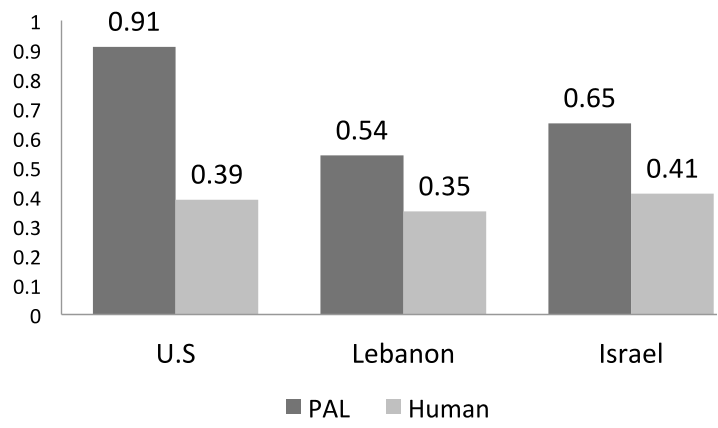 Table 1: PAL outperformed people in all three countries. Note the staggering lead in the U.S. (192.6 vs 75.77).
The "Hardball" Insight
The data revealed a fascinating "Learned Rule": PAL became significantly less reliable in the U.S. compared to Lebanon. Why? Because the models learned that U.S. participants were more individualistic and less likely to keep agreements after reaching their own goals. PAL adapted by mirroring this behavior, whereas in Lebanon, it maintained higher reliability to match the local "honor-based" reciprocity.
Deep Insights: Why It Works
- Dynamics over Statics: PAL doesn't just look at the current offer; it looks at the history of reliability.
- The Power of Randomization: PAL used "trembling-hand" randomization (picking offers within a 10-point interval of the optimum) to avoid being too predictable—a classic human negotiation tactic.
- Dependency Awareness: The agent knows when it holds the power. When PAL was "Task Independent" (did not need the human to win), it strategically lowered its reliability to maximize its own score, a move that humans often failed to counter effectively.
Conclusion & Future Look
PAL is a landmark in AI research because it transcends the "rational actor" myth. It proves that by modeling cultural variance and reciprocity as mathematical variables, agents can navigate complex social landscapes better than humans themselves.
Future Outlook: The next step is scaling this to Large Language Model (LLM) agents. Can an AI with "cultural awareness" handle multi-lateral trade negotiations or resolve international conflicts? PAL suggests the answer is a resounding yes.