
Decoding the Sound of Culture: A Pioneer Approach to Automatic Music Style Classification
Cultural style based music classification of audio signals
This paper presents a pioneer study on the automatic classification of music audio signals into six distinct cultural styles (Western, Chinese, Japanese, Indian, Arabic, and African). By integrating timbral, rhythmic, wavelet-based, and musicology-inspired features like chroma and chord contrast, the authors achieve a State-of-the-Art (SOTA) overall accuracy of 86.5% using a multi-class SVM.
TL;DR
Music is one of the most profound expressions of human culture, yet AI systems often struggle to distinguish between anything outside the "Western Genre" bubble. This paper introduces the first robust framework to automatically classify audio signals by cultural style (e.g., Arabic Folk vs. Japanese Traditional). By combining physical audio features (timbre) with musicological insights (tonal scales), the researchers achieved a 94%+ accuracy in distinguishing Western and Oriental music and an 86.5% overall accuracy across six global styles.
The Problem: The "World Music" Trap
In current Music Information Retrieval (MIR), non-Western traditions are often unfairly categorized into a monolithic "World Music" bin. This ignores the vast technical and cultural differences between, for example, the Indian Raag and Chinese Pentatonic scales.
Previous attempts at this classification largely relied on "symbolic data" (like MIDI files), which are easy for computers to read but hard to find in the real world. This paper moves the needle by analyzing raw audio signals directly, bridging the gap between Ethnomusicology and Machine Learning.
Methodology: Bridging Timbre and Musicology
The authors didn't just dump audio into a classifier; they engineered features that reflect how music is actually made across cultures.
1. Timbral Texture (The DNA of Instruments)
Culture is often defined by its instruments (the Sitar vs. the Cello). Features like Spectral Centroid and Subband Contrast were used to capture these unique sonic signatures.
2. Musicology-Based Features: The "Pentatonic" Advantage
One of the paper's most brilliant insights is using Chroma Distribution to identify musical scales.
- Western Music: Uses diatonic scales (7 notes), leading to a dispersed chroma distribution.
- Chinese Music: Uses pentatonic scales (5 notes), resulting in a much sharper, concentrated distribution.
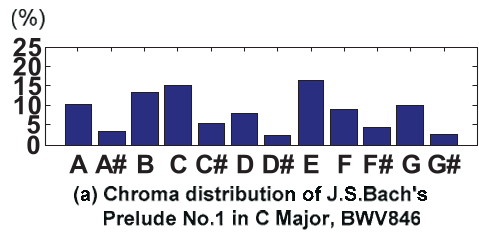 Fig 1. Comparison of Chroma distributions in Western (dispersed) vs. Chinese Traditional (concentrated) music.
The authors defined Chroma Contrast as a numerical way to separate these cultures, finding that Chinese music typically has nearly 3x the contrast of Western classical music.
Performance: Where AI Excels and Where it Struggles
Using a Multi-class Support Vector Machine (SVM), the results were highly promising.
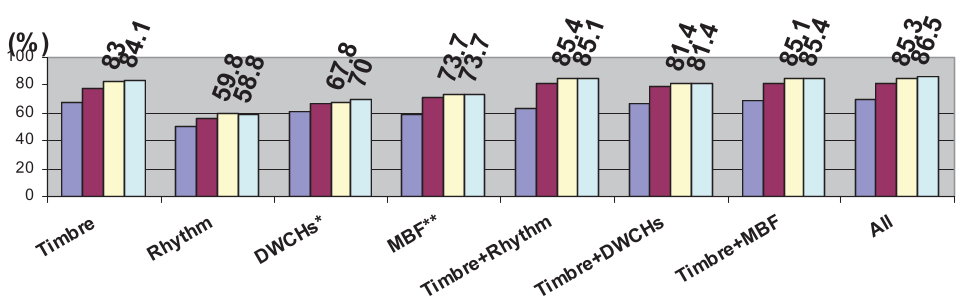 Fig 2. Accuracy Comparison across different feature sets and classifiers.
Key Findings:
- Timbre is King: Timbre features surprisingly provided the highest baseline (84.06%), proving that instrument choice is the strongest cultural signal in recorded audio.
- The Difficulty of Diversity: While Western, Chinese, and Japanese music were classified with near-perfection (94-98%), Arabic, African, and Indian styles showed more confusion. This is likely due to the massive internal diversity within these regions (e.g., North vs. South Indian traditions).
Critical Analysis & Looking Ahead
What makes this work effective? The integration of musicology-based features (Chroma/Chord contrast) provides a "physical intuition" that standard black-box models often lack. It proves that domain knowledge in Ethnomusicology can significantly reduce the search space for machine learning models.
The Road Ahead While impressive, the model is "flat"—it treats all features equally. The authors suggest a Hierarchical Framework for the future: first distinguishing broadly between East and West, then using more specialized filters for regional folk styles. Additionally, capturing "temporal sequences" (how notes follow one another) rather than just "histograms" (how often notes appear) will likely be the key to cracking the 90%+ barrier for all styles.
Conclusion
This research proves that "Culture" is not just a vague concept but a measurable set of acoustic patterns. By translating ethnomusicological principles into high-dimensional vectors, we are one step closer to recommendation systems that truly understand the global diversity of human sound.