
From Imitation to Instruction: Balancing Stability and Innovation in Cultural Evolution
A model of cultural transmission by direct instruction: An exercise on replication and extension
This research replicates and extends an agent-based model (ABM) of cultural transmission, originally developed by Acerbi and Parisi (2006). Utilizing artificial neural networks within a foraging environment, the study proposes a new "Direct Instruction" learning mechanism, demonstrating its significant impact on the emergence of adaptive traits compared to traditional imitation learning.
TL;DR
Is the way we teach as effective as the way we imitate? This study replicates a classic agent-based model of cultural evolution and extends it with a new mechanism: Direct Instruction. While imitation allows for broad exploration, direct instruction favors high-fidelity "authoritative" transmission. The research reveals a crucial trade-off: instruction provides superior stability in static worlds but requires "relaxed" evaluation to prevent population-wide stagnation when the environment shifts.
Background: The Evolution of Learning
Cultural transmission is the engine of human progress. In the "original model" by Acerbi and Parisi (2006), agents were simple neural networks learning to forage for mushrooms. Their primary survival strategy was imitation learning, facilitated by a supervised signal from high-performing "teachers."
The authors of this paper argue that "imitation" is a catch-all term that ignores a uniquely human trait: Direct Instruction. Unlike imitation, which is learner-centered, direct instruction is teacher-centered, authoritative, and structured around evaluation and feedback.
Methodology: Coding the Classroom
The researchers reconstructed the original model in NetLogo to verify its robustness. After achieving "relational equivalence," they introduced three modifications to simulate the mechanics of direct instruction:
- Asymmetry and Conformity (): Reduced the probability of "innovation" (noise), reflecting the social pressure to conform to the teacher's behavior.
- Explicit Feedback (): Restricted the magnitude of transmission errors. In direct instruction, feedback is precise, meaning the "student" deviates less from the "teacher's" target.
- Categorical Assessment (): Introduced a "pass/fail" mechanic where agents with sufficient energy were excluded from further training, simulating the way formal education focuses resources on those who haven't yet met a standard.
 The agents operate in a 2D environment, processing sensory input through a single-layer perceptron to navigate toward food.
The "Instruction Trap" in Dynamic Worlds
The experiment compared static environments (where food rules never change) with dynamic environments (where edible mushrooms suddenly become poisonous).
- In Static Worlds: Direct instruction excelled. By moderating noise and focusing on high-fidelity transmission, the population reached a high energy equilibrium faster and with more stability than pure imitation.
- In Dynamic Worlds: The tragedy of instruction emerged. Because agents were trained to obey the "old ways" perfectly, they struggled to adapt when the environment changed. The very fidelity that made them successful before became a cage.
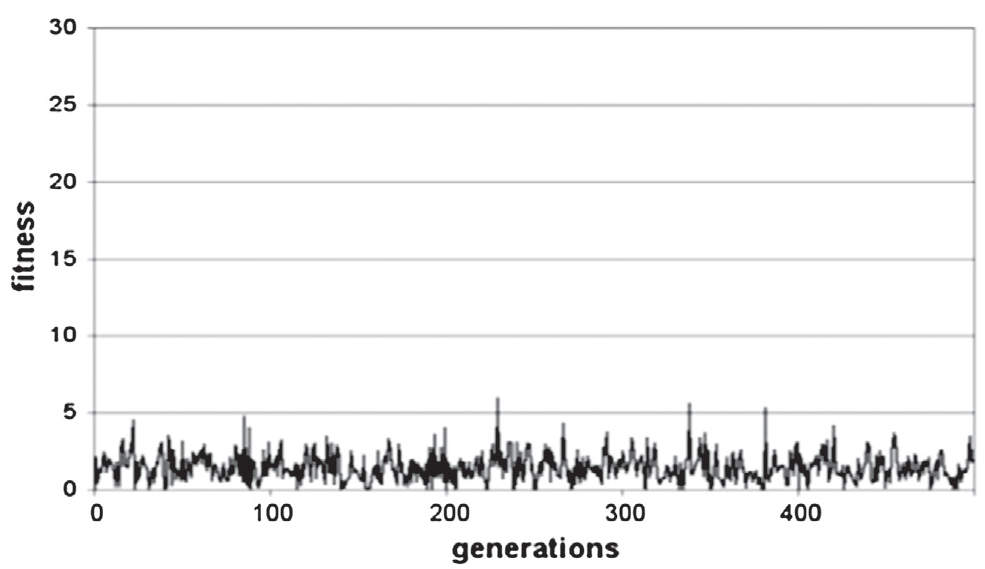 Key insight: As shown in E6 and E7, adding intra-generational transmission (learning from peers) dramatically accelerates recovery in dynamic settings.
Deep Insight: The Value of "Loose" Evaluation
One of the most striking findings involves the parameter (Evaluation). When the "passing grade" for foraging was set too strictly, the population lost its behavioral plasticity. However, when evaluation was "chosen loosely enough," it introduced a "healthy" amount of variation back into the behavioral pool.
This suggests that the most adaptive societies are those that balance authoritative instruction with a degree of "permissive" evaluation, allowing individuals the cognitive room to discover new solutions that the teachers themselves might not know.
Critical Analysis & Conclusion
Takeaway
The study demonstrates that Direct Instruction is a double-edged sword. It is highly efficient for preserving complex, "opaque" cultural traits (like social norms or complex tool-making), but it requires a safety valve—either via peer-to-peer (horizontal) learning or relaxed assessment—to survive environmental shifts.
Limitations
- Cognitive Simplicity: The agents are perceptrons, lacking internal "beliefs" or "desires," which are central to human pedagogy.
- Spatial Sensitivity: The replication showed that ABM results are highly sensitive to "micro" factors like NetLogo's patch topology and mushroom placement distances.
Future Outlook
This work paves the way for a more nuanced "Science of Teaching" within evolutionary biology. Future models could explore "Active Teaching", where teachers adjust their behavior based on a student's specific weaknesses, rather than just providing a static target output.