
cwFSS: Bridging Expert Knowledge and Swarm Intelligence for Resilient Engineering Optimization
Cultural Weight-Based Fish School Search: A Flexible Optimization Algorithm For Engineering
This paper introduces the Cultural Weight-Based Fish School Search (cwFSS), a hybrid multimodal optimization algorithm that integrates Cultural Algorithms' belief space into the Weight-Based Fish School Search (wFSS) framework. It successfully optimizes thermal power plant efficiency by achieving superior stability and safety compared to standard wFSS and the SOTA NMMSO algorithm.
TL;DR
Researchers have developed Cultural Weight-Based Fish School Search (cwFSS), a hybrid algorithm that injects human expertise—norms, history, and situational awareness—into the collective behavior of a digital fish school. By rewarding "safe" and "expert-favored" behaviors through a weight-based mechanism, cwFSS outpaces standard methods in safety, stability, and speed, particularly in high-risk engineering scenarios like power plant optimization.
Problem & Motivation: The Danger of "Black-Box" Optimization
In engineering, an "optimal" solution that sits too close to a physical breaking point is not a solution—it is a liability. Standard metaheuristics (like PSO or GA) are often "blind" to the context of the problem; they seek the absolute peak of a fitness function, even if that peak represents a pressure level that would melt a turbine or a configuration that violates safety norms.
The authors identify three critical gaps in current engineering optimization:
- Safety Neglect: Algorithms often evoke solutions in "non-permissive" or risky areas.
- Expert Exclusion: Professional engineers have decades of "intuition" (Situational Knowledge) that is typically ignored by the algorithm.
- Inefficiency: Real-world simulations are computationally expensive; running them until a fixed iteration limit is reached often wastes time.
Methodology: The "Culture" of the School
The core innovation of cwFSS is the integration of a Belief Space with the Weight-Based Fish School Search (wFSS). In wFSS, "weight" represents a fish's success; heavier fish exert more influence on the school's movement.
The Four Pillars of Knowledge
Instead of just using raw fitness, cwFSS modifies fish weights based on four types of knowledge:
- Normative Knowledge: Penalizes fish that stray near safety boundaries. Weight gain is multiplied by a factor (0 to 1) proportional to the distance from safety limits.
- Situational Knowledge: Rewards fish (multiplier of 1 to 2) that explore regions where experts have historically found success.
- Domain Knowledge: Uses technical literature to focus the search, speeding up the discovery of plausible results.
- History Knowledge: A temporal "stop-loss" mechanism. It monitors the rate of fitness improvement and decides whether to extend the search or terminate early to save costs.
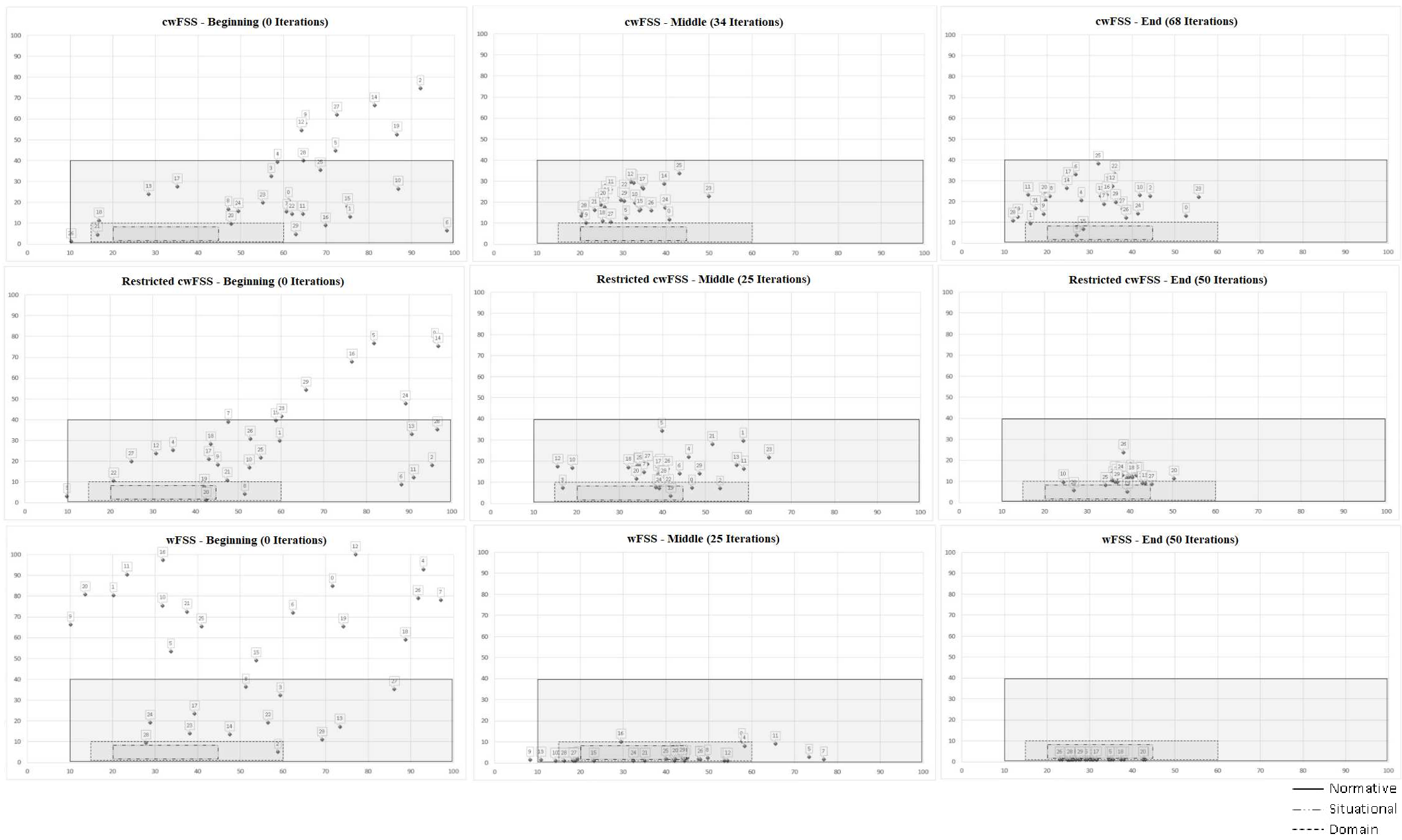 Above: Fish behavior graphs showing how the school concentrates within the "cultural" boundaries (dotted rectangles) over time.
Experiments & Results: Efficiency Meets Safety
The researchers tested cwFSS against the standard wFSS and the high-performing NMMSO (Niching Migratory Multi-Swarm Optimizer) using TESPy to optimize a thermal power plant's extraction pressures.
Key Findings:
- Stability & Safety: Standard wFSS often suggested risky pressure values (near 1.0 bar). cwFSS successfully steered the school away from these boundaries, providing solutions that satisfied all expert-defined constraints.
- Multimodal Diversity: Unlike NMMSO, which tended to collapse into a few very close solutions, cwFSS provided a wide variety of distinct, high-quality alternatives. This is vital for engineers who need backup options for diverse operational conditions.
- Temporal Savings: The History Knowledge mechanism allowed the algorithm to stop 15-20% earlier than fixed-iteration models without losing accuracy.
 Figure: Comparison of average best fitness across algorithms.
Critical Analysis & Conclusion
Takeaway
cwFSS demonstrates that Swarm Intelligence doesn't have to be a "black box." By treating expert knowledge as a biological bias (weight/success) rather than a hard geometric constraint, the algorithm remains flexible yet safe. This is a significant step toward "Human-in-the-loop" AI for industrial applications.
Limitations & Future Work
While powerful, cwFSS introduces several new hyperparameters (like the 'n' for history knowledge and various multipliers). The authors acknowledge the need to automate these settings. Future iterations may explore non-linear weight modification and broader testing in fields like CAD design or autonomous robotics where safety boundaries are dynamic.
Keywords: Swarm Intelligence, Fish School Search (FSS), Cultural Algorithms, Engineering Optimization, Multimodal Search.