
X-CORE: Bridging the Gap Between Human Laws and AI Logic Through Argumentation
Culture-Based Explainable Human-Agent Deconfliction
This paper introduces X-CORE, an argumentation-based architecture designed for explainable human-agent path deconfliction. It maps human-readable regulations into an Abstract Argumentation framework, enabling agents to resolve resource contention through dialectic dialogues and provide post-hoc explanations for their decisions.
TL;DR
Researchers at the University of Cambridge have developed X-CORE, a framework that treats "Culture" (laws and norms) as a mathematical graph of arguments. By turning deconfliction rules into a dialogue game, AI agents can now explain why they have the right of way. The study proves a critical insight: explanations are only useful when the rules are complex; in simple scenarios, they might actually get in the way.
The "Peer" Problem: Why Rules Aren't Enough
Since the Code of Ur-Nammu in 2100 BC, humans have used written rules to settle conflicts. As autonomous agents (robots, self-driving cars) enter our society, they need to act as "peers" rather than just "tools." The problem isn't just making them follow rules—it's making them accountable. If a self-driving car cuts you off, you need to know if it was following a specific "emergency vehicle" rule or if it simply malfunctioned. Existing AI often lacks the ability to map high-level legal logic to low-level decision-making in a way humans can understand.
Methodology: Culture as an Argumentation Framework
The authors propose that Culture is a shared agreement of norms. They represent this using Abstract Argumentation (AA), where:
- Arguments are the rules (e.g., "Rank higher" or "Is tasked").
- Attacks are the priorities (e.g., "Tasked status" overrides "Rank").
The X-CORE Architecture
The system operates in three distinct phases:
- Mapping: Human regulations are translated into pairs of arguments and "verifier functions" (code that checks if a rule applies in the current context).
- Deliberation: When a conflict arises (e.g., two agents wanting the same path), they engage in a Propositional Dialogue. They take turns "attacking" each other's claims until a winner is determined.
- Explanation: The history of this dialogue is mined to create a contrastive explanation (e.g., "I have priority because I am tasked, which overrides your higher rank").
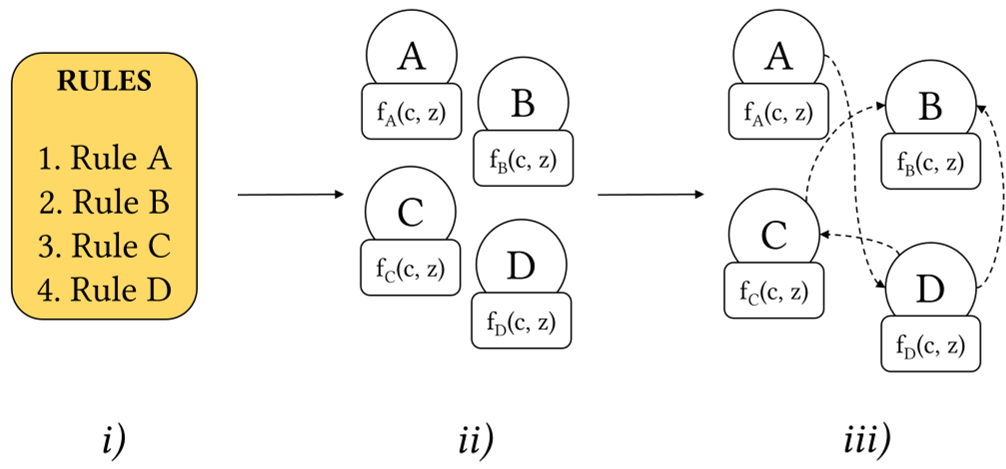 Figure 1: The X-CORE workflow—from human rules to argumentative attack graphs.
Experimental Results: The Complexity Threshold
The researchers tested X-CORE using a game called "Busy Barracks." Participants navigated a grid, avoiding collisions with AI agents governed by rules of varying complexity (Easy, Medium, Hard).
Key Findings:
- Performance Scaling: In the "Hard" mode (9 rules), players with access to AI explanations had significantly higher scores and fewer collisions.
- The "Simple" Paradox: In the "Easy" mode (2 rules), players actually performed worse when given explanations. The extra text acted as a cognitive distraction rather than an aid.
- Human Perception: Qualitative data showed that 75% of "Hard" mode players relied primarily on AI hints, while "Easy" mode players found them useless.
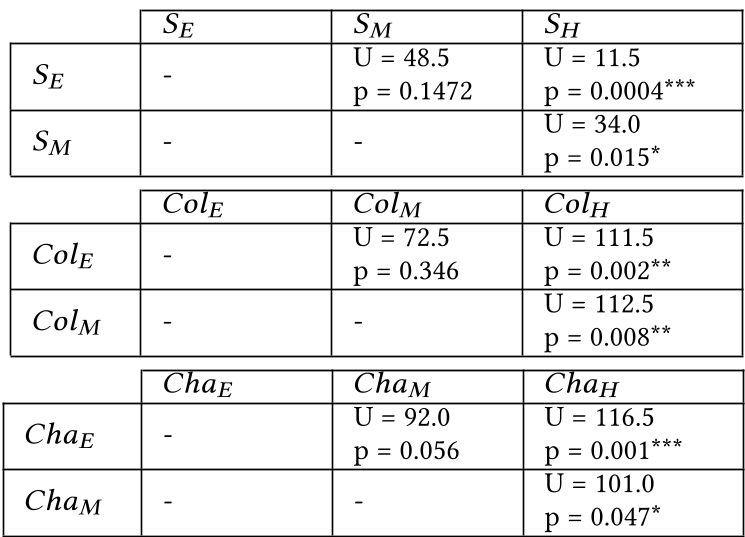 Table 1: Statistical validation showing significant improvement in Hard (H) vs Easy (E) rounds.
Critical Insight: When Should AI Explain Itself?
This paper challenges the "more is better" approach to XAI. It suggests a new dimension for the taxonomy of explanations: System Complexity.
If an AI's logic is intuitive or simple (e.g., "Stop at Red"), explaining it is a waste of time. However, as AI enters "high-logic" domains like legal adjudication, complex traffic management, or medical triage, argumentative dialogues like X-CORE become critical for user acceptance and safety.
Conclusion & Future Work
X-CORE provides a robust template for building "Rule-of-Law" into AI. By using Abstract Argumentation, we move away from black-box neural logic towards a transparent, "defeasible" reasoning process that mimics human debate. The next step? Scaling this to real-world autonomous vehicle fleets operating under diverse city-specific regulations.