
Computers are Not Neutral: Decoding the Cultural Schemas of Online Learning
Culture and Computers: A Review of the Concept of Culture and Implications for Intercultural Collaborative Online Learning
This paper provides a comprehensive review of the "nexus of culture, technology, and learning," focusing on how the social affordances of software vary across cultural dimensions. It synthesizes Hofstede’s cultural dimensions, Hall’s communicative contexts, and Nisbett’s cognitive findings to propose a culturally-aware framework for Human-Computer Interaction (HCI) and Online Learning.
TL;DR
Software is often seen as a universal tool, but this paper argues that the "social affordances" of technology—what a system allows us to do socially—vary wildly across cultures. By reviewing decades of research from Hofstede, Hall, and Nisbett, the authors reveal that our "collective mental programming" dictates how we learn, communicate, and solve problems online.
The Blind Spot of Universal Design
Why do some online collaborative tools thrive in the West but fail in East Asia? Most designers suffer from a "Content Independence" bias—the belief that basic cognitive processes like memory and perception are invariant across the human race.
Vatrapu and Suthers argue that this is a fallacy. Interaction through technology is never unproblematic; it may not "mean, feel, or afford" the same things to a student in Honolulu as it does to one in Tokyo. The core problem is that we've focused on Surface Culture (colors, date formats) while ignoring Deep Culture (how we perceive authority and information).
Methodology: Culture as a Cognitive Schema
The authors move beyond vague definitions, treating culture as an independent variable—specifically, a "cognitive schema." They utilize three major theoretical pillars:
- Hofstede’s Dimensional Model: Breaks culture into Power Distance, Individualism/Collectivism, Masculinity/Femininity, and Uncertainty Avoidance.
- Hall’s Communicative Context: Distinguishes between "High-Context" (social/emotional emphasis) and "Low-Context" (rational/information emphasis) communication.
- Nisbett’s Geography of Thought: Demonstrates that Westerners are "Analytic" (focusing on discrete objects), while East-Asians are "Holistic" (focusing on the relationship between objects and their field).
Cultural Effects on Learning (Synthesized from Hofstede)
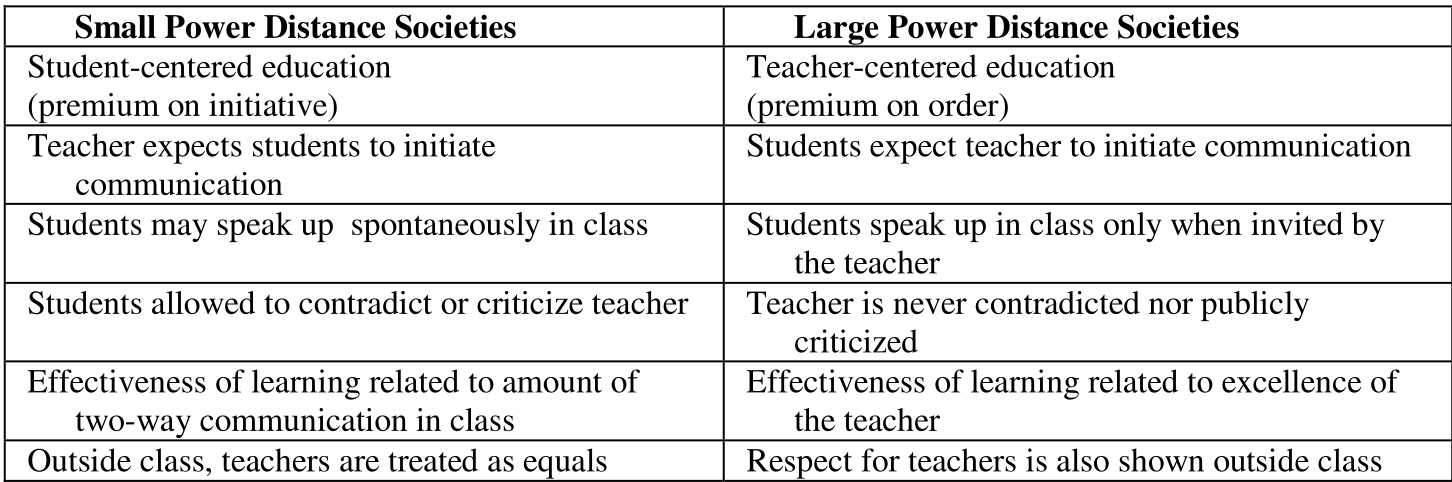 Figure 1: Comparison of Small vs. Large Power Distance in educational settings.
Key Insight: The Cognitive Divide
One of the most profound sections of the paper involves Culture and Cognition. Drawing on Nisbett’s empirical evidence, the authors suggest a "Socio-Technical Design Hypothesis":
- Westerners (Analytic): Focus on individual objects and formal logic. In a knowledge-mapping task, they likely reference specific data points.
- East-Asians (Holistic): Focus on the "Field" and relationships. They are more likely to reference whole regions or conceptual clusters.
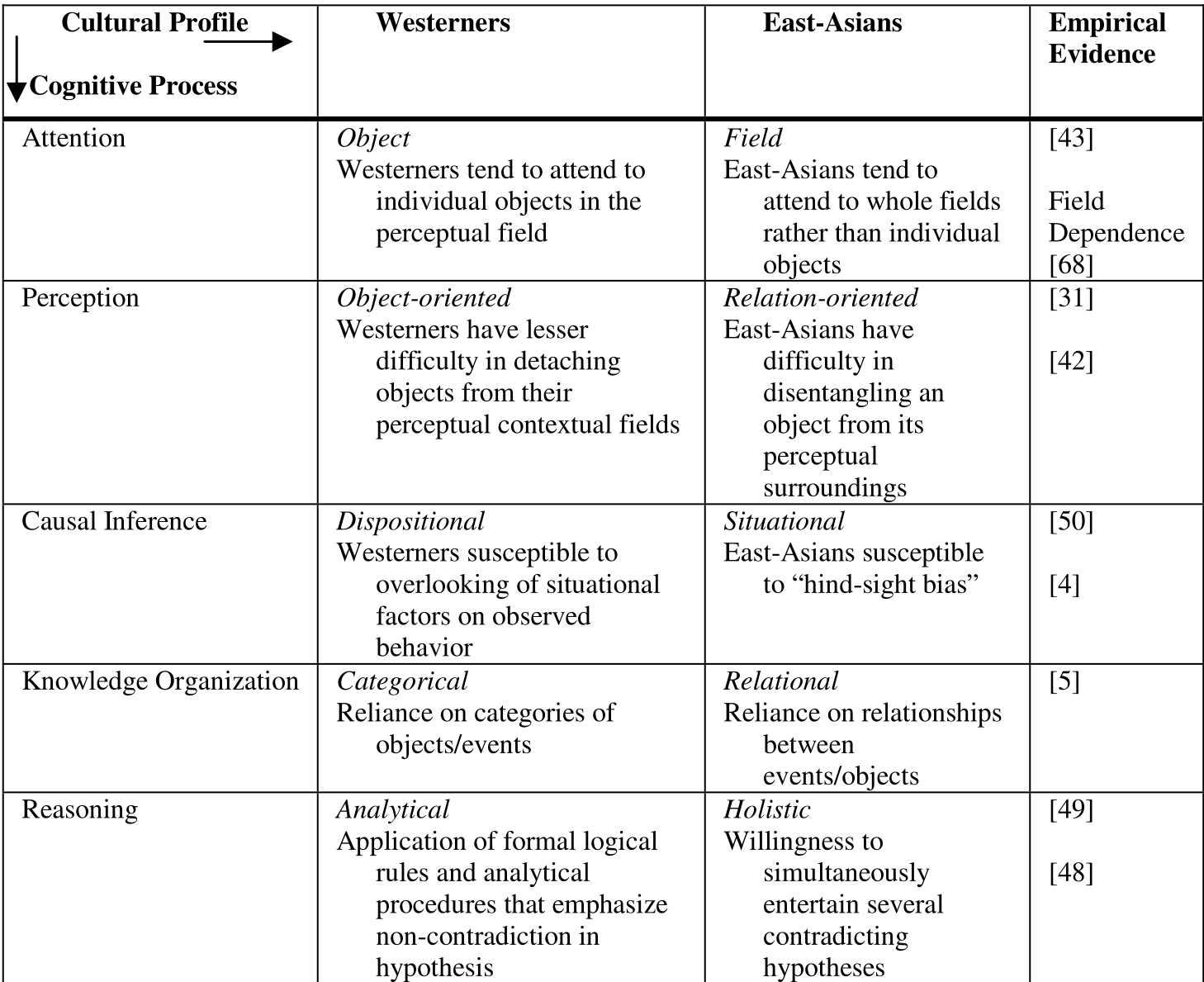 Figure 2: Empirical evidence of cognitive process variance across cultures.
Structural Implications for CSCL:
- Conflict Resolution: In Individualist cultures, open confrontation in a forum is "salutary." In Collectivist cultures, it causes "loss of face," leading to silence or disengagement.
- Causal Inference: Western users tend to blame an individual's "competence" for failure (dispositional), whereas East-Asian users look at the "situational" context.
Critical Analysis: Beyond Symbols and Rituals
The paper concludes that HCI research is currently stuck at the level of "single-user interface manipulation." We are good at changing icons, but bad at designing for "Technological Intersubjectivity"—the way people reach a shared understanding through a screen.
Limitations: The authors acknowledge that Hofstede’s dimensions can sometimes lead to "essentialist homogeneity" if applied too rigidly. However, they argue that as a starting point for empirical research, these dimensions are indispensable.
The Road Ahead: The future of Intercultural Collaborative Learning lies in affordance design. If a system only allows for individualistic "up-voting" or "logical proofs," it may inherently disadvantage learners from holistic, high-context cultures. Designers must move toward "negotiated cultural perspectives," where the software itself is flexible enough to accommodate multiple "collective programmings of the mind."
Takeaway for Researchers
Culture is not just an "extra feature" to consider during localization; it is the very lens through which every click, comment, and collaboration is filtered. Aligning technological affordances with cultural schemas is the next frontier of SOTA educational technology.