
Unlocking the Ottoman Archives: A Deep Deep Learning Approach to Historical Arabic Digit Recognition
Curation of Historical Arabic Handwritten Digit Datasets from Ottoman Population Registers: A Deep Transfer Learning Case Study
This paper introduces the first publicly available historical Arabic handwritten digit dataset curated from 19th-century Ottoman population registers. The authors combined manual annotation with automated page segmentation and numeral spotting to create a dataset of over 6,000 digits, achieving a benchmark accuracy of 99.7% using a custom CNN architecture.
TL;DR
Researchers have successfully bridged the gap between historical demography and AI by curating the first-ever dataset of handwritten Arabic digits from 19th-century Ottoman registers. Using a specialized CNN and Transfer Learning, they achieved an impressive 99.7% recognition accuracy, paving the way for automated census analysis on a massive scale.
Context & Motivation: The Data Gap in History
Digital humanities often hit a wall when it comes to historical archives. While modern Arabic OCR is relatively mature, historical documents suffer from ink bleeding, paper degradation, and "non-standard" handwriting. In Ottoman studies, manual data entry for 167,000 individuals takes years. To speed this up, we need machines that can read the registers. The primary blocker? A lack of labeled historical data.
Methodology: From Paper to Pixels
The researchers developed a sophisticated pipeline to transform 11,000 potential population registers into a machine-readable format.
1. Hybrid Annotation
Instead of purely manual labeling, the team utilized an existing project's database (UrbanOccupationsOETR) to match manually entered text with pixel coordinates. This "ground truth" was then used to train the automated systems.
2. The Recognition Pipeline
- Page Segmentation: Using the
dhSegmenttoolbox (based on ResNet-50), the system identifies clusters of individuals and sorts them according to the Arabic reading order (right-to-left). - Numeral Spotting: Since the Ottoman clerks wrote numbers in red ink to distinguish them, the authors applied an HSV color filter to isolate digits before passing them to the CNN.
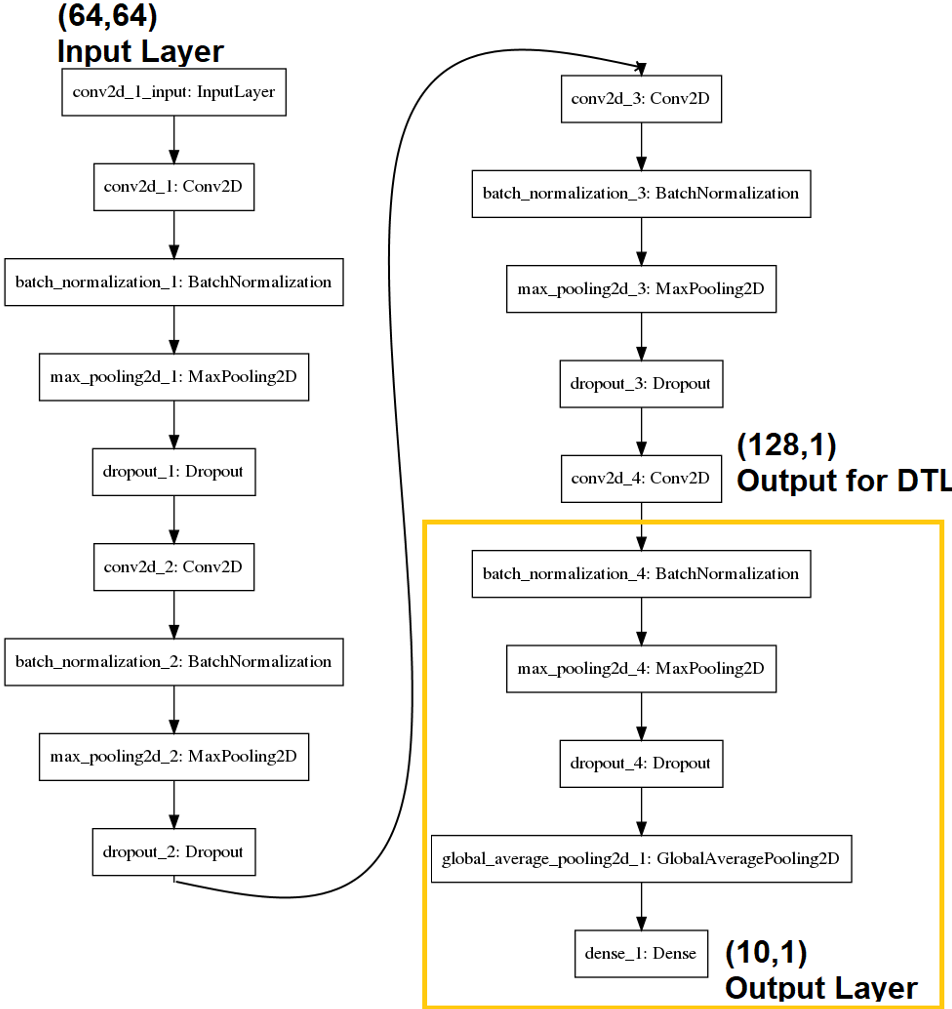 Figure 1: The CNN architecture used for digit recognition. Note the feature extraction layer used for Transfer Learning.
Experiments: Transfer Learning vs. Local Training
The study explored whether knowledge from modern Arabic datasets (HODA and ADBase) could be "transferred" to historical documents.
- The Findings: Modern datasets have subtle differences (e.g., Persian digit variants in HODA). Consequently, a CNN trained directly on the newly curated historical data performed best (99.7%).
- The Benefit of DTL: While Transfer Learning didn't boost final accuracy, it acted as a "catalyst," allowing the model to converge to high accuracy much faster than training from scratch.
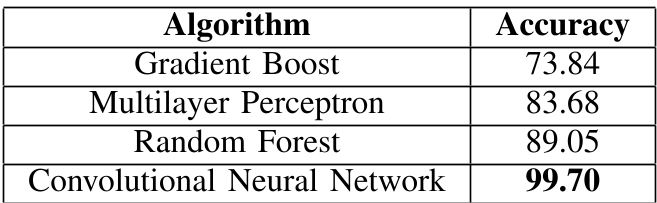 Table 1: Accuracy comparison of different classifiers on the Ottoman dataset.
Deep Insights
The most striking takeaway is the Domain Gap. Deep Transfer Learning (DTL) using modern features (extracting 128 features from the penultimate CNN layer) only achieved ~91.98% accuracy when paired with an MLP. This ~8% drop compared to the local CNN highlights why we cannot simply "plug and play" modern AI models into historical contexts. The subtle nuances of 19th-century calligraphy require specific inductive biases that only historical datasets can provide.
Conclusion & Future Work
By releasing this dataset (6,000+ digits), the authors have provided a vital benchmark for the Document Image Analysis (DIA) community. Future work aims to expand this to Arabic handwritten occupation titles, which would effectively allow AI to reconstruct the socio-economic fabric of the Ottoman Empire automatically.
Keywords: Ottoman Archives, Deep Transfer Learning, Arabic Handwritten Digit Recognition, Dataset Curation, dhSegment.