
Trusting the Crowd: Combatting Health Misinformation with AI Trust Modeling
The Current State of Online Social Networking for the Health Community: Where Trust Modeling Research May Be of Value
This paper explores the integration of trust modeling into online health social networks (OHCs) to combat misleading information. It contrasts platforms like PatientsLikeMe and HealthTap, proposing the use of multi-agent system frameworks, specifically CRED-Trust and Bayes-Trust, to filter health advice based on peer credibility and similarity.
TL;DR
As more patients turn to Online Health Communities (OHCs) like PatientsLikeMe for advice, the risk of "well-intentioned but wrong" information grows. This paper proposes using Multi-Agent Trust Modeling—specifically the CRED-Trust and Bayes-Trust frameworks—to automatically filter messages based on the learned credibility of posters, moving beyond simple popularity or similarity metrics.
Background Positioning
In the landscape of Digital Health, this work serves as a bridge between Social Computing and Multi-Agent Systems (MAS). It moves the conversation from simple "content moderation" to "intelligent trust inference," positioning trust as a calculable probability of a user's future reliability.
The Problem: The Danger of Peer-to-Peer Medical Advice
Online health networks empower patients but create a "wild west" of information. The authors identify a critical gap:
- Peer Influence: Patients often trust those with similar experiences more than distant professionals.
- Lack of Verification: Sites like PatientsLikeMe allow anyone to register as a "patient" with a simple email, offering no validation of the medical claims they post.
- The "Herd Mentality": Popular posts are seen as true, even if they advocate dangerous practices (e.g., anecdotal evidence that quitting smoking causes heart attacks).
Methodology: Engineering Digital Trust
The core of the paper lies in two mathematical approaches to determine whether a message should be shown to a user.
1. CRED-Trust (Heuristic Approach)
This model uses a Beta probability density function to estimate the likelihood of a message being beneficial.
- Physical Intuition: We shouldn't just show messages from people like us (Similarity); we must also account for their track record (Credibility).
- Mechanism: It uses the Hamming Ratio to adjust the weight of peer advice. If a peer has high credibility but low similarity (like a medical professional), their advice is still weighted heavily to overcome echo chambers.
2. Bayes-Trust (The Deeper Learning Approach)
Bayes-Trust treats message recommendation as a Partially Observable Markov Decision Process (POMDP).
- State (): A message is inherently "good" or "bad."
- Action (): The system can recommend the message, reject it, or "poll" more advisors.
- Reward (): The system learns to maximize the reward by correctly predicting which messages provide utility to the end-user.
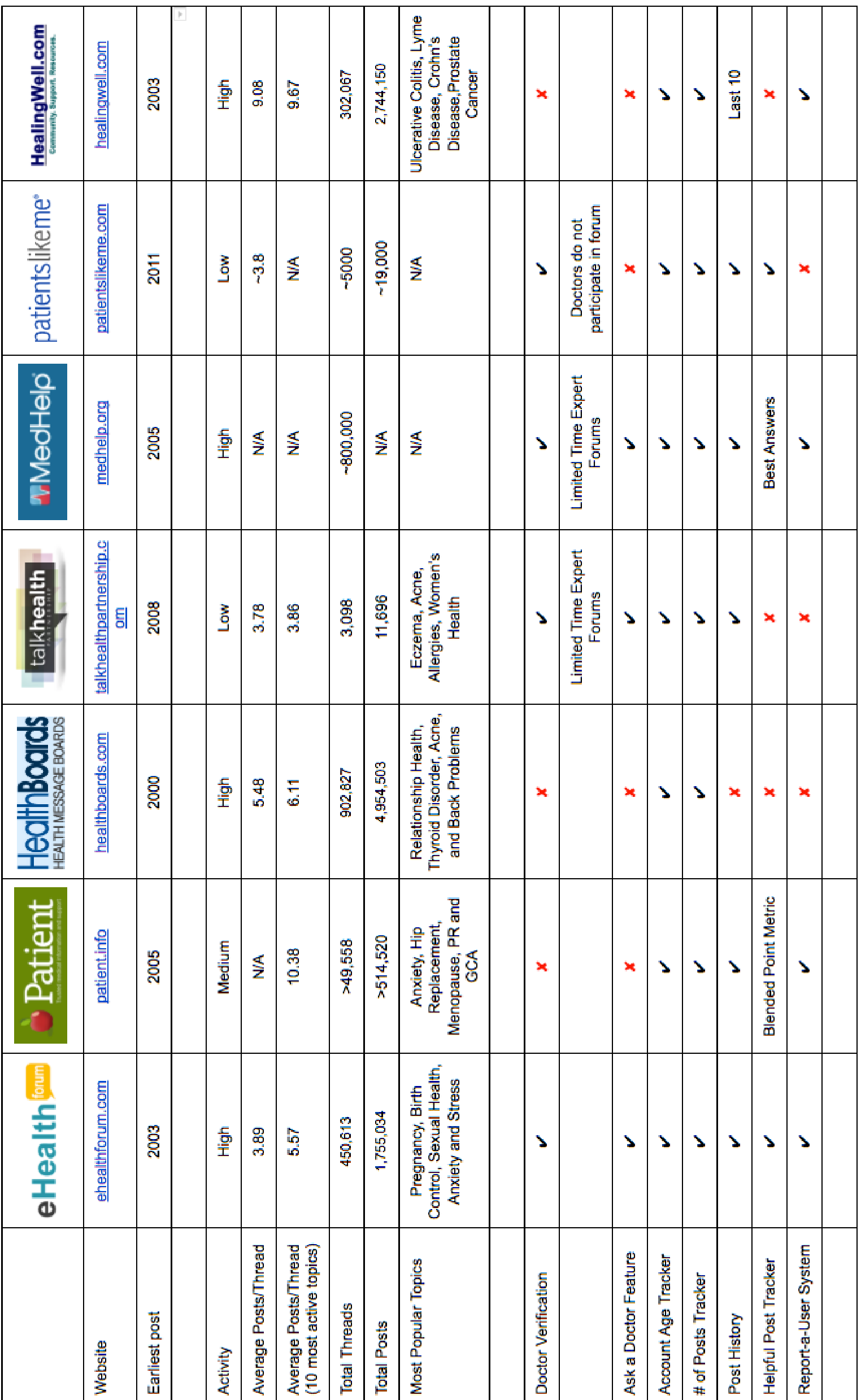 Figure 1: Comparison of features across major Health Forums, highlighting the lack of robust doctor verification on many popular sites.
Experimental Validation
The authors validated these models against datasets from Reddit and Epinions.
- Bayes-Trust significantly outperformed older heuristic models (LOAR) and other Bayesian models (BLADE).
- It proved resilient even in environments with "noisy" ratings, successfully identifying trustworthy advisors even when the ground truth was partially obscured.
 Figure 2: Real-world examples from MedHelp where users receive conflicting advice on cholesterol medication—a prime target for trust-based filtering.
Critical Insight & Conclusion
The genius of this approach is that it doesn't require a "Minister of Truth" to flag every post. Instead, it creates a Personalized Reputation Economy.
Takeaways for the Industry:
- Beyond Verification: While "Blue Checks" verify identity, Trust Models verify utility. A verified doctor might still give poor advice in a niche area they aren't specialized in; MAS can detect this.
- User Acceptance: The biggest hurdle remains "automated filtering." Will users accept an AI deciding which peer advice they can see?
- Future Path: The next frontier is moving beyond ratings (thumbs up/down) to Natural Language Processing (NLP) that can infer "sentiment-as-rating" from conversation threads.
By treating OHCs as ecosystems of agents rather than just static message boards, we can build platforms that are not only supportive but also scientifically safe.