
Architecting the Customer Mind: Moving CEM from Buzzword to Machine Learning Reality
Customer Experience Management Architecture for Enhancing Corporate Customer Centric Capabilities
The paper introduces a novel Customer Experience Management (CEM) architecture that formalizes customer experience as a set of learned intentional states. By leveraging Multi-Agent Systems (MAS) and Machine Learning, the authors model customers as intelligent agents whose experiences evolve through "stimulus events," ultimately achieving a predictive framework for consumer decision-making.
TL;DR
Customer Experience Management (CEM) has long suffered from a lack of formal rigor. This paper bridges the gap by proposing a technical architecture that treats customer experience as a learning process. By representing customers as intelligent, autonomous agents within a Multi-Agent System (MAS), the authors provide a framework to quantify emotions, memory decay, and rational deliberation using First-Order Logic and BDI (Belief-Desire-Intention) architectures.
Problem & Motivation: The "Aboutness" of Experience
In the world of CRM, managers often focus on functional metrics: Was the product delivered on time? Did the app crash? However, human experience is governed by Intentionality—the mind's tendency to be about something.
The authors argue that existing systems fail because they don't account for the "internalized learned concepts" that customers form after interacting with a brand. To solve this, they look toward the philosophy of mind (John Searle) and AI theory to answer: How do we code a "state of mind" into a database?
Methodology: Experience as a Training Process
The core insight of the paper is treating the flow of life (transactions, ads, support calls) as training examples for an internal learning algorithm.
1. The Formalism of Intentional States
The authors represent an experience as a tuple: Where:
- p: A logical predicate (e.g., "The brand is prestigious").
- v: The emotional value (valence and intensity).
2. The Decision Loop (BDI Model)
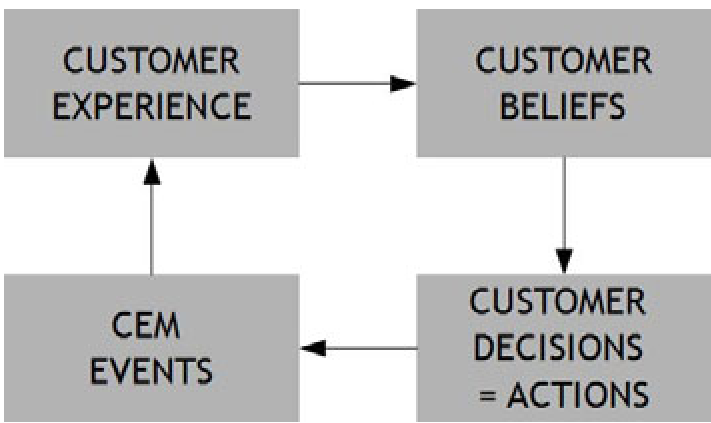
Using the BDI agent architecture, the system places "Experience" within the Belief (B) category. These beliefs influence the agent's Desires (D) and Intentions (I), leading to actions (purchases).
3. Defeasible Reasoning
Humans don't think in rigid silos; we change our minds. The authors use Default Logic to model this. For example, a customer might assume a high price implies quality, unless they see a "plastic" material, which invalidates the "durable" assumption. This non-monotonicity is key to simulating realistic, fickle consumers.
Experimental Analysis: Model Calibration
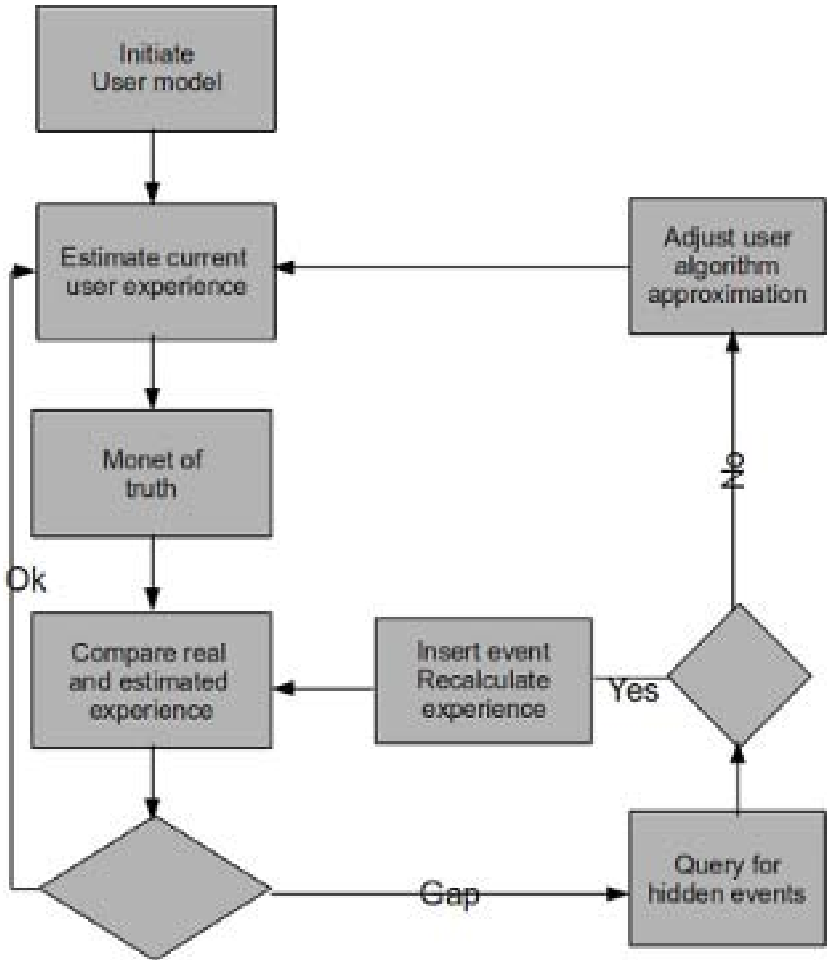
A CEM system is only useful if its "simulated customer" reacts like a "real customer." The paper proposes a Calibration Loop:
- The system estimates the experience based on events.
- Real-world feedback (surveys or behavior) is collected.
- If a gap exists (), the system modifies the agent's logic rules or assumes a hidden "missing event."
Multi-Agent System (MAS) Architecture
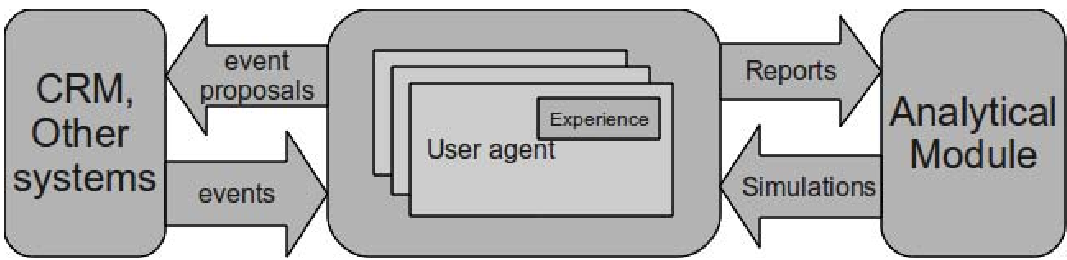
The proposed implementation involves a Multi-Agent System where every single customer in a database is assigned a unique, autonomous agent.
- Input: Event streams from CRM systems.
- Process: Each agent runs its own learning function .
- Outcome: Marketers can run "What If" simulations, sending hypothetical offers to the MAS to see which segments might respond positively before spending a single dollar on a real campaign.
Critical Insight & Conclusion
The true value of this work is the move toward Distributed Customer Intelligence. Instead of aggregate statistics (like NPS scores), it suggests we should model individual cognitive paths.
Limitations: The paper is primarily theoretical. The computational overhead of running millions of autonomous BDI agents for a global brand (like Amazon) would be massive, likely requiring significant advances in distributed agent-based computing or more efficient approximation methods.
Takeaway for Practitioners: Don't just track what customers do; model what they learn from what you do. Every touchpoint is an "event" that updates their internal logic.