
Beyond Generic Ads: Precise Customer Targeting via Semantic Profile Matching
Customer recommendation based on profile matching and customized campaigns in on-line social networks
The paper introduces a general framework for customer recommendation in Online Social Networks (OSNs) by matching brand and user social profiles. It leverages Word Embedding and TF-IDF to compare textual content (posts/comments) alongside personal attributes, achieving successful target identification in real-world Facebook datasets.
TL;DR
Social media advertising is often an expensive "spray and pray" game. This paper proposes a formal framework to bridge the gap between Brands and Customers by creating highly detailed Social Profiles. By analyzing the semantic content of posts (what people say) and personal demographics (who people are), the system identifies the top 3% of users most likely to engage with a specific campaign.
Background Positioning
While most recommendation systems focus on Action-Based filtering (what you clicked), this work falls under Content-Based and Demographic Filtering. It views the Online Social Network (OSN) not just as a graph of connections, but as a repository of semantic intent.
Problem & Motivation: The Cost of Irrelevance
Advertisers face three primary hurdles in OSNs:
- Astronomical Costs: Broad-spectrum campaigns waste budget on uninterested users.
- Degraded UX: Users are bombarded with irrelevant "spam-like" ads.
- Semantic Blindness: Existing methods often ignore the actual language used in posts, missing the nuances of user interest.
The authors' insight is simple but powerful: If a brand's "voice" (its posts) matches a user's "voice," there is a latent affinity that can be quantified mathematically.
Methodology: The Social Profile Framework
The core of the framework is the Social Profile (SP), defined as the union of Personal Information (PI) and Social Information (SI).
1. The Profiling Step
For every node in the network:
- : Static data like age, gender, and occupation.
- : A dynamic document created by concatenating all textual posts and comments.
2. Semantic Weighting (TF-IDF)
The system doesn't just count words; it uses TF-IDF (Term Frequency-Inverse Document Frequency) to weight words. This ensures that unique keywords (e.g., "Audi," "Cosmetics") carry more weight than generic words (e.g., "the," "is").
3. The Match Engine
Matching is performed using Cosine Similarity between the weighted vectors of the Brand and the Customer.
 Fig 1. The data flow from web scraping to targeted recommendation.
Experimental Validation
The authors tested the framework on a dataset of 345 Facebook users and 18 high-profile pages (including @BarillaIT, @AudiIT, and @Juventus).
Visualizing Interests
The study generated "Word Clouds" to contrast how different categories communicate. For instance, Companies focus on transactional terms like "store," while Communities focus on topical terms like "recipes" or "Intel."
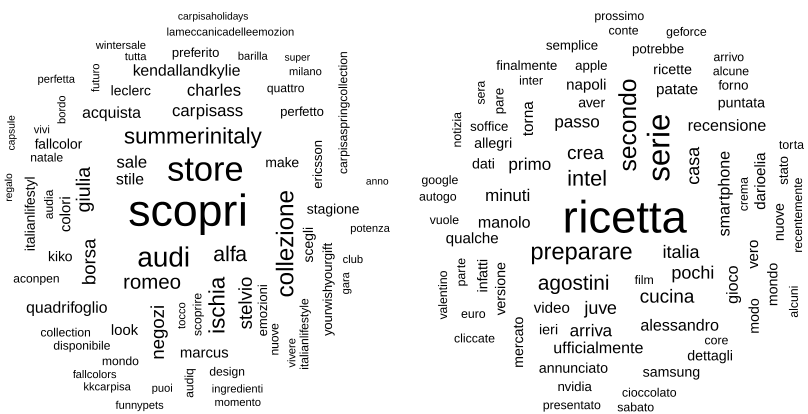 Fig 2. Differentiating frequency of terms across Facebook page types.
Results of Targeting
The framework proved its accuracy by simulating specific campaigns:
- Handbags (Carpisa): The system correctly narrowed the 3% target list solely to women.
- Music: It effectively segmented users based on the age-affinity of specific singers (Teenagers vs. Adults).
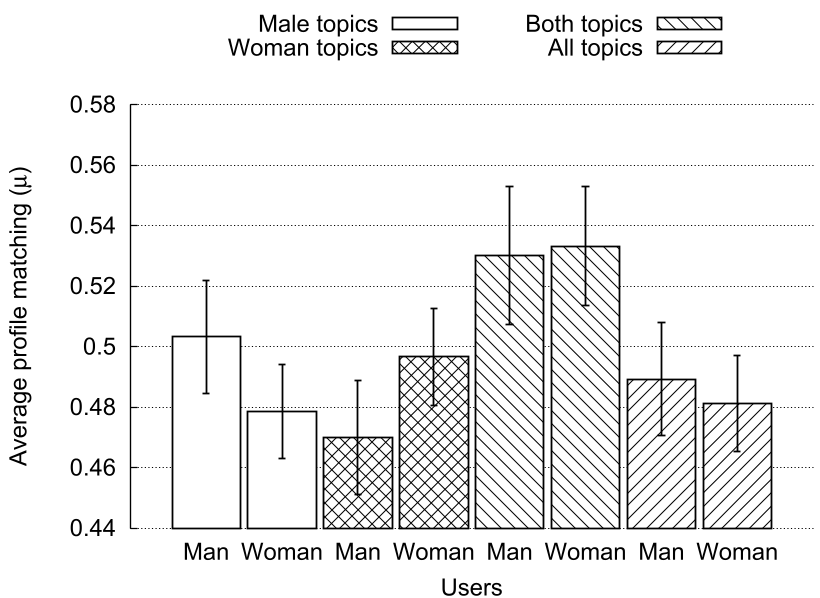 Fig 3. Quantitative evidence showing that interest-based matching aligns with demographic reality.
Critical Analysis & Conclusion
Takeaway
This framework provides a robust Mathematical baseline for Social Advertising. By treating brand activity as a "profile" to be matched against users, it transforms advertising from a broadcast medium into a targeted recommendation task.
Limitations
The current approach utilizes TF-IDF, which is a "bag-of-words" model. It lacks contextual understanding—it cannot distinguish between someone saying "I love this car" and "I hate this car" (Sentiment Analysis).
Future Work
The logical next step is integrating Big Data technologies (like Spark or Hadoop) to handle millions of users and replacing TF-IDF with Transformers (BERT/GPT) to capture the deeper semantic meaning of user interactions across multiple platforms like Instagram and Twitter.