
DARP Optimization: Balancing Operational Efficiency with Passenger Experience
8111_Customers' satisfaction in a dial-a-ride problem.
This paper presents a generalized mathematical model and a Simulated Annealing (SA) metaheuristic for the Dial-a-Ride Problem (DARP). The approach integrates a distribution heuristic for routing and a specialized programming heuristic for scheduling, achieving new best-known solutions with a significant focus on quality of service (QoS) for passenger transport.
TL;DR
The Dial-a-Ride Problem (DARP) is more than just moving goods; it's about moving people. This paper introduces a robust Simulated Annealing (SA) framework that redefines the SOTA for DARP. By implementing a clever "Programming Heuristic" that minimizes customer inconvenience, the authors reached a 75% reduction in ride times and a staggering 95% faster computation compared to existing Genetic Algorithms.
The "Human" Bottleneck in Logistics
Unlike standard Vehicle Routing Problems (VRP) where the goal is simply "shortest path," DARP must account for human factors. A package doesn't care if it waits in a truck for two hours, but a passenger does.
The specific challenges addressed here include:
- Heterogeneous Fleets: Vehicles with varying capacities for seats and wheelchairs.
- Multiple Depots: Managing starts and ends across different geographical hubs.
- Quality of Service (QoS): High penalties for excessive waiting times and long ride durations.
Methodology: The Logic of Delay
The authors utilize a Simulated Annealing approach, which is particularly adept at escaping local optima in sparse, constrained solution spaces.
1. The Model Architecture
The paper simplifies the decision variables by adopting a compact index formulation. This reduces the search space significantly, allowing the algorithm to converge faster.
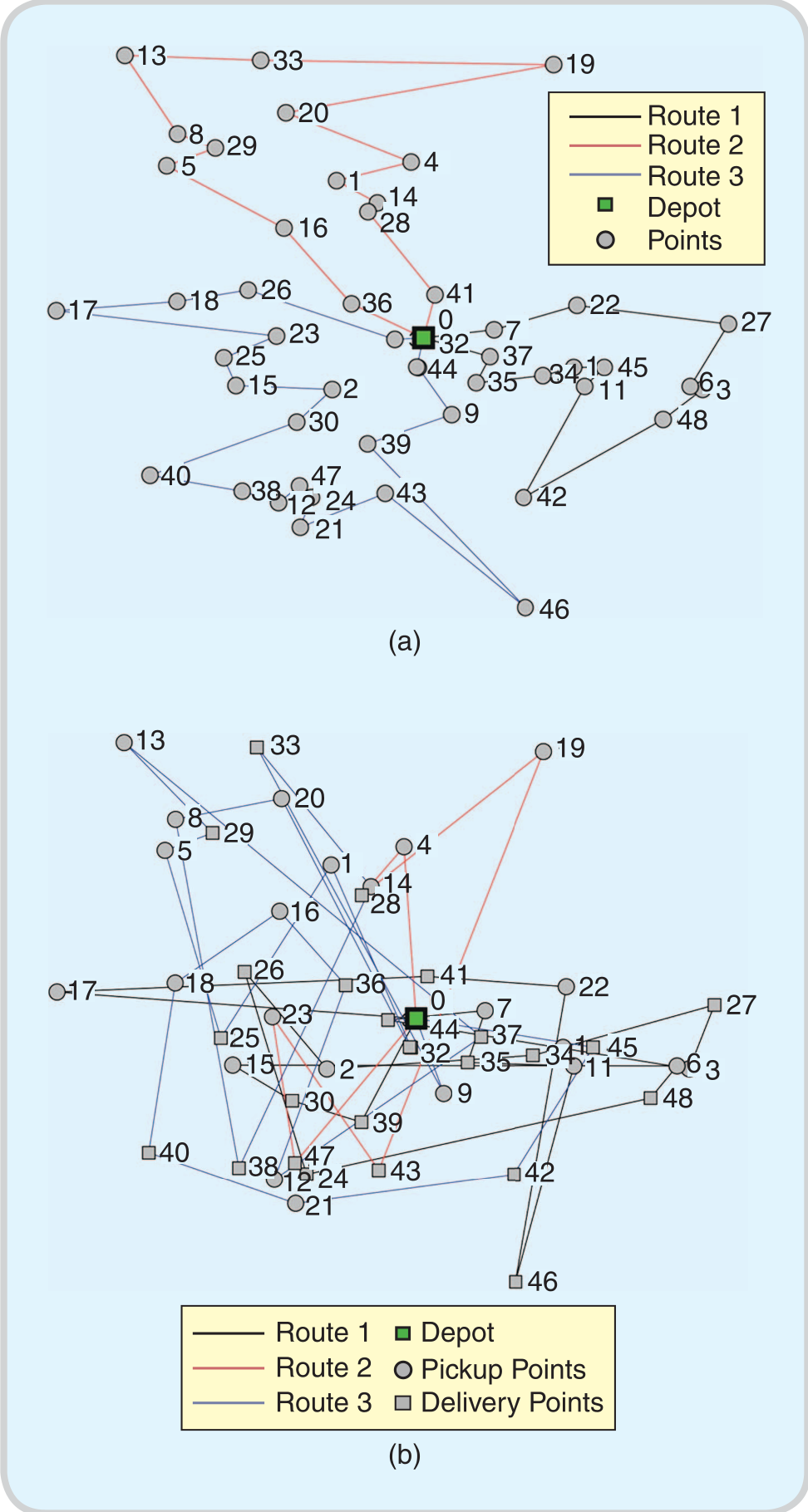
2. The Programming Heuristic (The Secret Sauce)
The standout feature is the scheduling logic. Instead of just arriving at a point as early as possible, the algorithm uses a delay mechanism.
- Physical Intuition: If a vehicle arrives early, it waits at the origin depot or the pickup point as long as possible without violating the time window. This "buffer" ensures that once a passenger is picked up, their ride time to the destination is minimized.
3. Neighborhood Moves
To explore the solution space effectively, three moves are used:
- Re-order route: Changing the sequence within a single vehicle.
- Re-allocate points: Moving a request (pickup + delivery) to a different vehicle.
- Swap points: Exchanging two requests between two different vehicles.
Experimental Showdown
The SA method was tested against the Montreal Transit Commission (MTC) datasets. The results were categorized into "Narrow" and "Wide" time windows.
Performance vs. Genetic Algorithms (GA)
When compared to the GA approach by Jorgensen et al., the SA method showed dominance across all metrics:
- Route Duration: -11.71%
- Waiting Time: -48.53%
- Ride Time: -75.33%
- CPU Time: The SA method completed in ~2 minutes what took the GA nearly 50 minutes.
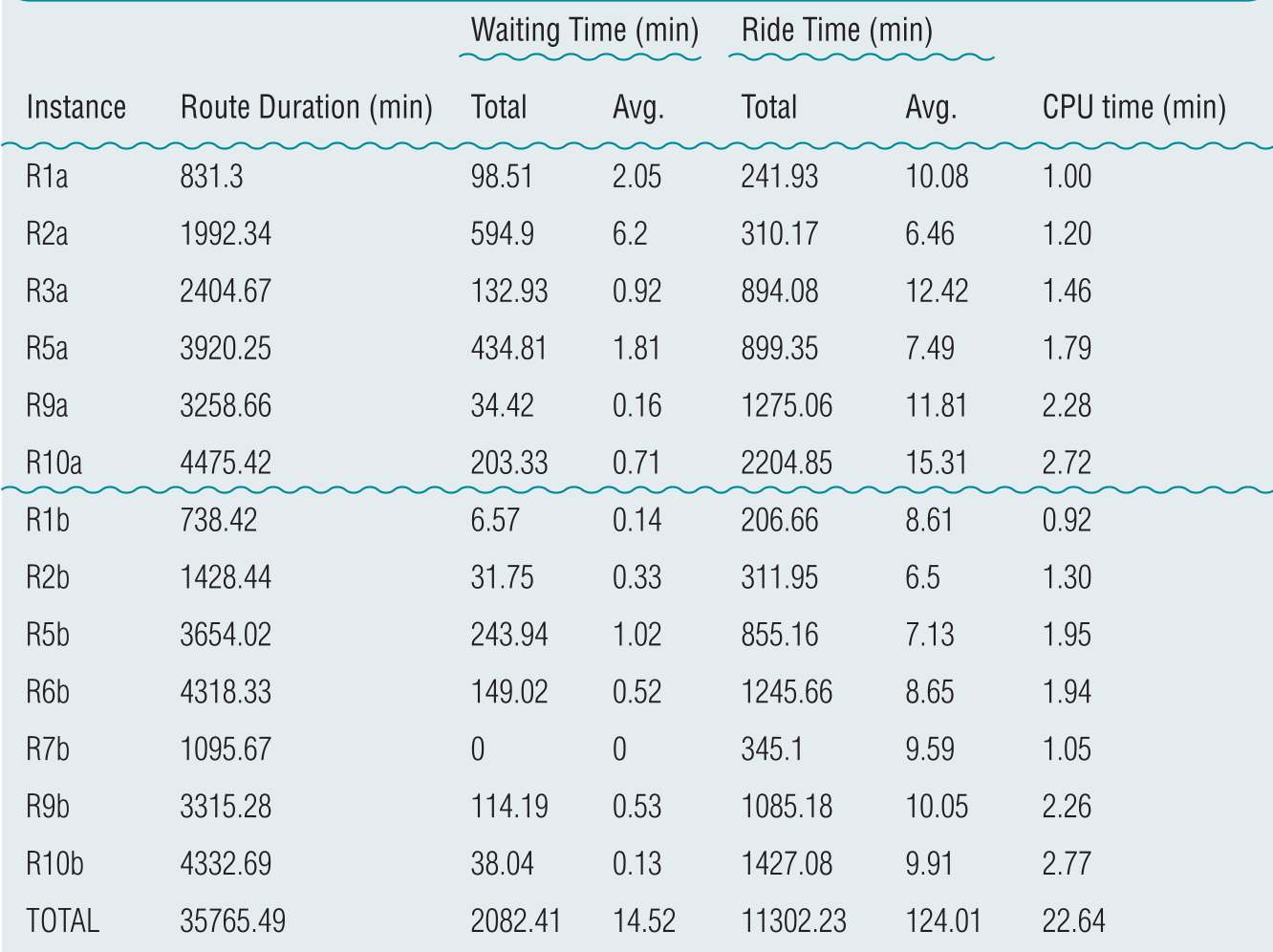 Table: The SA method delivers significantly lower waiting and ride times.
Critical Insight & Future Outlook
The beauty of this work lies in its Objective Function. By using a weighted vector for non-essential requirements (costs) and essential requirements (hard constraints), the model is highly flexible. It can be tuned for a "budget" service or a "premium" service just by adjusting the weights.
Limitations: The current model is static. In the age of Uber and Grab, the next frontier for this research is the Dynamic DARP, where the Simulated Annealing engine must react to new requests within seconds while the vehicles are already in motion.
Conclusion
This paper serves as a benchmark for how metaheuristics can be tailored to human-centric logistics. It proves that with the right heuristic scheduling (the delay concept), one doesn't have to choose between low operational costs and high customer satisfaction—you can have both.