
CRDP: Reconciling Personalization and Security in Social Network Data Sharing
Customizable Reliable Privacy-Preserving Data Sharing in Cyber-Physical Social Networks
The paper introduces a Customizable Reliable Differential Privacy (CRDP) model designed for data sharing in Cyber-Physical Social Networks (CPSN). It leverages social distance (shortest path) to adaptively set privacy budgets (epsilon) for different recipients, optimizing the utility-privacy trade-off while specifically defending against background knowledge and collusion attacks.
TL;DR
In the burgeoning world of Cyber-Physical Social Networks (CPSN), sharing data like location or status is essential but risky. Current privacy methods are often "one-size-fits-all," leading to poor data utility or leakage. This paper presents CRDP (Customizable Reliable Differential Privacy), a framework that tailors privacy levels based on how "close" you are to a recipient (social distance), while introducing a clever Markov-based noise mechanism to stop sophisticated collusion attacks dead in their tracks.
Problem & Motivation: The Customization Paradox
Privacy is subjective. You might be comfortable sharing your precise location with a close friend (low noise) but prefer a vague "city-level" location for a distant acquaintance (high noise). This is Customizable Privacy.
However, the authors identify a dangerous technical loophole: when a system releases multiple versions of the same data with different noise levels, the Composition Mechanism of Differential Privacy (DP) allows an adversary to compare these versions. By correlating the injected noises, attackers can "cancel out" the protection through collusion attacks or leverage background knowledge. Prior works recognized this but failed to model it quantitatively or solve the underlying correlation incentive.
Methodology: The CRDP Blueprint
The CRDP model shifts the paradigm from uniform protection to a distance-aware architecture.
1. Social Distance & QoS Mapping
Using the Dijkstra algorithm, the system calculates the shortest path between users in a social graph. This distance is then processed through a Sigmoid Mapping Function (resembling Quality of Service curves).
- Insight: Privacy demand doesn't grow linearly; it spikes as social intimacy drops, then plateaus. The Sigmoid function captures this "social intuition" perfectly.
2. The Markov Noise Mechanism
The core mathematical breakthrough is the Modified Laplacian Mechanism. Standard noise generation creates correlations that attackers exploit. CRDP ensures the noise generation process complies with a Markov stochastic process.
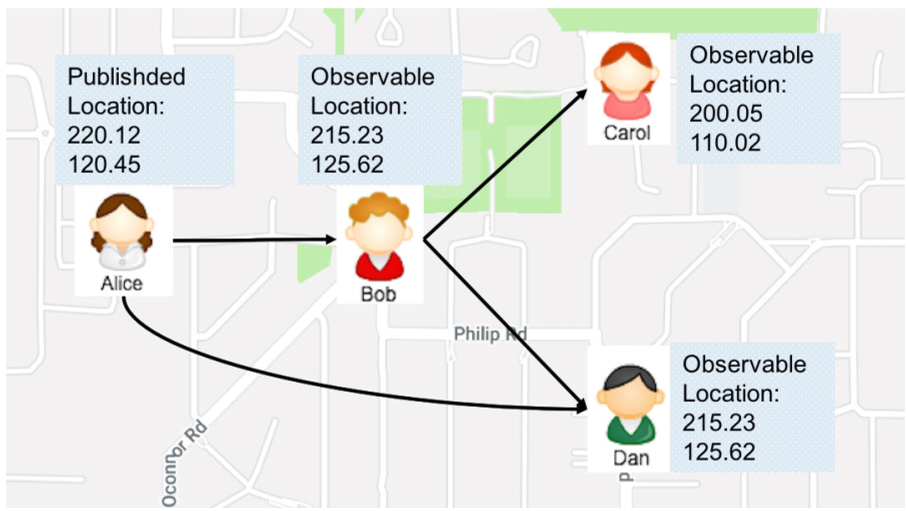 Fig 1: Example of Alice sharing data. Bob (1-hop) gets accurate data, while Carol (2-hop) gets significantly noisier data.
By making the noise generation "memoryless" across different privacy levels, the model de-couples the correlations. This effectively removes the mathematical incentive for adversaries to collude, as combining their data yields no more information than the strongest individual protection level already provided.
Experiments & Results: Efficiency Meets Security
The authors tested CRDP on the real-world Google+ dataset (over 100k nodes).
SOTA Performance
CRDP was compared against Classic DP (CDP) and Classic Customizable DP (CCDP).
- Data Utility: Measured by Root-Mean-Square-Error (RMSE), CRDP outperformed CCDP by roughly 8%, and significantly beat fixed-level CDP by providing higher accuracy for close-range nodes.
- Attack Resistance: In background knowledge attack scenarios, CRDP remained functional in the "danger zone" where both CDP and CCDP failed to protect sensitive bits.
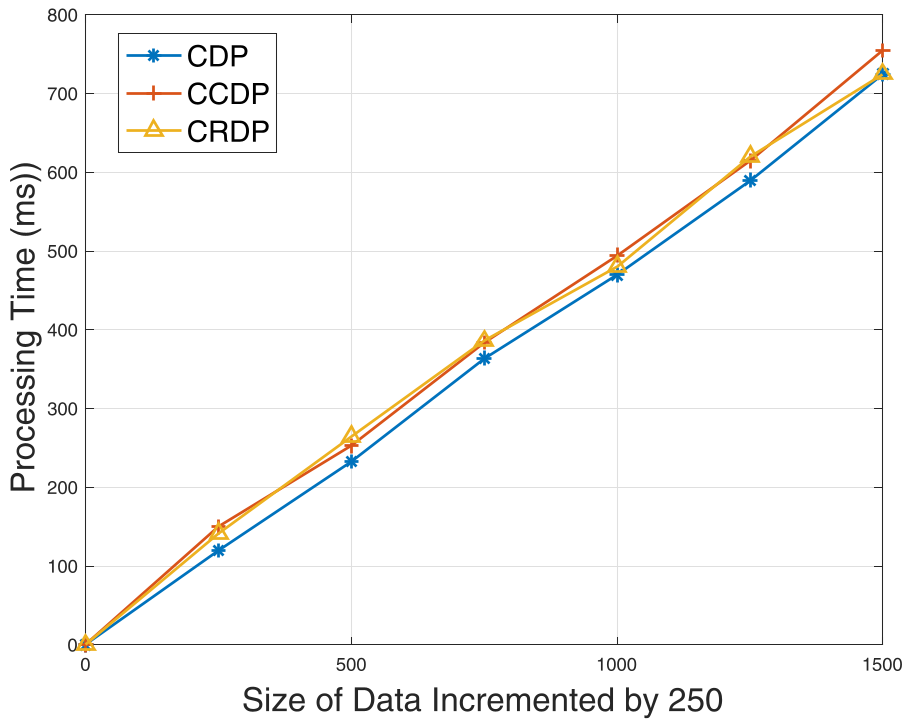 Fig 2: Processing time comparison showing that CRDP adds only a negligible 15% overhead, making it highly viable for real-time CPSN applications.
Collusion Elimination
The most striking result is found in collusion defense. In CCDP, the privacy budget "leaks" as more users collude. In CRDP, the sum of protection after collusion remains equal to the maximum single epsilon, effectively "chopping off the root" of the attack motivation.
Critical Analysis & Conclusion
Takeaway
CRDP successfully breaks the trade-off bottleneck between personalization and security. By mathematically re-engineering how noise is generated (Markov processes) rather than just how much noise is added, it provides a blueprint for reliable data sharing.
Limitations & Future Work
While the social distance approach is robust, it relies on an accurate and static social graph. In dynamic mobile networks, calculating the shortest path continuously can be expensive. The authors propose looking into GAN-driven personalized DP and Federated Learning integration in the future to further optimize these curves and protect model parameters in decentralized environments.
Final Verdict: This is a vital read for researchers in CPSN and privacy engineering, providing a rare quantitative bridge between social intimacy and mathematical data protection.