
CRDP: Reimagining Privacy as a Dynamic Function of Social Intimacy
Customizable Reliable Privacy-Preserving Data Sharing in Cyber-Physical Social Networks
The paper proposes Customizable Reliable Differential Privacy (CRDP), a novel framework for cyber-physical social networks (CPSN) that tailors privacy protection levels based on social distance. Unlike uniform differential privacy, CRDP utilizes a modified Laplacian mechanism governed by a Markov stochastic process to decouple noise correlations and prevent information leakage during data sharing.
TL;DR
In the sprawling landscape of Cyber-Physical Social Networks (CPSN), "one-size-fits-all" privacy is a relic of the past. This paper introduces CRDP (Customizable Reliable Differential Privacy), a framework that adjusts the strength of data obfuscation based on how far a recipient is from the data owner. By leveraging a Markov-based noise generation process, it solves the long-standing "collusion problem" in customizable privacy, ensuring that attackers cannot combine multiple sanitized versions of data to reveal the truth.
The Motivation: Why Uniform Privacy Fails
In a typical CPSN (like Groupon or social check-in apps), you might want your close friends to see your precise location, while casual acquaintances should only see a city-level blur. Existing Differential Privacy (DP) methods usually treat all queries with a uniform "privacy budget" ().
- The Problem: If you give everyone the same low-accuracy data, utility suffers. If you give different people different "customized" versions, the composition mechanism of DP kicks in.
- The Danger: Adversaries can exploit the mathematical correlation between these different noisy versions (via Background Knowledge or Collusion Attacks) to "cancel out" the noise and reconstruct your original sensitive data.
Methodology: Mapping Distance to Noise
The authors propose a two-step solution: Contextual Customization and Algorithmic Reliability.
1. Social Distance & Sigmoid Mapping
The system treats the social network as a graph . The "intimacy" is defined by the shortest path (hops) between users. A Sigmoid-based QoS function then translates these hops into a privacy budget : This ensures that as the distance increases, the privacy protection level (and thus the noise) increases non-linearly, respecting the intuition that strangers should see less detail than friends.
2. The Markov Noise Breakthrough
To prevent collusion, the authors move away from independent Laplace noise. They design a modified Laplacian mechanism where noise generation complies with a Markov stochastic process.
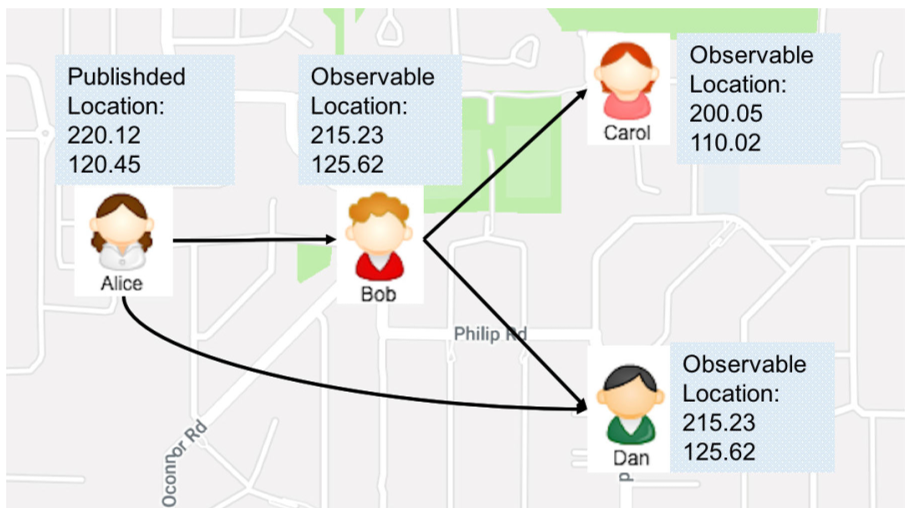 Fig. 1: Alice shares data. One-hop friends (Bob/Dan) receive high-fidelity data, while the two-hop friend (Carol) receives a noisier version.
By ensuring the noise is "memoryless" across different customization levels, the correlation that attackers usually exploit is decoupled. This effectively "breaks" the composition theorem for the attacker, making the total information leaked no greater than the highest individual released.
Experiments: SOTA Performance
The model was tested on the Google+ dataset (107k nodes, 13M edges). The results highlight a superior trade-off between privacy and utility.
Data Utility vs. Privacy
While classic DP (CDP) maintains a stagnant, high-error rate, CRDP optimizes the Root-Mean-Square Error (RMSE). The experiments show that CRDP achieves the lowest expected error, improving data utility by roughly 8% over other customizable models while maintaining higher resistance to attacks.
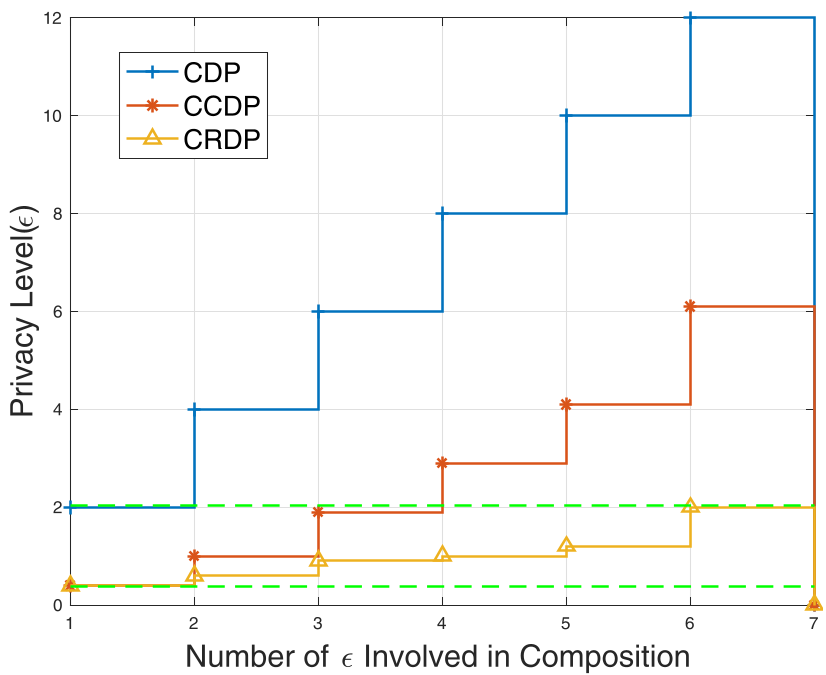 Fig. 2: Comparison of privacy protection levels. CRDP (orange) maintains a stable protection level despite multiple releases, whereas CCDP (blue) collapses due to the composition mechanism.
Attack Resistance
In collusion tests, CRDP successfully removed the incentive for attackers. In scenarios where multiple adversaries colluded, the total information gain was capped, whereas in classic models, the privacy budget effectively "leaked" to zero.
Final Insights
The genius of CRDP lies in the realization that privacy is social. By mathematically modeling "social distance" and utilizing stochastic processes to decouple noise, the paper provides a roadmap for future social platforms to offer personalized privacy without compromising the integrity of the data.
Limitations: Currently, the model assumes the server (data curator) is fully trusted. Future iterations integrating Generative Adversarial Networks (GANs) or Federated Learning could further decentralize this trust.
Future Work: The authors aim to explore GAN-driven personalized DP to further optimize the noise-utility frontier.