
CRDP: Bridging the Gap Between Personal Privacy and Data Utility in Social Networks
Customizable Reliable Privacy-Preserving Data Sharing in Cyber-Physical Social Networks
This paper introduces the Customizable Reliable Differential Privacy (CRDP) model, a novel framework designed for data sharing in Cyber-Physical Social Networks (CPSN). It utilizes a social distance-based mechanism to provide personalized privacy levels while maintaining high data utility and resistance against sophisticated attacks.
TL;DR
In the era of Cyber-Physical Social Networks (CPSN), sharing data like location and status is essential but risky. Current privacy tools either treat everyone as a stranger (killing data usefulness) or fail to stop hackers from combining pieces of information to de-anonymize you. The Customizable Reliable Differential Privacy (CRDP) model solves this by adjusting privacy levels based on how "close" you are to someone and using a clever mathematical trick—a Markov stochastic process—to ensure that even if hackers team up, they can't learn more than they're allowed to.
The "Uniformity" Trap in Privacy Preservation
Most Differential Privacy (DP) research operates under a "Uniform Protection" assumption. Imagine Alice wants to share her location. In a standard DP world, her best friend Bob and a complete stranger Carol receive the same blurry, high-noise data.
While "Customizable DP" exists to let Bob see clearer data than Carol, it introduces a fatal flaw: The Composition Incentive. If the noises injected into Bob's version and Carol's version are statistically correlated, an adversary (or Bob and Carol colluding) can mathematically subtract the noise to reveal Alice's true location. This is known as a Collusion Attack.
Methodology: Intimacy-Aware Protection
The authors' core insight is that privacy should be a function of Social Distance.
1. Mapping Intimacy to Privacy
Using the Dijkstra algorithm, CRDP calculates the shortest path between users in a social graph. This distance is then processed through a Sigmoid Mapping Function:
This allows the system to satisfy High Quality of Service (QoS) requirements: friends get high-utility data (low ), while distant nodes get high-privacy, high-noise data.
2. The Modified Laplacian Mechanism
To stop collusion, CRDP doesn't just add random noise. It ensures the noise generation follows a Markov Stochastic Process. By making the noise "memoryless," the system decouples the correlations that typically occur when multiple versions of the same data are released.
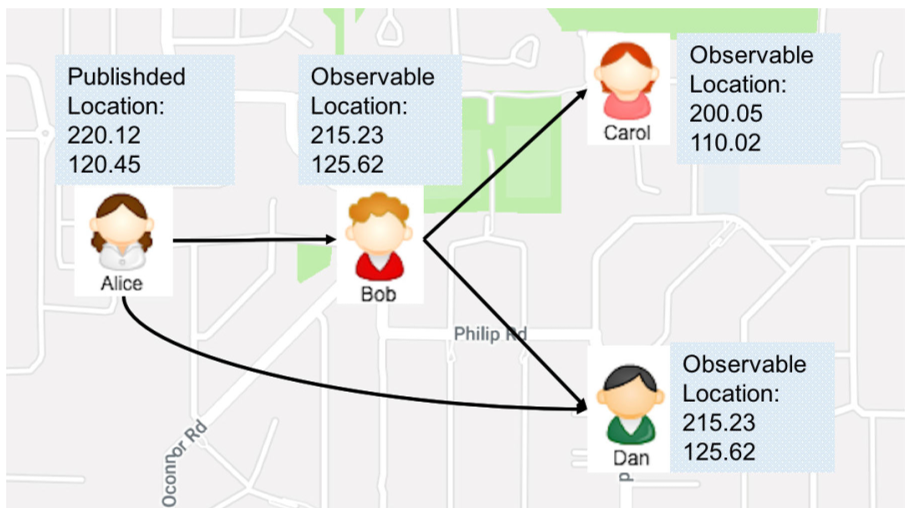 Fig 1. In this example, Alice's location is shared with different noise levels based on the hop-count of her friends Bob, Dan, and Carol.
Experiments: Performance & Utility
The researchers tested CRDP against Classic DP (CDP) and Classic Customizable DP (CCDP) using the Google+ dataset (100k+ nodes).
SOTA Comparison:
- Data Utility: CRDP achieved 8% higher utility (lower RMSE) than CCDP, and significantly outperformed CDP.
- Attack Resistance: In background knowledge attacks, CRDP remained functional in "middle-ground" scenarios where other models failed. In collusion scenarios, CRDP effectively "chops off the root" of the attack by ensuring the sum of privacy budgets does not exceed the maximum allowed budget.
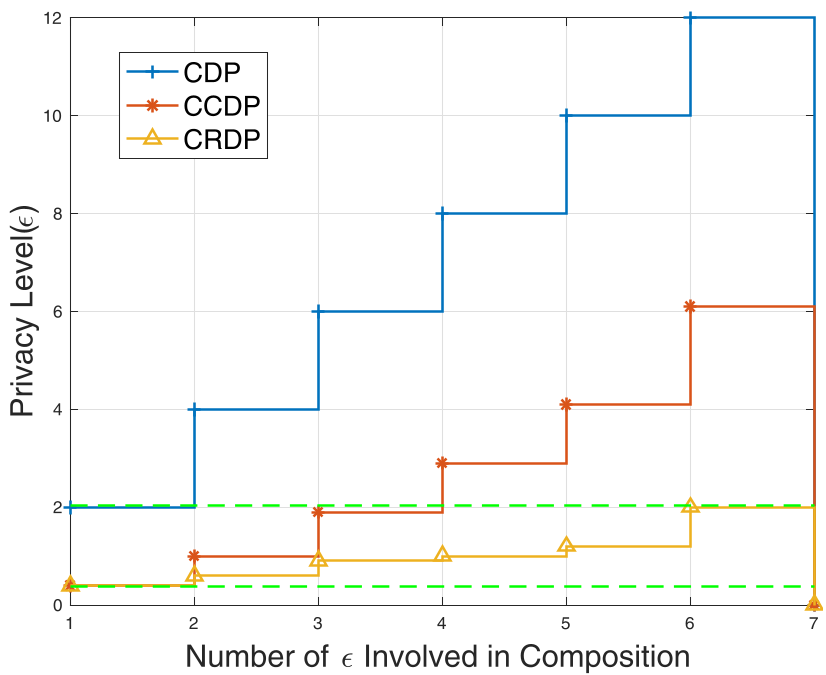 Fig 2. Comparative analysis of privacy protection levels. CRDP (red line) maintains a steady, superior protection level even as the number of queries or collaborators increases.
Critical Insight: Why This Matters
The breakthrough here isn't just "customization"—it's the Formal Reliability. By quantifying attacks like "Background Knowledge" and "Collusion" through the lens of the DP composition mechanism, the authors found a way to "disable" the mathematical reward for hacking.
Limitations & Future Work
While the model is robust, it relies on knowing the social graph's structure to calculate distances. The authors suggest that future iterations could use Generative Adversarial Networks (GANs) to automate personalized privacy or integrate these mechanisms into Federated Learning to protect model weights.
Conclusion
CRDP offers a rare "win-win" in the privacy space: it respects the nuanced reality of social relationships while providing a mathematically rigorous shield against sophisticated collaborative attacks. For developers of social apps and IoT platforms, it provides a blueprint for building trust without sacrificing the user experience.